
Cooking in clean comfort
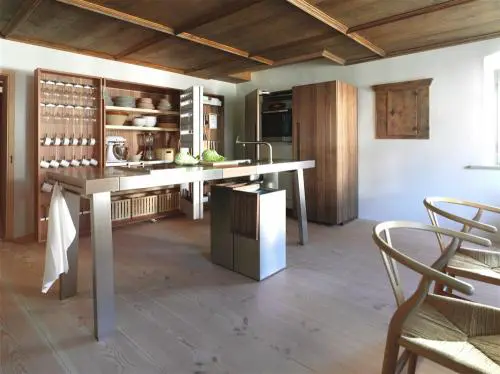


The German brand Bulthaup brings its ergonomic kitchen designs to Bangkok
Bulthaup, the German kitchen design brand, makes its Bangkok debut this month, promising hours of pleasure to those who opt for one of their simple and unfussy cooking spaces.
Known for its interpretation of the Bauhaus school of architecture, the brand offers a guarantee of quality, seamless design and the confidence of unique, creative works.
Friedrich Kleyboldt, director of sales for Asia and the director of international projects, was in Bangkok last week to explain Bulthaup’s designs.
“We like our customers to feel satisfied, warm, and at home in our kitchens,” he says. “Our core values are quality, architecture and innovation.
Founded by Martin Bulthaup in 1946, the company started building kitchens with the finest materials. In 1976, son Gerd took charge, bringing his love of architecture and contemporary design to the firm and teaming up with industrial designer Otl Aicher to develop the ultimate in functional and ergonomic kitchens.
“That was when we came up the idea to develop the wall as an element of the kitchen,” Kleyboldt explains.
“Take the Bulthaup B3 as an example. Here, the wall provides the strong base element, the sturdy steel skeleton, supporting the entire kitchen system. Everything can be hung from it and the wall conceals water, electricity, and gas pipes, and also allows cabinets to appear as though they are floating. This gives the kitchen a sculptural effect.”
The B2 series is one of the most versatile kitchens featuring an open workbench comprising fire and water points, a kitchen tool cabinet as well as an appliance housing cabinet for the oven, dishwasher and refrigerator. The smart compactness of the storage space makes pullouts and drawers unnecessary. You can either conceal everything or show it off.
All the materials, be they aluminium, laminate or veneer, are of the highest quality, says the director. “We have specific veneer features that are manufactured in a certain way. Our manufacture is the combination of craftsmanship and industrial engineering. Kitchens are designed individually for each customer.”
For Thai customers, account will of course be taken of the architecture of the home but also, says Kleyboldt of the “emotions” in the kitchen.
He explains that while attitudes towards functionality and even the ergonomics of the kitchen have evolved a great deal over the last 40 years, this room is still used primarily for preparing and cooking food.
“We try to analysis the process. When you cook, you need somewhere to wash your ingredients and your dishes, a stove, a fridge, a place to store ingredients plates, cutters and working tools so there are certain rules in how to situate the various work stations for maximum efficiency. The aesthetics are also very important.”
These days too, the kitchen is often used as a gathering place for the entire family.
“There are quite distinctive borders in different rooms – sleeping, eating rooms, working areas – they are very rigid with borders and doors. Today, we are tending to lose these borders and moving towards a more open space where one area leads to the next.
“The furniture has to contribute to this different way of building. Even when you are entertaining, you can welcome guests into the kitchen and they can relax in an attractive room.
“This is something we feel we can offer. We think about the functions, the aesthetics and the architecture. We make it clean and simple yet pleasing to the eye. The challenge is to not make it like in the hospital. We want a clean minimalistic style but a room that has a warm and welcoming feeling,” he says.
