
Sunti among the legends


A Thai sculptor in the US triumphs in the international ArtPrize competition
The haunting realism that Sunti Pichetchaiyakul achieves in his sculpture overwhelms even his own reality. That he’s transplanted from Nakhon Ratchasima to Bigfork, Montana. That his work is on view at more than 50 temples throughout Thailand, Laos and Cambodia. That he may be the world’s fastest sculptor, able to make a life-size clay bust in just 17 minutes.
And that he’s still only 39.
In Korat, Sunti fashioned startling renditions of revered monks. In Bigfork he extracts divinity from bronze and resin to depict Native American chiefs like Sitting Bull and Crazy Horse.
Last month Sunti ended up fourth overall among 1,600 competitors from 39 countries in the annual ArtPrize contest – the world’s largest art competition, with $500,000 in rewards just for the 10 finalists.
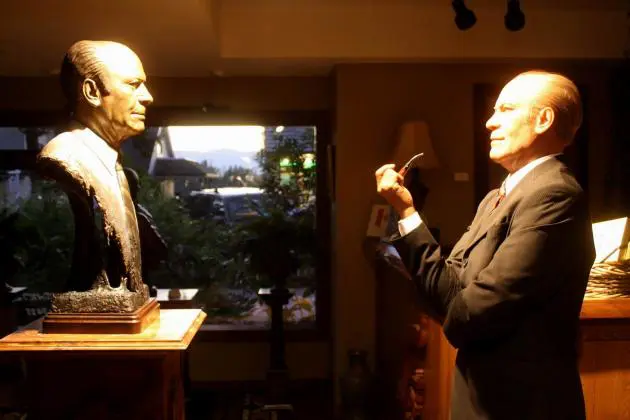
The judges in Grand Rapids, Michigan, obviously loved his dual-likeness of the late President Gerald Ford, a Grand Rapids native. Sunti was the only non-American in the top 10.
Betty Ford, the former first lady, gave Sunti permission to undertake the project five months prior to the competition, just before she died.
There is much to like besides parochial pride and exacting resemblance. While evoking the subject’s true spirit, Sunti’s realism extends as far as implanted hair follicles and pores in the skin, moulded in tough resin, as he explains in an interview.
Why did you choose President Ford this time rather than, say, a Thai personality?
I did portray the revered monk Luangbu Luan in hyper-realistic fibreglass resin last year, as my first-ever entry in the ArtPrize competition. I ended up in the top 25 among 1,713 artists from around the world.
A lot of people just assumed it was cast from life. They were amazed that I actually sculpted it by hand.
But this competition was based in Grand Rapids, and I wanted to enter a piece that the community could connect to, so I went with a “son of Grand Rapids”, former President Ford. I’ve been honouring local heroes for almost two decades.
Sculpting Ford was quite a challenge because if I didn’t get his exact likeness, the city of Grand Rapids would be the first to point it out. I set out to create a recognisable individual with two different expressions in two different media. I don’t believe this has ever been done before.
The concept was that President Ford appeared to be attending the competition preview and seeing a bronze bust of him. In the resin version he seems to be laughing inwardly, in reaction, while the bust has a more “presidential look”.
Tell us how you created the two images.
I made a full-body resin figure on a plaster mould of a clay sculpture. The plaster was then cast in wax, which accepts very fine detail. I worked from black-and-white photographs, but the greatest challenge was getting a neutral facial expression that didn’t appear in his photos. He always either looked very stern or completely overjoyed.
So I invented my own “relaxed” or “satisfied” expression by meticulously examining how his facial muscles changed with his mood and estimating what they’d look like when expressing a mood I’d never seen.
Next I fashioned a silicone mould to cast my final fibreglass resin piece. I used the same mould to create a hollow wax sculpture for the bronze bust and re-sculpted Ford’s expression using the “stern” look.
I covered the resin sculpture with many layers of acrylic paint, added the clothes, and inserted the hairs one by one. To finish off the bronze sculpture, I applied my own patina. And I only had four months to single-handedly create both sculptures!
What inspired your sculptures of Native American heroes?
I’ve always been fascinated by the American West. My brother and I used to play Cowboys and Indians while growing up in Chumpuang in Nakhon Ratchasima.
Once I moved to Montana, of course, I realised how misinformed I was. My idea of the antagonistic Native American was replaced with the reality of the genocide by the US government. The natives were slaughtered for their land and starved on reservations. The injustice is almost unfathomable.
Native American culture, I learned, is very similar to my own Thai Buddhist culture in its respect for elders and ancestors and nature. I could also identify with the native crafts and some of their ceremonial and social traditions.
My bronze collection “Legends of the Americas” honours people who had an impact on the US continent. The Native Americans I sculpted had invaluable wisdom that the world desperately needs today. Chief Joseph is recognised for his peaceful resistance and humanitarianism.
I strove to capture more than just their physical likeness. My aim was to honour their spirit and retell their stories in hopes of reminding viewers of their contributions.
How did people in Montana come to know your work?
When I first showed Grandfather Monk Luan, outdoors on Memorial Day weekend in 2008, pedestrians crossed the street to avoid it. I was devastated! Then someone in a crowd gathered across the street shouted, “Is he real?” They thought it was a real monk sitting there in meditation!
After that, masses of people crowded around, asking questions and saying how much they liked it.
When I showed my monk again a couple of months later I was prepared – it had a sign saying, “This is a sculpture.” A man from Florida asked if I could match that same realism in bronze. I boldly answered yes, although I’d never even heard of making bronze look like skin. He commissioned the image of Chief Sitting Bull, which began my “Legends of the Americas” collection.
But it’s always a challenge to gain name recognition in a new country, and especially in a remote location and during an economic crisis. I’ve been very fortunate to exhibit my work at the Yellowstone Club and the Calgary Stampede in Canada along with the top western artists in North America.
Wayne Newton [the singer known as “Mr Las Vegas”] wants me to sculpt him in fibreglass resin for his museum because he and his wife were so disappointed with his wax likeness at Madame Tussauds.
How did you fall so deeply in love with sculpture?
I’ve been hooked on sculpting ever since I was four. My family couldn’t afford toys so my father showed me how to make my own from clay. I made superheroes, elephants, spaceships –
Growing up in Korat, I was privileged to be surrounded by beautiful sculptures, my favourites being the ones at Wat Phi Mai and the monument of Ya Moe.
My formal training was primarily in painting and drawing, though, and I began my career as a two-dimensional artist. But that background also added to my understanding of sculpture.
Tell us about being an artist in Thailand.
Age plays a prominent role. The religious influence is taken very seriously. It’s extremely challenging to gain recognition as a young artist. I had to accept less than my art was worth, and at times I wasn’t paid at all.
People would see my work and come to my studio and say, “Hey, kid, where’s Ajarn Sunti?” I’d tell them that’s me and they’d accuse me of lying. I was constantly saying, “Yes, I really did make that.”
It wasn’t until television crews from Japan and South Korea and Taiwan started interviewing me that Thais started coming around. This year I was nominated for an honorary doctorate in sculpture at one of my old schools, Rajamangala University of Technology Isaan, but they decided to wait until next year, when I turn 40.
Despite the tremendous struggle, having to always prove my talent has made me highly critical of my own work and pushes me to improve. I’m proud of my accomplishments – but even more proud of what I have yet to accomplish.
Why did you move to the US?
I’d finally got to the point where I was working on three to five commissions at a time and had some respect in Thailand, but I wanted to explore the opportunities in the States. I believe in the American dream and I sincerely appreciate how Americans nurture young talent.
Selling art in America is very different. Collectors buy art at the galleries rather than commissioning work like they do in Thailand. And when the economy’s down, Americans stop buying art, while Thais commission more religious art in the hope of prosperity.
Are you trying to make each sculpture as realistic as possible?
My goal is to make it as historically accurate as possible, capture the personality, offer something biographical and make it appear alive.
The secret to hyper-realism is creating everything from scratch – and by yourself, so that the finished product is more unified.
Using lasers, digital enhancement or moulds of actual items or body parts not only deceives viewers, it loses the spiritual essence that brings the artwork to life. Creating from scratch, the artist projects into the piece his love for his craft and his regard for the individual, and that shows up in the completed work.
Do you plan to depict more Thai personalities?
I plan to eventually begin my “Legends of Thailand” collection. It will include the piece I already did of Luangta Mahabua, which is on display at Wat Pochai Sampoang in Nakhon Phanom.
I’m the only artist he personally entrusted to capture his likeness in sculpture as a young man. I showed Luangta Mun instructing Luangta Mahabua and Luangpa Gurng.
And you’re going to do the Dalai Lama.
His Holiness will be visiting Montana for the first time in 2012 to bless the Garden of 1,000 Buddhas in Arlee. In January I’ll begin a full-figure fibreglass-resin sculpture to present him as a gift.
I also hope to create a bronze bust of him from the original mould for my upcoming “Legends of the World” collection, once I’ve finished Jesus of Nazareth.
See the gallery
View images of Sunti Pichetchaiyakul’s sculptures at www.SuntiWorldArt.com.
