
How to build a clean future
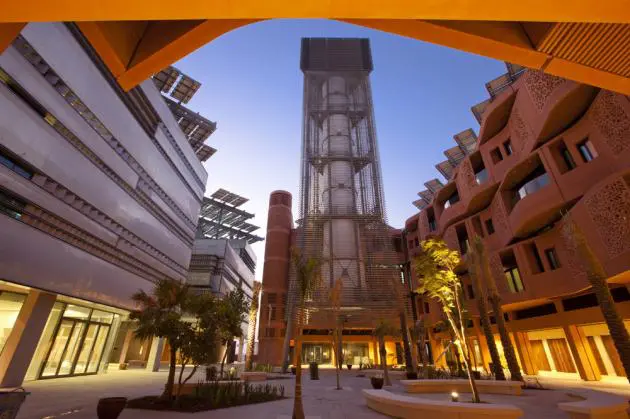


Masdar City in the UAE grows by consuming less. No cars, few elevators
Abu Dhabi, United Arab EmiratesThe oilrich United Arab Emirates have buildings and infrastructure under construction everywhere you look, but the country is determined to tear down its reputation as one of the world’s biggest carbongas generators.Masdar City, it proclaims, will be a “low-carbon city”. For starters, there are no cars.
Masdar City is actually part of the capital, Abu Dhabi, and has been under development since 2006, when it was conceived as a global leader in sustainability, both economically and ecologically, as well as a great place to live and work.
Part of the longterm plan of the late Sheikh Zayed bin Sultan Al Nahyan, the UAE’s founder and first president, it is envisioned as a hub for private firms that use clean, renewable energy.
“We must not rely on oil alone as the main source of our national income. We have to diversify and construct economic projects that will ensure a free, stable and dignified life for people,” Sheikh Zayed is quoted as saying by Sultan Ahmed Al Jaber, Masdar’s chief executive and “managing director”.
The UAE government, led by Sheikh Zayed’s son Sheikh Khalifa Bin Zayed Al Nahyan, has invested US$15 billion (Bt470 billion) in the sevensquarekilometre city within a city, and recently invited journalists from around the world to visit it as part of the country’s 40th National Day celebrations.
We discovered at the outset that it’s a nogo zone for private vehicles. Our bus dropped us off at the superclean terminus of the Personal Rapid Transit (PRT) transport system.
The network uses vehicles that have no drivers, being guided instead by magnetic sensors. Their power comes from the sun, with solar batteries recharged at the station.
We zipped over to the Masdar Institute, our destination 250 metres away, in about a minute. The PRT goes no faster than 40kph.
All of the buildings and facilities in Masdar City are being designed to use the least possible energy, while still relying primarily on natural resources.
A university, the Masdar Institute remains currently the only functioning main building. It has elevators, but they’re hidden from view – the better to encourage people to use the stairs that are always prominently featured.
It’s just the opposite of what people in other cities see in public buildings – lifts highly visible and stairs hard to find.
So up and down we walked, between the first and third floors, in this independent, researchdriven graduate institute.
The Massachusetts Institute of Technology had a hand in its development, ensuring a focus on science and engineering in advanced alternative energy and environmental technology.
Dr Al Jaber explained that the plan is for the institute to “engage, inform and educate people locally, regionally and internationally”.
The lovely campus has laboratories, student dorms, faculty offices and classrooms that consume 55 per cent less energy to stay cool than buildings of their size normally do. They need 54 per cent less potable water and 51 per cent less electricity. Fully threequarters of the power that would otherwise be wasted is instead recovered.
Any student from anywhere in the world who applies for the postgraduate programmes and meets the criteria is granted full scholarship. The first 72 degrees were bestowed in June.
The student dormitory stands out with its walls of red sandstone and reinforcedconcrete screens with undulating glass that serve much the same role as traditional Arab mashrabiya screens – shade and a bar to the sun’s heat. The students can gaze out on the street below and still have their privacy.
A 45metretall wind tower rises in a large urban square nearby, redirecting the high breezes to cool the plaza below. Enjoying the sensation at street level are cafes, a gym, prayer room and bank and retail outlets including an organicfood shop.
Next door a “family square” is being developed – a meeting place that will be smaller, quieter and more intimate than the public plaza. Already it has a cafe and a studentaffairs office and canteen.
Masdar City is dedicated to reducing water demand. While most of the shrubbery and trees are indigenous species, nonnative plants that suit the hot, dry climate are also deployed.
The sun, meanwhile, is transformed from being the desert’s great threat to life into a beneficent asset. The city lives on 10 megawatts of power from the biggest “solar farm” in the Middle East, and an area has been set aside to try out new technology for solar panels.
More than 35 suppliers currently have designs being tested there for energy yield and efficiency and how they cope with blowing sand and ambient temperature.
When asked whether Masdar could become a “zero-carbon city”, Dr Al Jaber said:
“We’re doing everything we can to meet the targets, but what we will ultimately achieve, no one knows. What we are today is based on what we have on the ground. No one can tell when it will be fully developed – but we’re not stopping.”
Masdar City is very much an experiment, its chief executive said. The UAE is constantly looking for technology from around the world to mix and match and see which combinations work best.
“The world has changed, so we have to adapt. We have to be smart enough. We have to be dynamic, and respond to current market conditions.”
The writer travelled as a guest of the United Arab Emirates’ National Media Council.
