
Up, up and away


Play
Beautiful balloons float over the Northern countryside
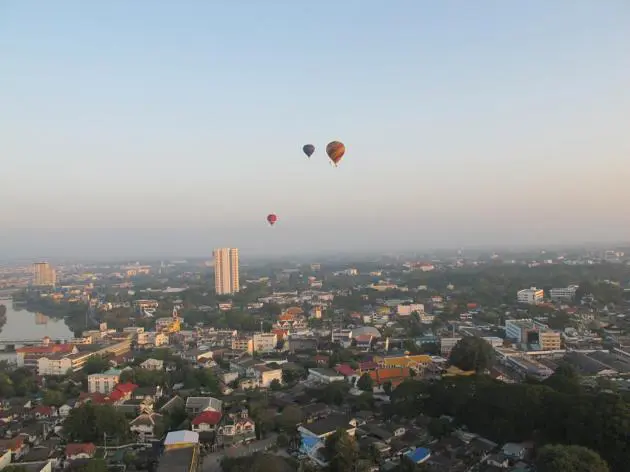
Apprehension mingles with exhilaration as I climb into the rattan basket of Yut wanichanond’s hot-air balloon on a chilly morning in Chiang Mai. The apprehension quickly fades as we gain height and I look down in wonder at the rustic villages of Thailand’s North nestled among the hills.
“We don’t have many instruments so we use our senses and experience when checking atmospheric conditions and controlling the balloon,” says Yut, who studied aviation at a New York airline operation training school from 1970-72.
“As pilots, we are happy to see local people and nature. We never compare Ayutthaya with Chiang Mai, or Chiang Mai with Ubon Ratchathani, Udon Thani or Khon Kaen because each of them has a different character and environment. But we can see what is happening with our Earth and that makes us very aware of the need for greater conservation measures.
“I also need the government or even the private sector to support balloon events as happens in other countries. That would allow us to take students and youngsters up in the balloons to see their Earth. It would help them feel more love for the Earth and want to protect nature,” he says.
The 61-year-old pilot is the founder of Earth, Wind & Fire, promoter of the Thailand International Balloon Festival 2011, held last month at the Prince Royal’s College in Chiang Mai in November and the only Thai among the balloon pilots.
This event, the fifth in the series, follows on the heels of last year’s hugely successful festival at Khun Dan Dam in Nakhon Nayok, which drew a crowd of more than 100,000. Ayutthaya hosted the event before that and Pak Chong has done the honours on two occasions.
Ten balloons made the journey to the northern capital, flying to sounds from the college orchestra and dancing in the dark sky at the “Night Glow” light and sound show to the accompaniment of Queen’s “We Will Rock You”, Michael Jackson’s “Thriller” and Justin Bieber’s “Someone To Love”. Thailand’s Got Talent’s Sompoch Thongyuak was there too showing his fire spinning skills.
“Not even the music festival in Khao Yai managed to draw as many as 100,000 people,” says Yut proudly.
On all except three days, when the cool breezes failed to oblige, the balloons were up and flying in early morning and again before dusk. I was lucky enough to go up with Yut around 6am.
“Like a captain on a plane, we are responsible everyone on board. However, the balloon doesn’t have stabilisers like a plane so if we’re faced with some turbulence or meet an air pocket, you will feel it,” says Yut, who has four balloons and has been flying them locally and internationally for the last 18 years.
After working for a while in the US, he returned to Thailand and opened his first balloon business in 1989. The following year, he underwent training to become a fully licensed balloonist.
During our flight, the 61-year-old pilot, who looks younger than his age, used his gloved hands to press the burners, releasing measured amount of gas into the balloon. We took photographs both of the town below and the balloons at front and behind. After our one-hour tour, Yut started looking for a location to park and suddenly landed, causing the basket to bounce a few times.
Some of foreign pilots treated their passengers to stranger flights: one skimmed the surface of a swimming pool while another temporarily parked it at an intersection.
Yut recalls some hair-raising experiences of his own.
“I know now to cancel flying if the weather conditions are not good. I remember seeing dark clouds in the sky but they were far away from my balloon and I was confident I could escape them. But I’d only been up about 15 minutes when I realised that the dark cloud was right above me. It made me move very fast and I crashed into a tree, buckling the aluminium gondola I had at the time. That’s when I switched to rattan.
“On another occasion, I hooked the electricity wire while flying above a village. I completely forgot that the village has a road, which means that it has also the electricity post.”
