
A real beauty?


You could always scratch some glass, but the best test for your diamond is at the Gem Institute
So, the beloved one gave you a diamond ring for Valentine’s Day, and the furthest thing from your |mind is having it appraised – for about an hour, |anyway. Then you get curious about whether the |diamond is natural, synthetic or imitation.
Don’t ruin your layman’s eyesight trying to spot the value. Take the ring to the laboratory of the Gem and Jewelry Institute of Thailand (GIT). Its aim isn’t to see if your man’s a cheapskate – it’s there to stem the trade in substandard and overpriced stones and trinkets.
But anyone can get any bauble assessed.
“To distinguish between real and synthetic jewellery normally takes about three working days, and the price can be as little as Bt300 for coloured stones,” says director Wilawan Atichat. “If you want to actually identify the type of diamond, though, or whether a gemstone has been enhanced, it will take longer.”
The lab’s experienced mineralogists, geologists and “gemologists” conduct a range of tests and produce an analysis report that can certify the stone’s authenticity. It includes variety, type, weight, physical properties, signs of enhancement and a digital photograph. Rubies and sapphires are graded for colour, clarity and cut too.
“The value of a gem is based on its beauty, durability and rarity,” Wilawan explains. “The beauty derives from the colour, clarity and brilliance, while rarity – apart from the stone’s scarcity in nature – is based on supply and demand, as well as additional factors like fashion trends.”
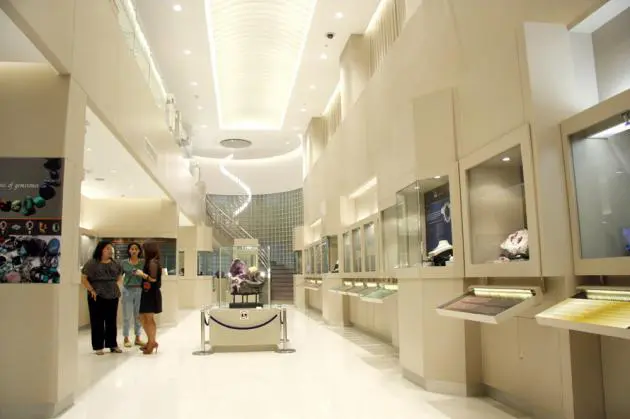
The institute is a public agency overseen by the Commerce Ministry. Having outgrown its quarters in Chulalongkorn University’s Gemological Research and Testing Building, it recently relocated to the ITF Tower on Silom Road, taking up fully five floors and more than 2,600 square metres. As well as the advanced testing lab, there’s a library and museum.
“We usually have about 30 customers bringing us more than 100 samples a day,” says gemologist Nalin Narudeesombat. “Our services range from gem identification and quality grading to certifying precious metals and determining the geographic origin. We also provide the insurance for the gems we handle.”
Following years of research on colour standards, the lab created its own “master stones” to which Pigeon’s Blood rubies and Royal Blue sapphires can be compared for trade promotion.
The hi-tech gear in the lab includes an X-ray fluorescence spectrometer that helps distinguish between natural and synthetic materials, and a transformer infrared spectroscope that detects prior heat treatment.
“Heat treatment is a method of enhancing a gemstone,” Nalin says. “Thais call it ‘burning’ – using electricity or an oil or gas flame to improve the colour and clarity. The technique is used to turn a white or milky sapphire blue, or a green sapphire yellow, or a brown zircon blue or colourless.”
A “soft X-ray” machine can measure the thickness of the nacre coating a pearl and determine whether the pearl is freshwater or from the sea. Operating at low temperature, it can tell if a diamond’s colour is authentic. Another service newly available at the lab assesses the amount of gold in any sample using the “fire assay” technique, which separates out other metals.
Customers pay Bt300 to have a coloured stone under five carats appraised and as much as Bt6,000 to check the authenticity of a ruby, sapphire or emerald topping 50 carats in weight, or a fancy diamond of up to five carats.
The sprawling library on the first floor has large collections of books and magazines as well as digitised resources. The museum on the upper floor traces the history of gem mining in Thailand, and explains which stones are found where and how they’re enhanced and synthesised. There’s a section on the art of making jewellery too.
“The rarest and most valuable gemstones are rubies, sapphires and emeralds, which we call ‘the Big Three’,” says gemologist Sakrapee Saejoo. “Most Thais regard the ruby as the best, while Indians generally prefer the emerald. The sapphire is most popular in the US.
“Thailand used to bring many sapphires and rubies to the market, but they’re rarely found here anymore. The most popular ruby – and the most expensive and rarest – is the Tabtim Siam."
A ruby is corundum coloured red by chromium, Sakrapee explains. Corundum of any other hue is sapphire, but unless it’s specified as “yellow sapphire” or “pink sapphire”, a sapphire is blue, the colour caused by iron and titanium.
Britain’s Prince William famously wooed Kate Middleton with the same ring his father Prince Charles gave to Princess Diana on their engagement in 1981, an 18-carat blue sapphire surrounded by diamonds set in white gold.
People who lack the cash for an actual ruby might choose a spinel instead, Sakrapee says. They’ll fool the average eye.
“Spinels occur in a wide range of colours – red, blue, pink, green and black – and the best source is Burma. Red spinels are often mistaken for rubies. In Thailand, we have black spinel, found mostly in Kanchanaburi and known as nin tan or nin tako.”
On view in the museum is a formal portrait of Queen Elizabeth II at her coronation in 1953 with a 170-carat red spinel adorning the Cross Pattee at the front of her crown, made in the mid-14th century.
“Emeralds can be substituted with olive-green peridot,” Sakrapee notes, “and certain colourless topazes can be irradiated to an aquamarine-blue shade so they look like expensive blue sapphires.”
The museum displays a massive amethyst weighing some 90 kilograms. “Amethyst is a purple variety of quartz,” he points out. “In Thailand we have fine-needle inclusions of rutile, locally known as mai thong, sai tong, kaew khon lek or pong kham.”
All this knowledge is a lot to take in on a museum tour, so the institute offers several structured courses toward business diplomas, and also one-day workshops. You can learn how diamonds are identified and graded, how jewellery is designed and how gems and jewellery are best marketed.
Private firms with specific needs can also arrange in-house coaching, such as a course on jewellery appraisal.
TEST YOUR EYE
<< The Gem and Jewelry Institute of Thailand is in the ITF Tower on Silom Road. Get in touch at (02) 634 4999 or www.GIT.or.th.
<< A workshop on identifying diamonds will be held on February 28, and another about grading diamonds on February 29. The fee for each is Bt900.
