
A NATURAL APPROACH TO HEALING


Play
'Functional medicine' gets a place of its own in Bangkok at the Better Being Hospital
If, like an ever-growing number of people today, you believe that certain chronic illnesses and autoimmune conditions can be blamed on environmental and lifestyle factors and can therefore largely be prevented, you may be interested in an alternative healthcare approach known as functional medicine.
Unlike traditional medicine, which focuses on the treatment of symptoms, functional medicine focuses on disease prevention first and the treatment of the underlying causes of disease —rather than just the symptoms — if disease does occur.
The functional medicine movement is growing rapidly in the US. It claims to offer a clear vision of the future of healthcare that more and more people will embrace as they become better educated on its many advantages over traditional medicine.
“It’s the ideology of the future. The West has many medical ideologies including alternative medicine and integrated medicine. But the most accepted by conventional doctors is functional medicine. In the US, it’s been endorsed by government, which is funding research on its feasibility for treatment. Last year, functional medicine celebrated its twentieth anniversary. In Thailand, it’s been available for seven years,” says Dr Torsak Tip-pairote, functional medicine practitioner and registered DAN (Defeat Autism Now) physician at Bangkok’s Better Being Hospital.
“It’s evolved over the years too. The Standard American Diet – SAD – is not right for every patient so we now offer organic food, whole grain and Mediterranean food.
Torsak, who trained with the Institute for Functional Medicine in US, founded Better Being, Thailand’s first functional medicine and rehabilitation centre in 2009, after a long career with Piyavate and Bangkok hospitals. His aim is to foster understanding about samuthai vejjasaat, which is how he’s chosen to translate functional medicine.
“‘Samuthai’ is one of the Four Noble Truths in Buddhism and means that suffering is caused by craving. Functional medicine looks at the cause,” he explains. “I’m the only doctor in Thailand following up both research and the functional medicine curriculum at the advanced level. I also participate in several training courses. Today, we have more than 10 doctors who have been through preliminary training in the discipline.
Located in Sukhumvit Soi 39, Better Being Hospital has two buildings. The first is home to the outpatient’s department and deals with minor operations while the second four-storey structure has 15 inpatient rooms.
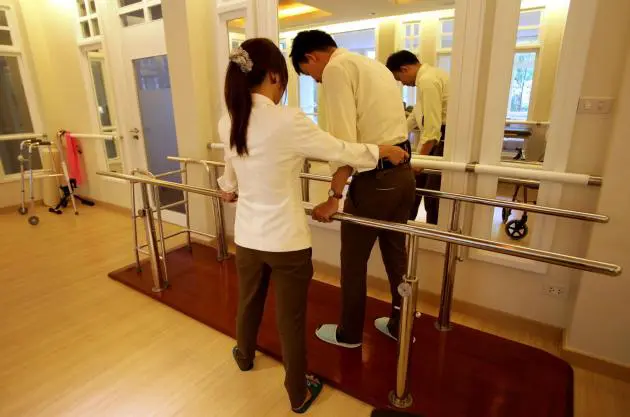
The hospital provides treatment to patients with chronic illnesses by combining physical medicine with rehabilitation modalities, together with occupational therapy, warm water hydrotherapeutic therapy and a variety of complimentary medical therapeutic options.
“The initial consultation is all important. The patient will be asked if he or she feels fresh on waking up. Often the response is ‘No, I always have a headache’. Another typical question is ‘how do you feel after exercising?’, says Torsak, who visits the institute in Italy every month to see his group of patients and offer advice.
As chronic disease is often caused by lifestyle, treatment requires that the lifestyle be adjusted to suit the patient and take account of his/her genetic weaknesses.
“Taking pills isn’t the answer,” Torsak stresses. “A patient tells me that he has high blood glucose level and is due to see the doctor again in three months for another blood test. In functional medicine, I have to check insulin and also analyse the patient’s consumption behaviour.
Torsak, who is on the online database of physicians at DAN! (Defeat Autism Now) and is associated with the Autism Research Institute, says that 80 per cent of his OPD patients are Thais with the remaining caseload made up of Vietnamese, Bangladeshis and Filipinos.
“We have almost 70 autistic kids undergoing treatment. The success rate depends on the kids’ ages and their parents’ comprehension and patience. The role of the doctor in functional medicine isn’t a physician but a coach. In terms of adult patients, most consultations are for autoimmune conditions, such as systemic lupus erythematosus or SLE and diseases of the nervous system.
“The hardest case I’ve had to face was a male patient from the United Arab Emirate who told me that he’d been diagnosed with amyotrophic lateral sclerosis (ALS) six months earlier. On average, patients with ALS die between seven months and three years of diagnosis. The UAE patient decided to move his family to Thailand and had been treated for three years because his condition was progressing rapidly. Now his DNA and RNA are back to normal and he’s returned to his country to recuperate.”
However, even without drugs, the healthcare doesn’t come cheap, especially because many of the laboratory tests need to be carried out overseas.
“The biggest barrier for examinations is using the overseas lab test because of the high costs ranging from Bt10,000-Bt40,000,” says Torsak.
GETTING FUNCTIONAL
- Better Being Hospital is located at 11 Soi 39, Sukhumvit Road.
- Call (02) 662 8464-6 or visit www.BetterBeingThailand.com.
