
Heaven and hell in Mumbai
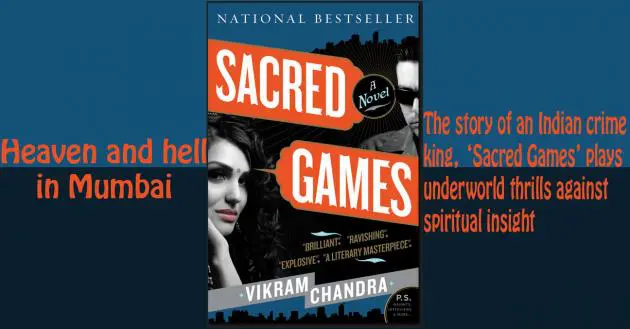


The story of an Indian crime king, 'Sacred Games' plays underworld thrills against spiritual insight
Sacred Games
Vikram Chandra
Published by Harper
Available at Asia Books, Bt559
Reviewed by Marquie Leelatham
From childhood we are plied with the idea that kings are happy beings. Fairytales preach this, reaching us through those Disney movies that make your eyes smart with tears every time you watch. As such, splendour and glory have become synonymous with leadership. Bling and regality are what it’s all about.
Little did we know that it takes a soldier’s endurance and courage in solitude to make a king. Vikram Chandra’s “Sacred Games” reveals all. Thrilling in every writhing twist and turn of the plot, it tells the story of a notorious Indian crime king, Ganesh Gaitonde, and how his sudden suicide catapults a policeman into the Mumbai underworld to discover terrorist plots under the guise of guru organisations.
Chandra follows Bollywood’s template – a roller-coaster ride of action and emotion. But unlike the films, “Sacred Games” refuses to romanticise love. If anything Chandra’s tale amputates the wings of romance. It forces the reader to question their very definition of love – is it merely a fantasy built on our selfish dependence on others?
But the beautiful yet straightforward prose moves beyond the spectrum of human emotion to explore the city itself. It depicts Mumbai as a sprawling epitome of chaos and beauty, riddled with dark criminals, Miss India competitions and grief-stricken lovers. Neither has Chandra neglected the elegance of Hindi speech – especially cusses. Injecting it into the English prose, he blends the languages together with the panache of the rice, spices and meat in a chicken biryani (a dish that gets repeated mentions in the story). The occasional Hindi “yarr” and “arre” hurled into the dialogue, adding to the realistic feel but also providing little insights on Mumbai street culture.
Many will say that Chandra’s ability to conjure such a satisfying Mumbai thriller is down to his background. Being the son of a Hindi film scriptwriter must surely have exposed him to the genius involved in creating Bollywood movies – which are famously filled to the brim with thrills. But regardless of where his talent springs from, the end results are impressive to say the least.
He uses that talent well to convey the stories of Sartaj Singh (the aforementioned policeman) and Gaitonde. Following these two narratives, the reader is lured into quick-sands of crime, lust, terrorism, Indian culture and even Hindu philosophy. Chandra achieves the seduction through his extraordinary powers to blend fantasy in with reality. You can be propped up in bed with the novel sprawled across your lap – and you are still able to taste the roti and scalding chai on your lips. Surrounding you is a roiling Mumbai skyline, in the foreground hot chapatis, all delivered via the pungent jargon and Hindi cusses in the prose. Heck, you might even learn a word or two of Hindi or Punjabi from this novel. In short, the window onto another world this novel opens is enormous. Despite being more than 800 pages, at no point will you be disheartened. And most importantly, you will not be disappointed.
Whatever you could possibly demand from the fragile pages of a novel, Chandra delivers. And delivers in spades: the ferocity of the Mumbai underworld colliding with the beauty of Indian culture stripped to its deepest core.
