
The games children play


Play
A new Unesco documentation project aims to offer an alternative learning tool to Thailand's youngsters
What did kids do before the advent of PlayStation and video games? As hard as today’s tech savvy youngsters may find it to believe, they played “Ngoo Kin Hang” (Tail Eating Snake), a simple game of catch that requires no other equipment and “Pae Khaeng” (Iceman), a type of catch where the players chase and “freeze” their friends to the spot.
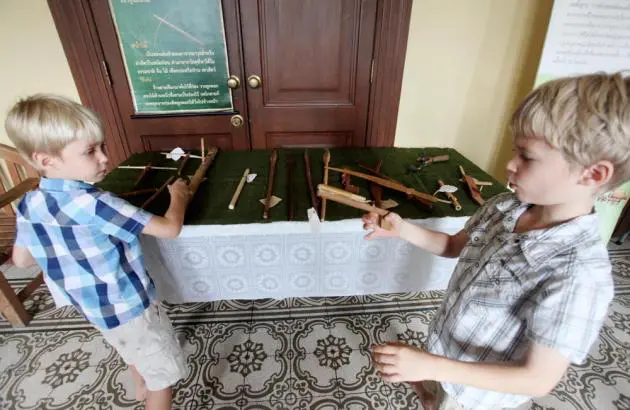
Kids and their parents can find out more at Museum Siam which is currently hosting an exhibition titled “Traditional Children’s Games in Southeast Asia”.
Part of a pilot documentation project under the auspices of Unesco Bangkok, the exhibition features more than 90 local children’s games in a form of English CD as an alternative learning tool for schools.
Making sure that the young generation doesn’t find them too old fashioned, the games can be tried out on a computer though visitors of all ages will also enjoy the selection of traditional wooden toys on show.
With the support of Gangneung City in South Korea, the Korean National Commission for Unesco and Korean Funds in Trust, Unesco Bangkok has spent US$500,000 and two years researching and recording more than 200 games in Laos, Cambodia, Malaysia and Thailand
The project aims to provide alternative class activities and encourage children to use those games in their playgrounds. The CD, which covers kids from kindergarten to secondary school level, brings together games from 14 ethnic groups, namely the Ahka, Cham, Chinese-Malay, Indian-Malay, Hmong, Khmer, Lao, Mon, Malay, Muslim Thai, Thai Buddhist, Tai Lue, Tai Yai and Tai Yuan.
Easy to adapt for both teachers and parents, this game-based pedagogy is designed by educationalist Janet Pillai from Arts Ed Penang Universiti Sains Malaysia to improve skills in mathematics, language, science, strategic thinking, art and social relations.
“It’s a pilot documentation project that we want to develop as an alternative learning tool for schools,” says Montakarn Suvanatap, project assistant for the Culture Unit at Unesco Bangkok.
“Our researchers identified 200 local games from 14 ethnic groups, which could be played in the same way, but were different in terms of language, materials and rules, depending on the cultures and surroundings. We've selected about 90 of the games and recorded them on 500 CDs, which will be distributed to schools around the country, especially in remote areas. Free downloads are also available from our website.”
The contents are divided into two parts for kids ranging in age from three to 15 and come with the history of the game, instructions on how to play and a summary of what they can learn from each game.
Guessing game “Koom Kook Koom Kuee”, for example, is typically played in Luang Prabang in Laos, while “Iceman” is a favourite with Indian children in Penang playgrounds.
Bangkok's Kasem Pithaya School is serving as a pilot for the project, with director Woranart Raksakulthai selecting six traditional games to teach the 170 kindergarten students under her care.
Once or twice a week, the games are used in an outdoor activity class. The teacher starts by teaching the lyrics as well as how to play and prepare the necessary tools.
“Monsonpa” (Mon hides a cloth) is a popular guessing game and is perfect for group of 10 children. Notice movement and run fast is the rule, with the players having to guess if the cloth has been placed behind them. If it has, they have to quickly pick it up and chase their opponent, catching them before they make it back to an empty seat.
“Our young students really enjoy the games and, as young as they are, they also appreciate the cultures. They are already showing a better understanding of language, mathematics, relations and rules,” Woranart says.
She’s also adapted “Dern Kala” (coconut shell shoes) to help the kids improve their balancing skills, coordinate their vision and strength muscles, while “Pao Gob” (rubber band blowing) lets children estimate time while making their lung stronger.
“I think this programme is good for children growing up in an age where much of their time at home is spent in front of a television or the computer," she says. “We try to offer creative activities in class and stimulate children to learn more about sociability.
“We’re planning to introduce game-based pedagogy for secondary students soon.”
OLD FASHIONED TOYS
>> Museum Siam is on Sanam Chai Road near Tha Tien and open daily except Monday from 10am to 6pm. Admission is free. The exhibition continues until September 15.
>> Call (02) 225 2777 or visit www.MuseumSiam.com.
>> Learn more about the project and download the games for free at www.UnescoBKK.org/culture/ich/children-games
