
Listen to your palate
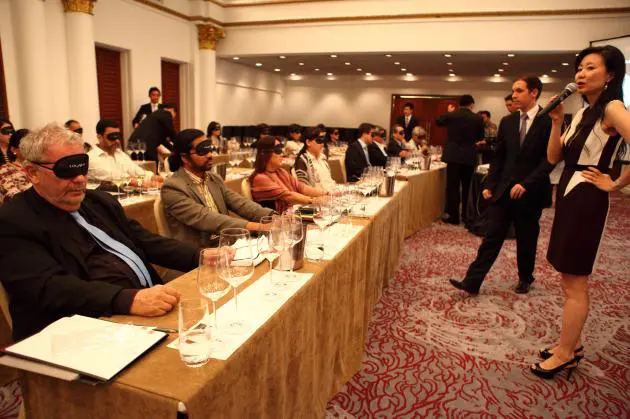


Jeannie Cho Lee demystifies the dilemma over which wines complement Thai food
Asian food is all the rage all over the world, says Jeannie Cho Lee. From Paris to Piedmont, local chefs are sourcing ingredients from Japan, China and Thailand. But pairing Asian food and wine remains a difficult task for many. If there is an expert on the matter, it’s hard to imagine anybody other than Jeannie, the first Asian Master of Wine and author of two seminal books, “Asian Palate” and “Mastering Wine for the Asian Palate”.
Educated at Oxford and Harvard and based since 1994 in Hong Kong, the Korean-born wine expert says her soul and stomach are “definitely Asian”. Her strength is Asian food and wine pairing.
At her recent “Wine Master Class with Lucaris”, which was part of the World Gourmet Festival at the Four Seasons Bangkok, Jeannie paired six Thai dishes with six wines, supplied by FIN, a local boutique wine importer whose bosses Jan Ganser and Benjawan Wisootsat attended the class. Wineglasses were supplied by an up-and-coming new Thai wineglass maker Lucaris.
In this country, what’s true is Thais don’t drink something to complement the food. Pairing wine and food is a practice that remains alien to most Thais. Some believe no wine goes with the intensity of flavours of Thai cuisine.
Jeannie thinks otherwise. There’s room to enjoy wine with Asian food “before or after an Asian meal” if those “super-hot, tongue-numbing dishes” are not compatible with the wine. She’s confident that it’s possible to pair a wine with an Asian dish that she dislikes.
“If I hate durian, as part of my job I might find a wine that will absolutely stop and kill the flavour of durian cold, a wine that cleanses the palate,” she says. “But those who like it might find a wine that prolongs the flavour of durian on the tongue.” That method of stopping and prolonging the flavour of Asian food through wine pairing came in handy in class.
Jeannie listed four major flavours in Thai food: sweet, sour, spicy and umami (in fish sauce and soy sauce). Food flavours influence the flavours of the wine, she says. The salty dish accentuates tannins, the sour can overpower wine’s flavours. The sweet dish makes a dry wine become drier, thin, tannic or sour. The umami increases the taste of alcohol, and can bring out earth, bitter or metallic notes.
Acknowledging the aromatics and acidity in wine as key in Thai cuisine, Jeannie introduced six wines to match six Thai dishes.
The first dish was Fresh Spring Rolls with Shrimp, which she paired with 2010 Riesling, Fritz Haag, Mosel, Germany. “Wine needs to have sharp acidity to cut through the fermented/salty flavours. You get the lime and lemongrass notes in the wine. The acidity of the wine is present but not jarring. You feel that the element of lightness of the dish comes through in the Riesling,” she said.
One student said too much basil overpowered the wine. Jeannie responded: “But I prefer the riesling. Leaves with such strong herbal notes in the dish go well with the other wine, which is the sauvignon blanc with its fresh herbal character.”
The second dish is Spicy Salad Glass Noodle, partnered with 2011 Albarino, Pazo de Senorans, Rias Baixas, Galicia, Spain. The flavours of this dish were more complex than spring rolls. “A traditional European pairing would be an off-dry wine because the dish is spicy. Since you like the dish, you need a wine that is a little more acidic and stronger, that keeps the expression of the dish and chilli flavour lingering a little longer, not to change it. The first sweet wine will change it,” she noted.
The third dish was Green Mango Salad, married with 2010 Gewrztraminer Les Elements AOC, Domaine Bott Geyl, Alsace, France. To match the textural element from nuts and fresh shallots and herbs, the white wine needs layers of flavours, strong fruity profile, lightly sweet with generous body. “The biodynamic wine is intensely aromatic, with lychee notes. It’s slightly sweet but does not have as high acidity as riesling. The wine is definitely not for Szechuan and Cantonese food because it will overpower the dishes.”
Next was Green Curry Chicken, which was paired with 2010 Sptburgunder Pinot Noir, Meyer-Nkel, Ahr, Germany. She explained layered spices and flavours and sweet coconut juice makes up curry base. The texture is creamy but not rich and has balanced spices and sweetness.
“Either white or red wine would work but ideally a chilled Pinot Noir from cool climate like Germany or NZ. This pinot noir is very Burgundian style,” she noted.
The fifth dish was Stir-fried Beef with Basil, which was partnered with 2010 Crozes Hermitage le Rouvre, Yann Chave, Northern Rhone, France.
Fresh basil enhances aroma whilst seasonings adds complex umami & spicy flavours, she explained. “A good pairing involves medium bodied red wine with strong fruit character, hint of spices and moderate tannin levels,” she said, adding: “The wine with elegant tannins plus spicy and peppery notes doesn’t take over the dish; it keeps the integrity of the dish. Fresh herbs go well with the wine which stays in the background.”
The dessert was Mango & Sticky Rice matched with 2002 Grande Cuvee “Nouvelle Vague” TBA No 7, Kracher, Austria.
She explained the sticky rice based dishes are about the gooey texture. Dessert wine needs above all to have unctuous texture along with very high acidity. “The wine, a blend of late harvest Chardonnay and Welschriseling, is sweet with a tingling sensation on the tongue.”
We all agreed Jeannie managed to bridge the gap between Asian cuisine and wine. We went home with Jeannie’s wisdom still ringing in our ears. “Listen to your palate and be open to learning.”
