
Standing in the shadows


Play
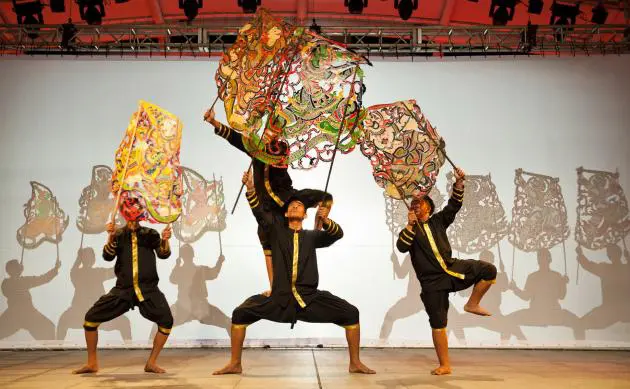
The young Nang Yai Players of Wat Ban Don put on an impressive performance at the dan:s festival in Singapore
The Nang Yai Players of Wat Ban Don were scheduled to give three performances last Saturday at the Esplanade Outdoor Theatre as part of “Rasas”, a showcase for traditional dance from Asia in the 2012 edition of the da:ns festival. Sadly, the heavens opened and the heavy rain cut that down to one show, at 9.15pm. While I was able to rearrange my schedule, my Singaporean friends couldn’t. The troupe was however able to perform as scheduled both on Friday and Sunday evenings.
Their name might give the impression that they are professional players but in fact the troupe is made up of secondary school students from Rayong province. They only rehearse and stage nang yai when class and exam schedules permit and when they’re not engaged in other activities more exciting for boys their age.
The 30-minute showcase presented three scenes from the Ramayana, each carefully chosen for its different nature and the nature of this troupe: the prologue in which the White Monkey catches the Black Monkey; the scene in which Rama is lured away from his camp and Sita by the golden deer; and finally the grand battle between Rama’s and Thotsakan’s armies.
Given the time allocated, each scene was trimmed significantly — meaning the pace was faster than usual — and the supertitles provided sufficient information to remind our Southeast Asian neighbours of the epic, asking them perhaps to draw comparisons to their own country’s variation.
This was the first time I had watched this troupe and I was impressed by their raw energy and sheer enthusiasm, which was noticeably higher than that of Bangkok students forced into khon training for end of year fund-raisers. Equally impressive was the planning that went into the balance between the time spent moments behind the big white screen and in front of it.
However, the main light in the back didn’t do full justice to the colours in each piece and also had to fight with the glittering Marina Bay Sands across the bay. I found myself wishing for the real fires traditionally used to light nang yai plays. Some of the young artists seemed overly focused too on their leather puppets, perhaps forgetting the need to become the characters they’re manipulating especially when they’re in front of the screen and the audience is looking at leg movements as well.
Some audience members made no effort to hide their departure in between the scenes – despite the brevity of the show – and I wondered about their reasons for leaving. In comparison to other shadow puppet traditions, nang yai, with each piece showing one moment in a scene and not movable in any parts, may not be as exciting. But, for me at least, the intricate Thai craftsmanship that has been put into each piece of nang yai, the movements of the puppeteers, who have to be trained as dancers, in addition to the teamwork of the troupe makes it unique.
Given the value of nang yai’s rare presence in a foreign country for touristic and diplomatic purposes, I was surprised to find neither the TAT’s Singapore office or the Thai embassy attached any significance to this event. This also happened when Pichet Klunchun Dance Company was the festival’s artists-in-residence, staying in the city state for a month and performing two works at last year’s dan:s. Maybe we’ve already assumed that Singaporeans only visit Thailand for shopping and beach resorts. But isn’t AEC 2015 also about cultural exchange?
The writer wishes to thank the Esplanade’s corporate communications team for all assistance.
More da:ns
“da:ns festival 2012” continues until Sunday at Esplanade—Theatres on the Bay. This weekend’s must-see is the Southeast Asia premiere of Sidi Larbi Cherkaoui’s contemporary dance homage to the celebrated Japanese manga artist “TeZuKa”. Visit www.DansFestival.com for more details.
