
Moving in the lights and shadows
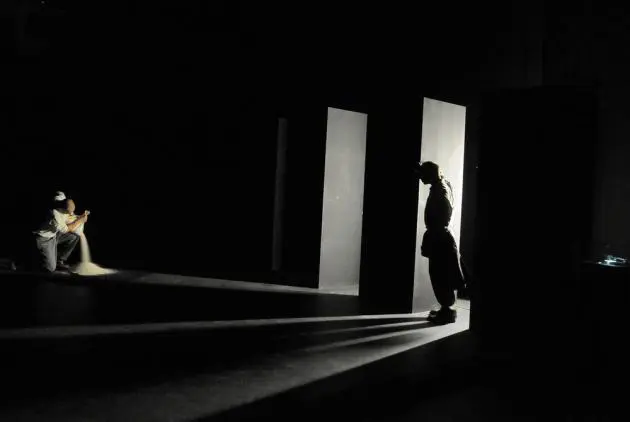


The stage reveals its wonders anew at a French dance festival
Innovative works are being created in experiments in which people from different fields join hands and work outside their boxes. Contemporary dance is another genre in which the possibility of cross-disciplinary collaboration is limitless, thanks to its freedom in form and content.
Such is the case for “Ellipses” at the 15th Biennale de la danse a Lyon, a short solo dance work in which the frequent blackouts amid the front and back lighting created an illusion that it was not a solo dance. Of course the dancer Aragorn Boulanger also deserved much credit for being able to rapidly and accurately adjust, or juggle, his movements in accordance to each new scene defined by the lighting.
The work was co-created by circus artist Clement Debailleul and “new magic” artist Raphael Navarro, the duo that forms Compagnie 14:20. And right here, Navarro explained this new term, “When the artist’s concern is to distort reality in the here and now – in other words, in the very presence of reality – that’s what we call ‘new magic’.”
Another work which heavily relied on lighting, and showed that the lighting designer worked hand in hand with the choreographer for a long time before the performance, was choreographer Maguy Marin and composer Denis Mariotte’s “Nocturnes”.
Couples were at different parts of the stage while other areas were in total darkness. Their movements were mostly naturalistic. However, the relationship between these movements with the intensity and angles of lights and shadows as well as Mariotte’s electronic soundscape was so astonishing that their intriguing combination looked, sounded and felt like a dance performance. This reminded me that the meaning of dance is never restricted to extraordinary movements that require high levels of physical skill we viewers can never achieve.
The performers’ actions suggested contemporary life’s themes of, in the words of Marin, whose works are frequently unpredictable in both style and content, “memory, living together and also the question of history, of what’s been passed on to us and what we’re going to pass on”. Themes of migration and exile, as significant for modern French society as many others, were also raised when performers uttered such a line as “I am Tunisian.”
When all the lights were up at full strength, “Nocturnes” also reminded us how attractive a bare stage could be, and how much work the lighting designer in collaboration with the choreographer put into creating this fantastical world of contemporary dance.
It should also be noted that both works had been created at the theatres where it was staged – they were part of the biannual festival’s “fabrique des oeuvres” programme, allowing more time for the artists’ fruitful collaboration and their adjustment to, and of, the venues. In the former case, as it was at ENSATT, or l’Ecole Nationale Superieure des Arts et Techniques du Theatre, the artists had a chance to share their expertise and insights with the students, or the future artists, as well.
In Thailand, lighting designers and technicians usually come on board later in the process, occasionally only a few days, or even hours, before the performance. Plus, there have been few collaborations involving artists from different fields. In most cases, it’s the choreographer who makes all artistic decisions in his production. Some of them take ticket reservations too. Perhaps it’s about time to think differently for better work.
For more details, visit www.Compagnie-Maguy-Marin.fr and cie1420.free.fr.
The writer’s trip was supported by the French Embassy in Thailand, Institut Fran
