
Getting off on the right foot
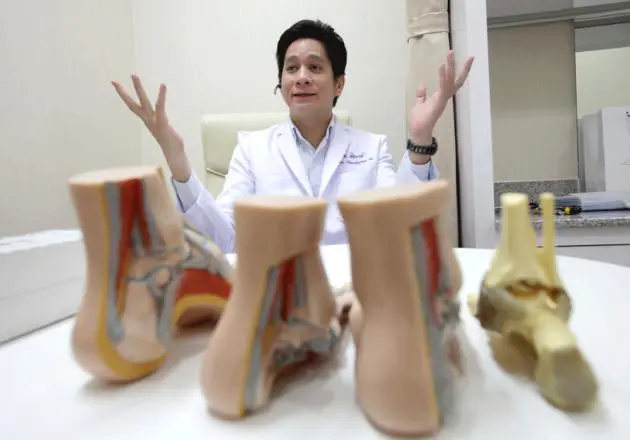


Take it from a podiatrist - treating the lowest part |of the body right can save you a lifetime of pain
When Phattra Thepjunda found she was wincing in pain as soon as she took her first step in the morning, her first reaction was to down a painkiller. When that didn’t help, Phattra, a trained nurse, turned to physiotherapy, then exercise and consulted an orthopaedist about her painful foot.
“It’s incredibly painful,” says Phattra, who often works 12- to 16-hour days on the busy paediatric ward at Bangkok Hospital.
Phattra is suffering from plantar fasciitis – known in Thai as rong chum, which is when the thick tissue on the bottom of the foot becomes inflamed.
Those who suffer from plantar fasciitis are desperate to recover but the process is not easy. Pain medication is only a temporary measure and the problem will recur if the problem isn’t fixed.
“If your arm is broken, you wear a cast and stop using it. You can’t really do the same when you have a pain in your foot. It’s just not possible to stop using the feet,” says podiatrist Dr Cherdpong Hansasuta .
“A dermatologist once told me that taking care of our faces is far less important than healing our feet. It’s absolutely true,” says the nurse.
In Phattra’s case, Cherdpong says that the healing just follows the symptoms not the cause. After examining Phattra, the podiatrist found a bone spur growing on her foot, which he explains is down to the body trying to repair itself by building extra bone in response to pressure or stress that continues over a long period of time.
Phattra was worried that the pain might be due to one leg being slightly shorter than the other – the result of a past accident. Over the years, she has tried everything including wearing shoes designed to support her feet while she is on shift. “It helps but the pain still comes back,” she says.
Cherdpong took an imprint of Phattra’s foot, noted the pressure on the area with a callus, then marked the pressure area, moved the force out of it and created a counter force area to relieve the problem area. Using a plaster-cast mock-up of her foot, a custom insole or foot orthotic is being made, which should bring Phattra some relief.
She is also supplying the shoe in which she wants the custom insole to be fitted. This goes to the to the pedorthist, who works closely with the doctor.
“The shoe should be the one that you wear for more than 80 per cent of the day,” Cherdpong says. To avoid problems with fit, the existing insole of the shoe will be removed so that the custom-made one can replace it.
The price of an insole price starts at around Bt4,000 per shoe and has an average life of four to five years. The insole can be designed to fit the same toe-cap style so it can be switched to another shoe with the same cap.
Custom shoes are also available and vary in price from Bt2,500 to Bt7,000 depending on the material.
Custom shoes are also necessary for young children who need support for and reshaping of their feet before it’s too late.
Cherdpong says that detection of foot problems in toddlers is ideal, as children's feet are actively growing and developing so problems like flat foot, high arches or club foot can be easily corrected before the bones fully develop.
As children grow, problems like flat feet or high arches inevitably become a problem and foot pain occurs, often leading to chronic symptoms in the knees or back.
Early detection, Cherdpong stresses, is ideal, and he urges parents to bring their babies for a foot x-ray, which costs around Bt500. If a problem is detected, customised shoes can be built for a child from the age of 12 to 18 months and the foot problem corrected in two years.
“After seven to nine years old, the bone, connective tissue and collagen are too strong to adjust,” he says.
Experienced shoemaker Paluckpon Achichutithip, who works closely with Cherdpong, says children who wear orthotic shoes will need to change their shoes every four months to keep up with their growth. Throughout the two years of treatment, they will use six pairs of shoes at a cost of around Bt89,000.
While that seems expensive, Paluckpon points out that it is equal to the cost of orthodontics and is money well invested to save a lifetime of foot problems.
Diabetics suffer chronic foot problems, and Cherdpong is seeing an increasing number of diabetes patients. Sores on their feet can be critical.
“If they come to see the podiatrist, we can check the sore and design a shoe that helps to ease and protect the wounded area from infection so they can lead a normal life. Theptharin Hospital can save 92 per cent of diabetes patients who are at risk of amputation by bringing the cases to the podiatrist,” he says.
Although in the last five years podiatry has become more recognised as a discipline, Thailand still has only a few podiatrists. Cherdpong is now working seven days a week at three hospitals: Bangkok Hospital, Samitivej Hospital and BNH Hospital.
