
A love that binds nations


Play
The Javanese story of Inao and Bussaba spread its charm across Southeast Asia
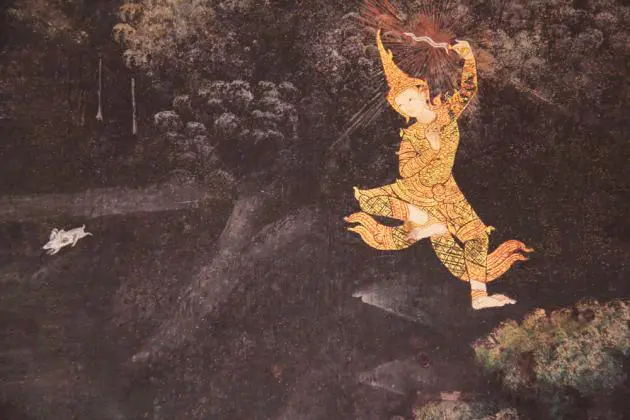
The mural in the calm hall of Bangkok’s Wat Somanas Rajavaravihara shows a couple whose shining traditional-Siamese royal garments add to the painting’s golden flow, brightening the temple premises – even though they sit in a cavern. The handsome man smiles in pleasure as he speaks to the beautiful young woman. Yet she draws her arm from his reach, lowering her face to hide a shy smile of her own.
The scene is from “Inao and Bussaba in the Cave”, part of the lyrics that King Rama II wrote for his classical royal dance-drama “Inao”. It’s been called one of the most beautiful poems in Thai literature, and in fact its rhythm inspired the elegant dance movements and dazzling music of the play.
The story of Inao, the handsome Prince of Kurepan, and Bussaba, his beautiful fiancee from Daha, has been told and retold for centuries throughout old Malaya, which today covers Indonesia, Malaysia, Thailand and Cambodia.
It has varied somewhat and gone by different names depending on the location, but most Thais know it from high-school literature, or they’re heard the proverbs it fostered. The most famous is “People criticise you for what they do themselves”, referring to Inao chastising other men for making war to win the heart of Bussaba and then turning around and doing precisely the same thing.
Indonesians know the story as “Panji” or “Inu” and rank it alongside the epic poetry of the Mahabarata and Ramayana. The home-grown tale circulated in Javanese and Malay and travelled across the sea to become one of the most popular royal dance-dramas in Siam, Laos, Cambodia and Myanmar. How this migration came about remains an engaging question.
One Thai historic source indicates that Princesses Kunthon and Mongkut of King Boromakot’s Ayutthaya household heard the legend from a servant, a Pattani native. The princesses both wrote stories based on the tale – “Dalang” and “Inao” – which were presented as plays at the palace. The scripts disappeared with the fall of Ayutthaya but were “revived” during the Rattanakosin Era that followed.
Assistant Professor Dr Davisakd Puaksom isn’t so sure about this version of events.
“Personally I’m still a bit curious about how the story came to Thailand,” says the Southeast Asia scholar. “At the time Siam had diplomatic relations with its neighbours and sent shipwrights to Indonesia to learn how to build ships big enough to carry elephants. They would have spent months or even years mastering the skills, so they would have learned the language and some of the culture.
“There are also records of the Siamese court sending people to Java to get good horses every year,” Davisakd notes. “Wouldn’t these people communicate with the locals about their daily lives and entertainment? Would it be possible that they heard the tale of Panji and brought it back to Thailand? And there were also many Javanese and Malays living in Thailand, so it’s possible they brought the story here.
“Language wouldn’t have been a barrier, since Malay was a significant language throughout the region. Our diplomats could speak Malay, so there would be no problem understanding the story and the performance.”
Though inspired by the Javanese version, Siam’s “Inao” is not a carbon copy.
“There are several versions even in Indonesia and Malaysia, but none is exactly like the Thai ‘Inao’,” says Assistant Professor Dr Rattiya Salae, an expert on the history of Malayu and Pattani states. “Our version mixes different versions of ‘Panji’ and was adapted to local tastes and culture.”
Thus the characters wear Siamese attire even as the action unfolds in Kurepan, Java. It’s the same for the renditions found in Cambodia, Laos and what is now Myanmar. “All the names in Cambodia’s ‘Inaaw’ are transcribed from Thai, which makes it clear that Cambodia got the story from Thailand rather than Indonesia or Malaysia,” says Dr Santi Pakdeekham, an assistant professor in Thai and other oriental languages at Srinakharinwirot University.
“‘Inaaw’ seems like a direct translation from Thai, since many parts are the same, almost word by word. The author’s name is still unknown, but it’s been assumed that Pra-ong Duang, a Cambodian prince, translated ‘Inao’ into ‘Inaaw’ during the reign of King Rama II. He took refuge here at age 16 and didn’t go home until he was 43. Pra-ong Duang was also a great poet, so this is our best assumption, based on the artefacts we have.
“Plus, ‘Inao’ was performed only in the palace, so ordinary people would have a slim chance of seeing it.”
“Innao”, the Lao version, was almost lost to time, but several copies were preserved at the Luang Prabang National Museum, of which one remains legible. “From that text we learned that it was written in the palace and meant to be kept there,” says Dr Thaneerat Jatuthasri of Chulalongkorn University’s Thai Language Department.
“The characters are very similar to those in the Thai version, but the Lao poet was very keen on detail. Elements of life in that era are revealed in soldiers’ discussions with their wives, and in the very unique description of Joraka’s beautiful palace and his strong feelings toward Bussaba. There are traces of Thai tradition in the poem, so we know it came from Thailand, but ‘Innao’ is brilliant in its own way. The poet wonderfully presented the Laotian lifestyle and beliefs without detracting from the main plot.”
Myanmar got its version from Siamese palace actors seized in the conquest of Ayutthaya. “Inao” was translated into Burmese by royal order. “The play was very popular until the reign of Kings Mindon and Thibaw, who preferred the Ramayana for its moral message about doing good deeds, whereas ‘Inao’ is about love and romance,” says Sitthiporn Nethniyom of Mahidol University’s Research Institute for Languages and Cultures of Asia.
In the saga, Inao wanders from Java to Malacca in search of his lost love, an odyssey that inspired poets and artists to create dazzling work that have endured for centuries. Thus the legacy of Inao’s forlorn heart is a golden thread that binds Southeast Asia.
“‘Inao’ would be a great choice to symbolise the bond among the countries in this region,” says Rattiya. “It’s a story of love, and there’s a saying – ‘If you don’t know each other, you don’t know how to love.’ It’s like Inao, who refused to marry Bussaba sight unseen, but once he’d seen her, he tried everything to gain her love.”
