
When wise words count


Play
Former Silly Fools frontman Veerachon 'To' Satthaying explains why he left the music business to concentrate on his religion
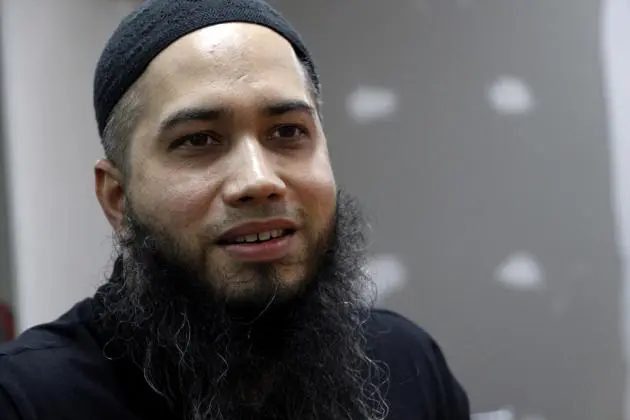
Once the idol of many teenagers, former Silly Fools and Hangman front man Veerachon “To” Satthaying has renounced rock for religion and today dedicates himself to Islam.
“Music is ‘haraam’ [sinful] in Islam,” says the 38-year-old, chatting with The Nation at the White Channel, a 24-hour Islamic satellite television station where he now works.
Under Islamic rules, singing coupled with music is sinful while singing without musical accompaniment is permitted under certain circumstances and with particular conditions.
The lyrics of the songs must be pure and innocent, and must keep within the moral bounds set by Islamic teachings. Hence, lyrics that are erotic and licentious and/or sung in a licentious manner, which adversely affects the libidinous instincts of the listener, are forbidden.
Veerachon is not a convert but a Muslim by birth. The first of three children born to a doctor and poet, he was given the Islamic name Firdaus meaning heaven. But he has always enjoyed music and almost 20 years ago was singing on stage at a pub when he caught the ear of Silly Fools’ founder and guitarist Jakarin “Ton” Juprasert, who recruited him as the band’s new singer in 1996.
“My parents are modern, so I didn’t have to seriously adhere to the rules,” Veerachon explains. “Even so, I presented the philosophy of my religion through the lyrics I wrote and tried to soften fans’ attitudes during my show. That’s one of the reasons I didn’t sing any covers. I think God was building me.”
Those songs included “Roy Yim” (“Smile”), a number about betrayal and his first for Silly Fools, as well as “Chan vs Satan” with Hangman.
“I wrote the first song from my viewpoint of an 18 or 19 year old facing up to the world. As a kid, I remember that a bus conductor didn’t collect my fare and a passenger gave me a seat. When I grew up, the boot was on the other foot. The conductor collected my fare and nobody gave me a seat. I wanted to express my feelings about this change but didn’t have the skills to write a poem. I did however know how to mix music with words.
“‘Chan vs Satan’ was more concerned with the Islamic religion, as it talked about having another character in my mind who was trying to make me go contrary to what I knew was right. It’s about the fight between Satan and myself.
“When I started learning more about Islam, it was harder for me to speak nonsense as I knew it was a sin. For us, nonsense covers love, money, sex, boastfulness and arrogance. Instead, I wanted to talk about God. I wanted to convey that people shouldn’t betray each other but rather respect each other. That’s hard because it isn’t a topic that anyone wants to hear. After reading the Koran, I discovered that singing to the accompaniment of musical instruments is forbidden in Islam and understood that Muhammad, the messenger of Allah, was propagating goodness without music. When I realised that music wasn’t the way to change the world, I put a halt to my singing career,” he says.
In 2006, the rock star shocked fans with his announcement that he was retiring from Silly Fools and would form a new band called Hangman. That outfit too went by the wayside, with Veerachon decided to stop his music career and devote himself to Islam.
“I’m just an ordinary man, a student, who tries to carry out his duty to help other people, different from a savant or mullah who has studied the religion since childhood in Saudi Arabia, Morocco and Egypt. They can recite the entire Koran, word for word and vowel for vowel, without any personal opinion. I, on the other hand, have gradually learnt it by myself and speak to listeners using ordinary words so that they can understand what I’m talking about. This is possible because I had a concise way of songwriting, which I recognise was a gift.
“The Koran is about knowledge not incantations. Reading the Koran in Arabic is used for Ramadan and can get earn the sawab or reward for good deeds, so obviously Muslims should study the language. But I had been unconcerned about Islam since I was a child. It’s the same with Buddhism – how many true Buddhists are there? We live in a modern world so our religious education depends on us and also our parents,” says Veerachon.
Since the expiry of his recording contract with GMM Grammy a few years ago, Veerachon has become a propagator of his religion, working with the White Channel, which is known as the “station for goodness”.
“I’m responsible for the production. The channel features a variety of programmes including cooking for children as well as the religious dissemination and has no musical soundtracks or appearances by seductive woman. I host ‘Motor Vaccine’, which offers tip on repairing second hand cars, co-host with a friend the talk show, “To Kap Tal”, and host another talk show that has an imam answering trivia questions. In the future, I will be producing a travel variety show presenting places of interest as well as halal foods around the country.”
In addition to the production, Veerachon is also responsible for promoting the satellite TV channel in all regions of the country, especially in the largely Muslim South.
“I talk to tens of thousands of people about such topics such as heaven and hell, family problem, marriage, gossip as a sin, and I focus on drugs and hooligans when I target the youth. Before, young people used to shy away from our activities but now they come because of me. This year, we will also go to Chiang Mai, Chiang Rai, Pai, Khon Kaen and Saraburi,” says Veerachon, who is married and has two children, a son aged two and a one-year-old daughter. “I think my speaking is much more interesting than singing.”
So what is his ultimate aim?
“My aim is heaven,” says Veerachon. “I have to die after satisfying God.”
