
Diving deep into Asia's 'Atlantis'


Play
Do the waters off Japan's westernmost island hide the remnants of an ancient civilisation?
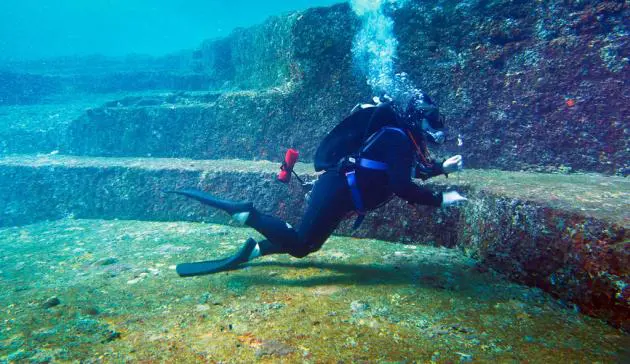
The currents that wash Yonaguni, a solitary island far to the southwest of Japan’s Okinawa, rock the boat that holds my fellow divers and me, and I plunge into the sea in front of cliffs layered like a wedding cake.
As we descend, an immense monolith resembling the base of some long-lost temple materialises before us.
Having passed through the half-metre-wide “castle gate” arch I make for the main terrace, a set of giant right-angled stairs, all perfectly flat. Below I can see stones that look as though they might once have functioned as a drain.
It simply isn’t possible to believe that this is a naturally occurring structure, so seemingly well designed and hewn are its lines.
Suddenly I am swept along by the current and have to cling desperately to a rock nearby. Out here in the open ocean is no place for a novice diver.
I feel satisfied when I return to the boat 30 minutes later, but I am quite exhausted.
Experts say there is no evidence to suggest that the megalithic structures off Yonaguni, Japan’s westernmost island, were man-made. Although archaeologists flatly reject the theory that the marvellous structures I saw on my dive were built by humans, I can’t shake the impression that somehow they were.
Kihachiro Aratake, 65, who found the “monument” in 1986, says, “There are some areas that seem like they could have been a martial arts arena and the remnants of a village.”
Aratake’s comment stirs romantic ideas in me of a phantom civilisation.
After a rest I dive again, this time floating 25 metres below the swell for a glimpse of a hammerhead shark. All is silent, save for the sound of the breathing apparatus that supports me in my brief visit to this impossibly blue and mysterious world.
Then, a magnificent three-metre-long fish flashes into view a few metres ahead. It is an Indo-Pacific sailfish, a sight even rarer in this area than the hammerhead I had hoped to see.
Back on terra firma in the warm spring air, I rent a motorbike to explore the island. I head to Musashi, a small bar with a stage at the centre of the Sonai community, in the hope of learning about a local folk song this area is famous for.
The song is called “Dunan Sunkani.” Dunan is another name for Yonaguni, while Sunkani means to pull back.
“The original meaning conveys a feeling of having left one’s heart behind, or finding it hard to tear oneself away from a person or place. It’s a song of separation between men and women, so only those aged 20 or older can really bring out its unique charm,” says Takashi Tamaki, the 72-year-old owner of the bar.
Tamaki sings the song in the Yonaguni dialect and accompanies himself on the three-stringed sanshin lute. I listen, sipping my glass of Donan, a local liquor with a mild taste.
The next song features mayagwa (a cat) and livens up the atmosphere with its humorous tale of a Ryukyu-dynasty moggy that was awarded the rank of warrior for catching mice.
An elderly customer stands and struts like a feline, her hands casting paw-like shadows about the room.
Urged on by the woman, I mimic her moves. Entranced by the dance and perhaps under the influence of the donan liquor and the fatigue from my dive, I somehow find it hard to stop.
