
The rainbow and the road


Play
After a fight, Sydney loses its gay-friendly pedestrian crossing
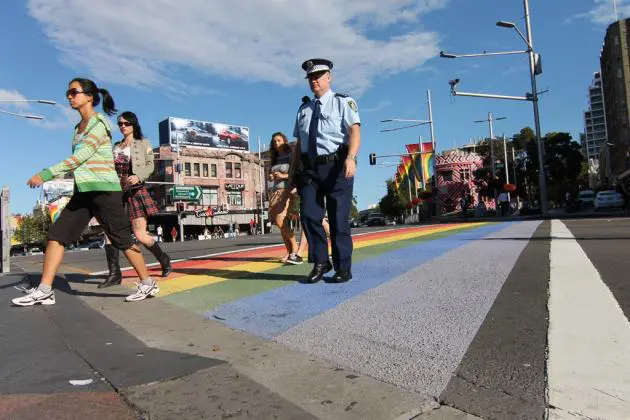
There used to be a rainbow-coloured pedestrian crossing in Sydney. Just one.
It was torn up in the dead of night last month after officials said it had become a tourist attraction and people were putting their lives in danger by snapping photographs of themselves as they walked across it.
Activists enraged at the removal of the gay-friendly Oxford Street icon are fighting back by chalking up their own rainbow crossings around the city.
“It’s a positive and peaceful protest against what was a nasty and aggressive act,” says Alex Greenwich, a member of the New South Wales state parliament, and the driving force behind a failed campaign to keep the crossing.
The Oxford Street crossing was intended to last for the month-long Mardi Gras festival but became such a powerful totem that people wanted to make it permanent.
It had become a sacred site for Sydney’s gay and lesbian community with pilgrims drawn to where Australia’s first gay pride march set off 35 years ago – a protest famously met by police brutality, arrests and prosecutions.
“For us to now have our flag at where that parade started is of immense historical importance and it also shows how far we’ve come and how celebrated we are,” Greenwich said when campaigning for its retention.
Tearing the flag down has galvanised the community into replicating the colours, albeit only in crayon, on Sydney’s streets.
“These rainbow crossings are being put together by straight supporters of the gay and lesbian community who want to send a clear message that the road minister's aggressive actions do not represent the people,” Greenwich says today. “This is their way of making that point.”
Duncan Gay, the state’s roads minister, justified a return to black and white tarmac on public safety grounds.
“We saw more than 15 incidents in a month, including people lying and sitting on the road,” he said. “I’ve seen the footage where cars have been queued up as people have been sitting on the road posing for photographs.”
A 16,000-signature petition Greenwich put together failed to change his mind about a bit of street art that had proved a magnet to the local gay and lesbian community and to out-of-towners intrigued by a gaudy symbol of acceptance.
“It's a bit of history,” said Hamburg-born Nicole Reese, a young German in Australia studying teacher-training who heard it was about to go and took the bus into town to see it before it went.
“It's important. It’s like also we have the Berlin Wall.” Sandro Miranda, a Brazilian who has been working in Sydney for seven years, also came in specially. “It’s sad if they are removing it,” he said.
Supporters wondered how the crossing – expensively made with anti-skid paint – could be a hailed by officials as a tourism draw-card one month and yet be labelled a traffic hazard and focus for anti-social behaviour the next.
There were no accidents. Motorists did not complain of inconvenience.
The police were happy. A poll in The Sydney Morning Herald newspaper found 73 per cent of over 16,000 respondents wanted the rainbow crossing to stay.
Some suggest the state government was responding to those against recognition for the homosexual lobby.
“As with all other gifts to noisy protest movements, the rainbow crosswalk has again demonstrated the failure of appeasement,” a column in Sydney’s Daily Telegraph said, claiming the crossing was a “politically correct push by the noisy end of the homosexual lobby to inflict its narrow agenda on the broader community.”
Greenwich says he thinks safety concerns were just a pretext to get rid of the crossing “because they are not based on any fact or evidence”. He notes that the pedestrian crossing outside London’s Abbey Road music recording studios that featured on the cover of the eponymous 1969 album by The Beatles receives hundreds of thousands of pilgrims each year without any recorded death or injury.
The Abbey Road crossing is now heritage listed for its “cultural and historical importance”.
The do-it-yourself rainbow crossings began appearing after fans of the original rejected what Gay termed a compromise solution: a small-scale replica of the original rainbow crossing on a stretch of pavement near Oxford Street that would not interrupt the flow of traffic.
