
Dharma in the darkroom
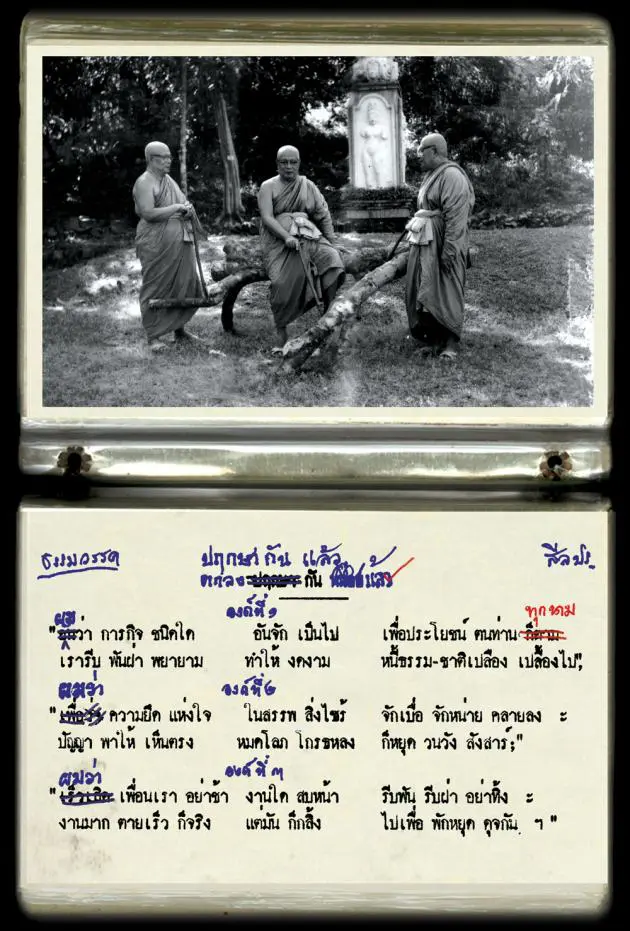


Alarmed that people were worshipping his portrait, Buddhadasa Bhikkhu exposed the camera's real magic
Modern digital programs make it quite literally a snap to modify photos. You want a triple exposure? Just click. But back in the days before pixels, photographic film and chemicals were involved and considerable skill and patience were needed in the darkroom.
Camera buff Manit Sriwanichapoom of the Kathmandu Photo Gallery recalls this all too well, so he was astonished to discover that the venerable monk Buddhadasa Bhikkhu used such techniques. He found pictures of the monk ringed by flowers that had been superimposed on the original portrait image.
One of Thailand’s most revered guides to the dharma, Buddhadasa died in 1993. He was an esteemed poet as well and would write verse to accompany each image. He championed photography at his Suan Mokh monastery in Surat Thani as a teaching aid, and had his own darkroom.
Manit came across Buddhadasa’s pioneering photo-laden “dharma riddles” project in the monk’s three-volume book “Dharma Text Next to Image” and spent months researching it at the Buddhadasa Indapanno Archives in Bangkok.
Now Manit shares what he learned in an exhibition that’s also called “Dharma Text Next to Image”. He’s enlarged 34 of the more than 300 images uncovered in the archives as part of the gallery’s series “Seeking Forgotten Thai Photographers”.
“These are nothing like the kind of photos of people posing like you see on Facebook – every picture has its own concept. The abbot put a lot of thought into them,” says Manit.
It was Phra Maha Boonchoo Jittapunyo, then a mere novice in both spiritual and photographic matters, who actually took the pictures of Buddhadasa at the monastery, at leisure or conducting classes. Manit interviewed him about the whole process, captured in a 15-minute video with English subtitles. (Buddhadasa’s poetry has also been translated into English.)
By 1972, aged 66, Buddhadasa was famous throughout the land and beyond, but he took umbrage at devotees attaching spiritual significance to his portraits, dismissing the worship of such objects as superstitious. Buddhism, he reminded followers, demands the denial of ego.
To wean people from the habit of idolatry, he had Boonchoo take pictures around Suan Mokh – of him, the lotus pond, the resident pets, even the dirt. Many of these were superimposed in the darkroom to create a “mystical” effect, forming what the abbot called “dharma riddles”. Accompanied by a suitably stirring poem, they might spur flashes of spiritual insight.
Boonchoo credits a layman at the monastery with showing them the double-exposure trick. “He worked at the Songkhla Provincial Office, taking the pictures for ID cards. He made a double-exposure portrait of the master – maybe you’ve seen it, where he’s saying to himself, ‘I’ve done nothing all day!’ The master thought it was cool because he could make up Buddhist riddles with a question-and-answer format.”
Left to their own devices, Buddhadasa instructed Boonchoo as to the angles, composition and lighting.
“He’d say, ‘I’ll sit here and you stand there. Set the camera just so. Make sure the background isn’t messy and nothing looks like it’s sticking into my head.’ The master had a great artistic sensibility. I could only see him – the background escaped my notice!” Boonchoo laughs.
Buddhadasa was meanwhile instilling every image with Buddhist teaching, enhanced by his companion poems. One of them conveys the correct way of dying – righteously, happily. It’s next to a portrait chosen because of its deteriorated condition, showing the monk behind a lotus flower with eyes closed. “No material things form your ego. Clarity saves you from grovelling in torment. May we all die correctly as such.”
Manit is fascinated. “In some of the damaged photos his face is almost unrecognisable, and he used these to teach people not to be attached to their bodies.”
“And the lotus, as we all know, signifies the Awakened, the Joyous One,” Boonchoo notes. “He once held up a lotus with him standing behind and told me to focus only on the flower. I thought, ‘No, that’s not right. The master is the model – I should focus on him.
“It only dawned on me later that he had a meaning to convey, perhaps the preparation for Enlightenment. But at the same time he was trying to teach me about depth of field!”
The “dharma riddles” were never printed while Buddhadasa was alive, only emerging in the 2006 book commemorating the centenary of his birth. The year previous, Unesco had added his name to its list of “great international personalities”.
Carrying on his dharma teaching, his nephew Karunphol Phanich toils at the Buddhadasa Indapanno Archives preparing his other books for publication. “Interestingly, he designed the layout of his books himself,” Karunphol says.
The abbot’s 423 poems and photographs reveal a deep understanding of both art and technology, particularly the potential of photography to help spreading dharma wisdom. In this, Buddhadasa was far ahead of his time – and certainly well in advance of the notion of “conceptual art”.
“He never called himself an artist,” Manit says, “but in the way he worked, he was.”
RIDDLES AND| ANSWERS
- “Dharma Text Next to Image” continues through June 30 at the Kathmandu Photo Gallery at 87 Pan Road, near the Indian Temple off Silom Road. It’s open daily except Monday from 11 to 7. Find out more at (02) 234 6700 and www.Kathmandu-Bkk.com.
- The Buddhadasa Indapanno Archives in Suan Rod Fai next to Chatuchak Weekend Market is hosting activities tomorrow through May 30, commemorating both the 20th anniversary of the abbot’s death on May 20, 2003, and the 107th anniversary of his birth on May 27, 1906.
-Tomorrow’s Visakha Bucha Day will be marked with merit making, vipasana meditation and dharma talks from 8am.
- On Saturday Dr Pravej Vasi will talk about “Suan Mokh from Past to Present”, followed by a panel discussion on “How Suan Mokh promotes Buddhism nowadays” and, in the afternoon, a discussion on “Music as a Dharma Tool”.
- On Sunday Phra Prasong Paripunno will address “New Media and Buddhist Learning” along with dharma-comic artist Chaiyapat Tongkumbanjong and the abbot’s nephew, Karunphol Phanich. Get the details at www.BIA.or.th.
