
Remembering Tiananmen


Play
Ai Weiwei's installation resonates with a victim of the 1989 crackdown
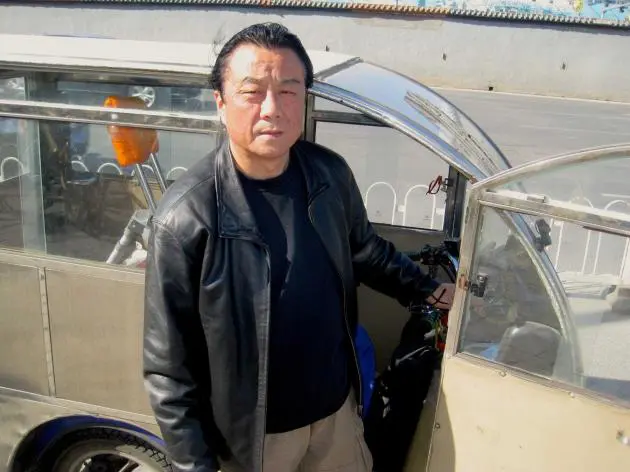
Artist Ai Weiwei’s accounts of his torture by Chinese police during 81 days of extra judicial detention stirred vivid memories for fellow Chinese dissident Qi Zhiyong.
“I cried when I read Ai Weiwei’s story because I’ve also suffered the same thing,” says Qi in his first interview about his ordeal.
Ai, who was released on bail pending tax charges in June 2011, re-enacted his detention in a recent music video and an installation in Venice.
Police seized Qi, 57, a few months before Ai, in November 2010.
“They said, ‘Qi, we are taking you away today because we know everything about you: your hometown, all your relatives, where your wife works, how she goes to work, how many bus stops she needs to take, how long it will take,’” he says.
The police told Qi they had an unspecified reason to arrest him.
“So I asked, what crime did I commit? They said, ‘You think you are totally clean? We took the order from higher levels’.”
Qi believes his detention was linked to the award of the 2010Nobel Peace Prize to jailed writer Liu Xiaobo.
In a statement issued by his wife, Liu dedicated his prize to Qi and other victims of the ruling Communist Party’s military crackdown on democracy protesters on June 3-4, 1989.
“They were angry because Liu Xiaobo won the prize,” Qi says of his captors.
As the police pushed Qi out of his Beijing home, they took away his crutches, which he has used since his left leg was amputated after he was shot near Beijing’s Tiananmen Square in 1989.
“Then they put a black hood on (my head) before I could react, and my arms were held behind my back,” Qi says. “I remember I was taken away in a black jeep, a Land Rover or something, a luxury car.”
When the hood was removed, Qi found himself in a brightly lit room of less than 15 square metres.
He still has no idea of the location of that room or two others he was moved to over the following six weeks. The officers who guarded or interrogated him did not identify themselves.
“They said they had informed my local police station and got the legal documents, but they refused to show me the documents,” he says.
During his first interrogation, Qi asked if he could smoke, which prompted a uniformed paramilitary officer to search him and confiscate his cigarettes, belt, shoelaces, wristwatch and other belongings.
“You are a cripple, an idiot. You want to smoke? We took everything away!” Qi quotes the officer in charge as saying.
Like Ai, Qi was guarded round the clock by paramilitary officers. He was forced to sleep on a mat on the floor with the lights on, and ordered to keep his arms visible to the guards.
He was branded a “counter-revolutionary” and accused of trying to overthrow the party and socialism”. “We could bury you alive at once if we get an order from the higher leaders,” Qi quotes one interrogator as saying.
“You should remember, the party has all kinds of measures if you want to fight with the party,” he was told.
The interrogators urged Qi to write a summary of his experiences and the injustices he believed he had suffered since 1989.
“But after I wrote it, they said ‘You accused the party!’ and just tore it up,” Qi says. After six weeks of repeated interrogations, sleep deprivation and constant surveillance, Qi was released to resume his life as a dissident under police monitoring and periods of house arrest in Beijing.
His latest house arrest began on May 26, Qi says in an email.
Police nationwide detained, warned, held under house arrest or “vacationed” dozens of other activists and dissidents nationwide in the run-up to the 24th anniversary of the 1989 crackdown, which was marked on Tuesday.
“I have no freedom,” Qi writes. “The party’s State Security polices et a deadline of June 1 (for me) to leave Beijing.”
Qi was among 123 signatories of an open letter issued ahead of the anniversary by the Tiananmen Mothers, an informal group of dozens of parents and supporters of the victims.
The group said it was disappointed that its 15 years of campaigning for an inquiry into the 1989 crackdown had received no response from the party.
Under President Xi Jinping, who has led the party since November, the party has even taken “giant steps backwards towards Maoist orthodoxy,” it said.
The group said it had confirmed the deaths of 202 people in Beijing in 1989, but it said the total was probably closer to 3,000.
Qi was again “moved to tears” while reading the Tiananmen Mothers’ latest statement.
“As long as I am alive and have the opportunity, I want to tell the people of the world the real process and the truth about the Tiananmen massacre,” he says
