
Caught in the shamen's web


Play
Though the intricate patterns of Mentawai tattoos are fast-disappearing from local skin, visitors are still eager to go under the needle
In the realm of body art, the Mentawai tattoo is recognised around the globe for its striking, intricate lacework of lines. But etched just as deeply as its reputation is the pain of those who go under the needle to adorn their skin with Indonesia’s age-old tribal art.
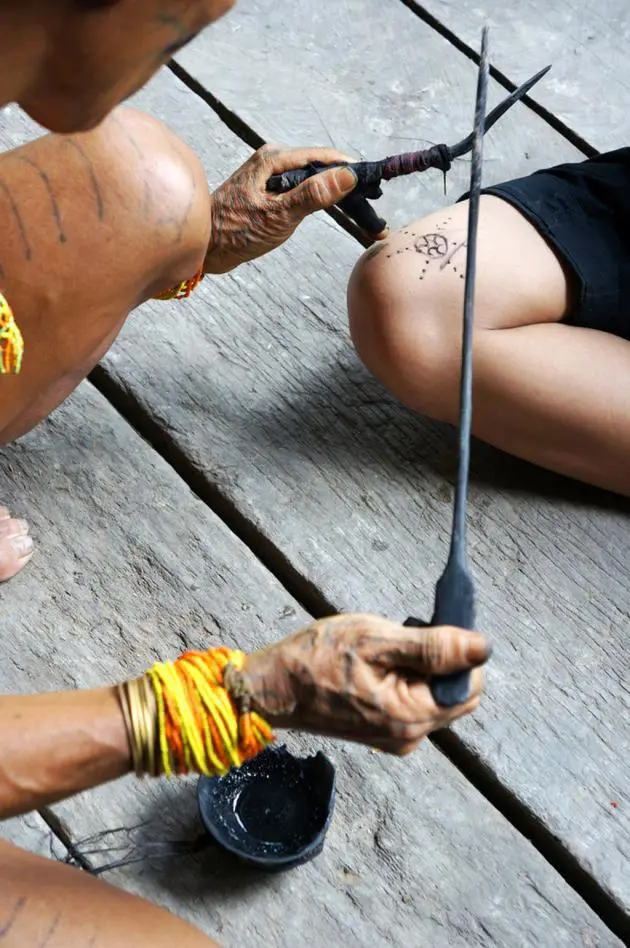
Using the sharp splintered rib of a palm leaf and natural ink made of sugarcane syrup and coconut-shell charcoal, a Mentawai tattoo artist, or sipatiti, meticulously draws a simple design on his client’s skin.
If satisfied with the result, he then carefully etches the design into the skin using a mabiau hammered down rapidly with a lili ’pat.
A mabiau is a pointed needle made of animal bone or sharpened wood attached to a wooden stick, while a lili ’pat is a long wooden stick.
“It hurts and bleeds and can take a long time to heal. But the sipatiti has a special herb from medicinal plants to stop the bleeding,” says local tour guide Rilus Saleleu Baja, 40, at Manai Koat Guesthouse in Mentawai Islands regency’s Siberut Island, West Sumatra. Rilus says that he endured the excruciating pain of a tattoo two years ago, even though it was not something that he had wanted to do.
“My clients wanted to take pictures of someone with tattoos but none of them wanted to do get a tattoo themselves. So in the end, I got the short stick,” he recalls.
Due to the pain of the process, his first Mentawai tattoo is still only half-finished.
Rilus’s reluctance to continue his tribe’s long-held tattooing tradition is shared by many Mentawai nowadays, especially the younger generation, who consider the art an outdated custom.
The fact that the tattoos are closely associated with Mentawai’s ancient animistic belief system of arat sabulungan, which the younger generations no longer practices, is also a major factor behind its waning popularity.
“According to arat sabulungan, the tattoo reflects one’s initiation into adulthood. It is their rite of passage,” says tattoo enthusiast and video maker Rahung Nasution.
Since 2009, Rahung has collaborated with Jakarta-based tattoo artist Aman Durga Sipatiti in a project called “Mentawai Tattoo Revival” which involves creating workshops and documentary videos in Siberut’s remote villages.
The project aims to help Mentawai people and sikerei (shamans) motivate the younger generation to keep the tradition alive.
“The first tattoo [A Mentawai native] has to make is an outrigger canoe on their back which represents a balanced life between the present and afterlife,” Rahung explains.
“The next tattoo is on their arms, with lines resembling a crocodile’s tail as respect to the water deity. There are also other important tattoos that resemble sago leaves, which is their staple food, and young fern, which is their sacred protection against evil spirits,” he adds.
Local administration representative Minarsih says that, in the old days, everyone in Mentawai had to have a tattoo, as it was seen as a person’s badge of belonging, much like an ID card is used nowadays in modern societies.
Indigenous people from Matotonan and Butui villages in Siberut, for example, have similar tattoos since they come from the same clan.
“There are five types of tattoos available, in accordance with the number of Mentawai clans. So when people from different clans meet, they can easily recognise where the other person comes from just by looking at their tattoos,” says Minarsih.
Other than as identity markings, Mentawai tattoos also tell the bearer’s life story. For example, there are tattos that signify a person is good at hunting animals, or that he works as a sikerei – or even that he has killed another person.
As body art, Mentawai tattooing is internationally regarded as unique thanks to its unique symbols and traditional technique.
“It offers an artistic romanticism that you don’t get from instant and modern [tattooing] techniques. Many people are interested in doing it simply to get the spiritual experience of traditional tattooing,” Rahung says.
