
Our (wo)man in Caibarien


Play
Cuban transsexual earns political post in country that had banned homosexuality
Jose Agustin Hernandez hardly looks like your standard Cuban communist official: he is short and adopts a mincing gait as he walks, and his hair is dyed a garish blonde that contrasts with his copper-coloured skin.
He wears high heels for special occasions and his neighbours affectionately call him “Adela”, even now that the 49-year-old has become a leading local-authority politician.
Hernandez is transsexual and has been, “for as long as I can remember,” he says proudly.
Since October 2012, Hernandez has also been a municipal councillor elected to represent his fellow residents in the small port of Caibarien in Villa Clara province in central Cuba.
Hernandez is the first openly gay man elected to public office in Cuba since the Cuban revolution in 1959.
Being elected made him instantly famous but despite his fame, Hernandez continues to live in a poor district with few mod-cons.
His home is a wooden shack, or “ranchito” (small barn) as the Cubans calls such a hut, measuring 10 square metres. It lacks running water and even a toilet.
But over the last few months Hernandez has received many visitors, including envoys from Mariela Castro, daughter of Cuban President Raul Castro. Mariela Castro played a major role in eliminating harsh anti-gay legislation in Cuba after her father became president.
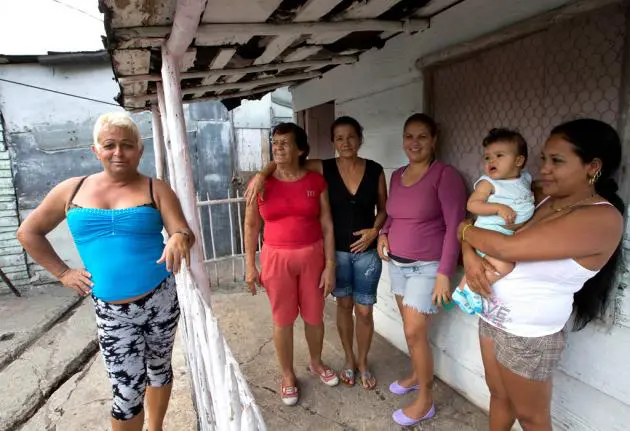
“He is family to us, says Hernandez’s neighbour Magaly Alvarez, 48. Hernandez, who earns a living as a nurse in a medical centre in Caibarien, has earned a reputation in the neighbourhood.
“He has always stepped forward to speak up. He has always helped us,” Alvarez says.
As a member of the Caibarien municipal council since last October, Hernandez has been able to bring street lighting to the neighbourhood where before there was none before.
“It was very, very dark here,” says another neighbour, Alexis Cepeda, 41, “He has solved many problems.”
Hernandez was nominated because there were no other willing candidates in the neighbourhood. “They had proposed a party member, but he did not want to accept,” Hernandez says.
The Cuban system works by municipal and parliamentary representatives being chosen by citizens themselves in district assemblies. But many Cubans do not want to be candidates.
Privately, most also doubt that the legislative bodies really have any kind of power compared to that wielded by President Raul Castro and his close circle.
For Adela to be chosen, his strong beliefs as a Communist were also significant. “I am a fervent homosexual and a fervent revolutionary,” he says. “All countries make mistakes and when the time comes to amend them and correct them, this is welcome,” he says.
“I am ready to serve my country and do what is needed.”
Authorities were initially sceptical about Hernandez and his victory in the second round of voting in municipal polls in October. But later they accepted the election.
Homosexuality continues to be a taboo issue in one of Latin America’s most macho and patriarchal societies. Stigmatised as “counterrevolutionaries”, many gays were sent to labour camps in the 1960s and 1970s.
Fidel Castro himself in 2010 apologised to homosexuals for the persecution they suffered at the hands of his government.
“If someone is to blame it is me,” he told Mexican newspaper La Jornada in an interview.
The current Cuban government has made efforts to dismantle discrimination on the grounds of sexual preference one of its main causes, with Mariela Castro, head of the National Centre for Sexual Education, leading the changes.
She continues to lobby for same-sex marriage to be established by law in Cuba.
Hernandez was invited to Havana in mid-May to take part in anti-homophobic events and a gay parade.
Despite the prominence he has achieved, Adela has other, bigger problems. His partner of 21 years was sent to prison recently, for the third time, for stealing livestock. Hernandez is his only visitor, since his partner “has nobody (except me)”.
Hernandez too has known a prison from the inside, as his father had him sent to jail as a youth because of his homosexuality, he says. “I came out worse!” he laughs.
Hernandez grew up amid extreme hardship. His father beat him until he bled when he was young. As soon as he was able to, Hernandez fled and went to live with an aunt. When he entered military service his companions made fun of him. He was finally allowed to train as a male nurse.
He hopes to soon be able to undergo a sex-change operation and treatment in Havana that would be paid for by the government so he can at last have the body that matches what his mind says he is: a woman.
For the time being, Hernandez has his political work to do and in his time off, he continues to perform in a transvestite show near Caibarien.
“I need to put on 12 pairs of tights to hold up my thighs and buttocks,” he says, laughing.
