
Coaxing grapes out of the Gobi


Play
A vineyard is greening Inner Mongolia's desert while producing high-quality wines
It looks like a mirage.
A five-story European-style chateau surrounded by verdant fields stands in the Gobi Desert.
This oasis is host to a 250-hectare vineyard guarded by poplar thickets. The Chateau Hansen produces more than 10,000 tonnes of wine a year from what was barren sand less than a decade ago.
“We’d been trying various methods, such as planting trees and bushes, to combat desertification for years,” the vineyard’s deputy director Li Aixin says.
“But these government-led initiatives didn’t embrace the market and didn’t gain traction. We can’t sacrifice our ecology for profits, but it’s equally unwise to ignore economic opportunities and solely rely on selfless dedication.”
Wuhai has an abundance of annual sunshine – up to 3,200 hours. Its latitude is similar to France’s Bordeaux and California’s Napa Valley. The vast temperature differences within the 24-hour cycle are conducive to the grapes’ sugar accumulation.
Migrants brought grape seeds, and local families often trellised their backyards and grew vines. Vineyards were common in the city.
But only 65 per cent of grapes survived past a year, because the soil is too alkaline – around pH 8 – and temperatures plummet to -30 C in winter. Grapes had to be replanted annually, while top-tier wines usually come from aged vines.
Technicians in Li’s team grafted French varieties, including Cabernet Sauvignon, Cabernet Franc and Merlot, on roots from local wild grapes to create hybrids.
They also grew breeds common to China for comparison. Though the new varieties grew slower in the first year, they struggled to survive and bloom. Others gradually withered.
Annual rainfall in the region is 100-200mm, but evaporation exceeds 3,000mm.
And the precipitation that soaks the ground seeps through the vineyard’s sand without nourishing the plants. An Israeli drip irrigation system was introduced, and the survival rate rocketed to 95 per cent.
“If you drop a grape seed in a southern province, it will easily grow into a vine,” Li says.
“But our varieties are much stronger against cold, disease and other ecological inhospitalities. It’s not good to always protect plants in greenhouses.”
Sandstorms pose the greatest threat to seedlings, say Li.
“No matter how we grow the plants, sandstorms can blast or bury, and kill them.”
Poplars became the first shield.
But the 10-metre-high trees only blunted the force of the sandblasts, and many seedlings still died.
In 2008, the vineyard piloted the method of growing grapes and alfalfa on the same ridge.
Alfalfa proved to be the fragile grapevines’ effective guardian. The herb typically lives five to seven years, providing grapevines time to grow strong enough to survive sandstorms. Alfalfa stalks are buried to enhance fertility.
“You must respect nature’s rules,” Li says.
“If you cheat soil, it cheats you back. Using scientific approaches to adapt can best reap nature’s rewards.”
Alfalfa’s rewards are the rich nitrogen it gives soil and the nutrition it offers sheep. Sheep have long been a staple of the area’s largely nomadic herding economy.
The vineyard produces 100 tonnes of alfalfa annually in addition to 500 tonnes of grapes. The alfalfa is sent to a sheep farm 100km away and returns as manure that fertilises organic grapes.
The vineyard is set to expand its claim on the desert, with a 13-hectare poplar and pagoda tree nursery.
This not only improves the local environment but also provides economic opportunities to migrants driven off their land by ecological hardships.
Chen Huizi, a native of Qingyang, Gansu province, struggled with unstable corn yields in her dry and marginally arable hometown.
She came to the vineyard in 2008 and trained to become a grape farmer.
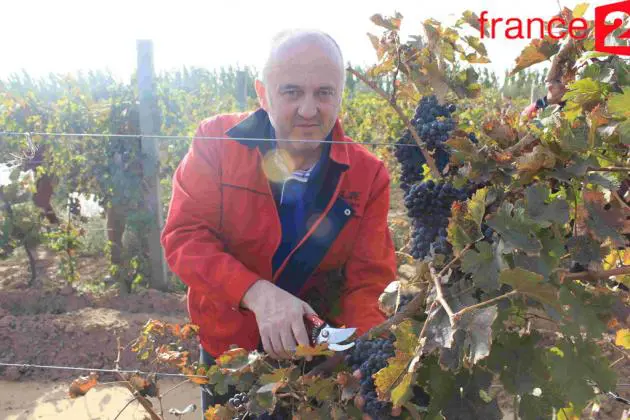
“We used to depend entirely on nature’s mercy,” she recalls while pruning a vine.
“A stable salary is a blessing.”
This small self-sustaining ecosystem has been replicated in three larger vineyards with similar habitats west of Wuhai, in neighbouring Ordos and in the Ningxia Hui autonomous region’s Wuzhong. The model now covers more than 6,600 hectares.
Inner Mongolia University biology professor and Hansen’s cultural director Xue Xiaoxian explains: “The word ‘chateau’ is usually misunderstood. People usually think of a castle with cellars. Instead, it’s an essential form of agriculture.”
Chateau’s Chinese translation – jiuzhuang – literally means “wine manor”.
“This is a carbon-reduction industry that’s one step ahead of the low-carbon model,” Xue says.
“Grapes are a long-term investment. We’ve just begun to see results.”
This progress encourages Chinese winemakers long frustrated with the country’s inability to produce internationally acclaimed wines.
“Chinese wine is neglected in overseas markets because its production bases lack unique characteristics,” says winemaker Kang Dengzhao, who’s also chief technical engineer of the winery in Hansen.
“Wineries often collect grapes from individual growers, making it difficult to stick to a single standard. Sometimes the more grapes are grown, the poorer the quality.
“But our desert grapes are distinctive.”
