
Beauty in all its forms


Play
Museum Siam looks at how women have been bent, folded and perforated over the ages
The extraordinary lengths to which women have gone in reshaping their bodies according to shifting perceptions of beauty are examined in a new exhibition at Museum Siam.
“The Body Project: Beauty, Brutality and the Reasons Behind” – continuing through September – includes what curator Pachat Tiptus calls a “believe-it-or-not” section featuring lip plates, neck rings and bound feet.
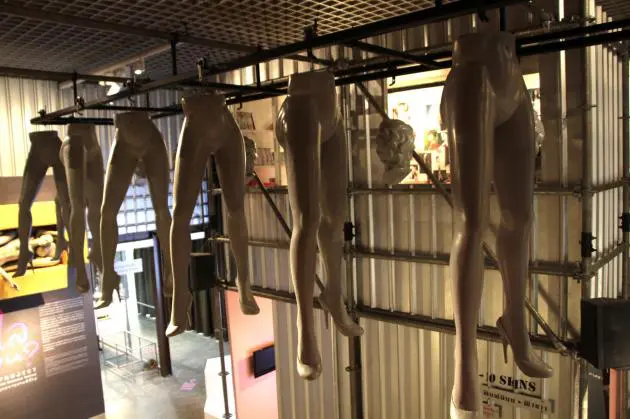
From the ceiling, though, hangs the body shape that remains the ideal for most women, not to mention ogling men. It’s a mannequin of Marilyn Monroe in all her 35-22-35 glory, the hourglass that seems to have stopped time in terms of trying to “improve” the female form, waif-like fashion models notwithstanding.
To achieve the wasp waist that Monroe somehow managed naturally, women have for centuries oozed themselves into corsets, of which several samples are on show. Laced up tightly enough to turn the wearer blue, they were the Western counterpoint to the tiny shoes in which Chinese women literally crushed their feet to the point that they could barely stand in order to appeal to men of good standing.
The Chinese practice of binding feet to miniaturise them is one of 10 “beauty standards” that Pachat has focused on. Others are the plates the size of teacup saucers that the women of Ethiopia’s Mursi tribe wear in their lips, the stack of rings with which the Golden Triangle’s Kayan women stretch their necks and – wait for it – the skin-whitening products that so entrance Thai ladies.
Of course it’s easy to understand that the Mursi women’s clay plates in their lower lips aren’t mutilation but a signal of maturity. The facsimile plates in the exhibition vary in size from three to eight inches and bear decorative patterns. A documentary film is screened showing Mursi girls having their lips pierced and stretched.
“Like the Siamese tradition of cutting a young boy’s topknot, when a Mursi girl reaches puberty, her lip is cut. The bleeding is a reminder that she’s reached reproductive age,” Pachat explains.
“The clay disc is also a way of teaching good manners and discipline – with a fragile plate in her lip, she can’t rush while doing her chores.”
The foot-binding that was common in posh Chinese households for centuries was abetted by bone-crushing shoes, of which an elaborately stitched pair is on display. They’re all of six inches long – which would have been considered monstrously big, though still acceptable.
“The size of a woman’s feet was associated with her ability to find a husband,” says Pachat. “The ideal size was as tiny as a lotus blossom, pointed at the toes and rounded at the heels.”
The six-inchers are C-grade, made to contain “steel lily feet”, whereas A-grade shoes, three inches long, produced “golden lily feet” and B-grade at four inches offered “silver lily feet”. The painful process of binding the feet is depicted in a scene from the movie “Snow Flower and the Secret Fan”. Little Lily is forced to walk in her bindings until the foot bones break, the easier to jam them into doll’s shoes.
Bones were occasionally broken when the women of Victorian England donned their rib-cracking steel-and-whalebone corsets, a holdover from medieval times that, with bustles below and fanned shoulders above, created an exaggerated hourglass that even Marilyn Monroe would giggle at.
The exhibition has a reproduction of a 16-inch-waist corset alongside a sort of peep viewer. Look through the tiny hole and you see holographic images of once-famous wasp-women actresses including Britain’s Lillie Langtry, the Belgian Camille Clifford and France’s Polaire, whose middle measured a mere 14 inches around.
From strangled torsos to stretched necks, the show moves on to Myanmar’s Kayan women, who change their brass coils every four years, increasing the length to lengthen their necks. You can see a memorable 1979 National Geographic photo of one such Kayan woman and an actual ring once worn by a woman in Mae Hong Son. You can even try it on.
At five kilograms, the brass invariably compresses the shoulders and gradually deforms and lowers the wearer’s collarbones. And yet the ethnic women consider it quite light, and certainly no bar to their demanding daily duties.
It’s one of the exhibition’s most appealing aspects, being able to “try things on”. You don’t want a Mursi clay plate in your lip, but you’re encouraged to position a large twig in your mouth, stretching the lip out, just to get a sense of how you’d look.
Sampling tiny feet is painless – you simply place your foot over a tiny footprint – but they have an 18-inch corset that might shatter your belief that you’re fit. And there’s a pair of five-inch stiletto heels that men are prodded to try to see how long they can remain upright.
Beauty ideals continue to shift, from Hollywood-starlet curves to fashion-runway sticks, but Thais have lately begun paying less attention to Western trends and more to Korean fancies. Plastic surgery assures us of more V-shaped faces, more pointed chins and higher bridges on the nose. You can see all these in the Korean TV series and posters on view in a separate room. Those full Thai thighs might yet give way to chopstick legs thanks to liposuction.
As if to help you make a decision, the final exhibit is dimly lit with a mirror in front of which you’re invited to stand. Phrases are projected onto your body, such as “Born this beautiful” and “Imperfectly beautiful – is that such a crime?”
Pachat is clearly trying to make the point that what we have is good enough. “Look beyond the surface of light skin, large breasts and skinny body,” he suggests. “We are each beautiful in our own way, as they are in theirs. Explore yourself, and you will find that you are indeed beautiful like no other.”
Shape shifters
<< “The Body Project” continues until September 23.
<< Museum Siam is on Sanam Chai Road and open daily except Monday from 10am to 6pm.
<< Learn more at (02) 225 2777, extension 411, or www.MuseumSiam.org.
