
Giants and looping rhythms light up Singapore’s Esplanade
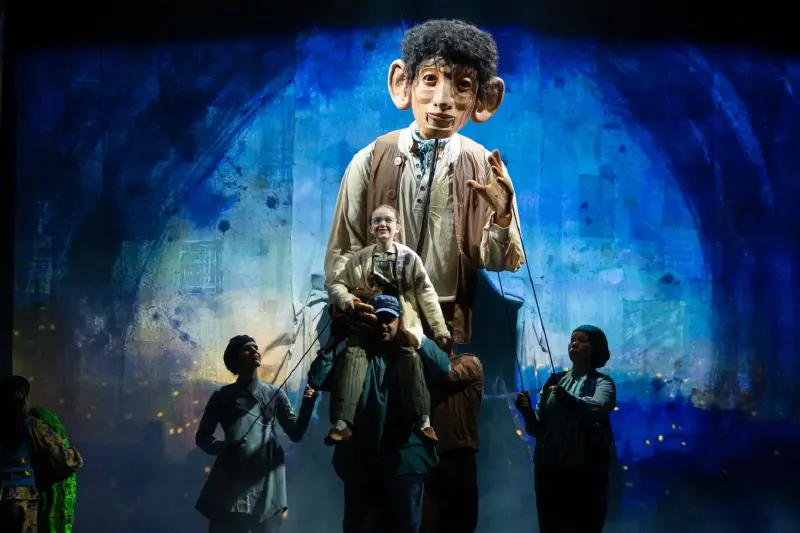


The BFG and Fase bring puppetry, dance and theatrical simplicity to Singapore’s Esplanade, showing why classics still resonate
“The Durian” ripens with giants, dreams and looping rhythms
The Royal Shakespeare Company (RSC) and Chichester Festival Theatre’s stage adaptation of Roald Dahl’s much‑loved 1982 novel “The BFG” opened in Stratford‑upon‑Avon last December and played earlier this month in Chichester. Thanks to the combined vision of Esplanade–Theatres on the Bay and Singapore Repertory Theatre (SRT), the city‑state becomes the first international stop for this Big Friendly Giant. It is delightful news for theatre lovers—and children—in the region, many of whom have already embraced RSC’s musical adaptations of “Matilda” and “My Neighbour Totoro.”

To conjure a magical dream world that travels from an orphanage to Giant Country and on to Buckingham Palace, populated by characters of vastly different sizes, director Daniel Evans and puppet designer Toby Olié deploy four distinct scales of puppetry across various scenes. In Giant Country, for instance, the kidnapped orphan Sophie appears as a half‑human‑sized puppet when she shares the stage with the BFG—an ogre smaller than his peers, bullied by them and notably the only one who does not eat humans—portrayed by a live actor. The BFG speaks in his natural voice, while Sophie’s lines are delivered through a speaker embedded within the puppet itself. When the human‑sized BFG finds himself opposite the Bloodbottler, the latter is rendered so enormous that only his head, upper body and arms are visible, manipulated by three puppeteers. It is an ingenious theatrical solution, though at the Wednesday preview the sound balance was occasionally uneven. That said, the ensemble of actors and puppeteers deserves full credit for switching fluently between roles and techniques with energy and precision.

Originally designed for a thrust stage that places the action closer to the audience, the production adapts thoughtfully to the Esplanade Theatre’s proscenium configuration. An extended apron and angled front rows, marketed as the “Giant Country Experience” and priced at nearly double the next ticket category, help restore a sense of intimacy. This quasi‑thrust arrangement enhances audience engagement and highlights just how assured these performances are, particularly when the actors rely solely on the human voice.
Scriptwriter and dramaturg Tom Wells, together with Jenny Worton, add the character of Kimberley, Sophie’s friend from the orphanage. This addition sharpens the work’s social conscience, reminding us that “The BFG” is not merely a whimsical adventure but also a story about marginalisation and compassion. In an era when xenophobia is openly promoted in parts of the world, the play gently suggests that recognising difference is not enough—we must also be willing to embrace it.
Although “The BFG” is not a musical as many audiences expected, the presence of seven musicians in the orchestra pit—providing underscoring, textures and sound effects—adds a rich layer of theatrical licence and atmosphere.

After attending the Wednesday preview, surrounded by delighted children and visibly satisfied parents, I found myself booking an appointment for Botox. I simply could not stop smiling—and the wrinkles were beginning to show.
Running concurrently at the Singtel Waterfront Theatre at “The Durian”—the affectionate nickname Singaporeans have given their national performing arts centre—is Belgian choreographer Anne Teresa De Keersmaeker’s seminal work “Fase, Four Movements to the Music of Steve Reich,” coincidentally also from 1982. The piece is presented as part of the inaugural edition of Esplanade’s da:ns focus series, titled “On Loop.”
Set against a white backdrop on a bare stage, two dancers perform four sections: the duet “Piano Phase”, the duet “Come Out”, the solo “Violin Phase,” and the duet “Clapping Music” —all named after American pioneer of minimal music Steve Reich’s compositions from the 1960s and 1970s. Performed with striking energy and vitality, the dancers’ musicality is so precise it feels as though the music were composed specifically for De Keersmaeker’s choreography.

Built on repetition, variation, and angular movement, with intricate shifts in speed and rhythm, “Fase” demands extraordinary concentration and precision. Rosas company dancers namely Japanese dancer Yuika Hashimoto and French dancer Laura Bachman rise fully to the challenge, never faltering. In a work that asks the audience to focus closely—to observe how difference emerges from similarity—lighting designer Rémon Fromont plays a crucial role, articulating space and punctuating the choreography with remarkable clarity.

Some audience members may wonder why the Esplanade, long known for co‑commissioning new international works, is presenting this 2018 revival of such a widely referenced piece. Seventy minutes later, the answer becomes clear: this performance affirms that classics never die, that contemporary classics continue to resonate, and that in the performing arts, simplicity can be profoundly effective.

“The BFG” runs until May 9 at the Esplanade Theatre. Tickets start from SGD 48 (THB 1,218). More details: https://www.rsc.org.uk/the-bfg. To watch a trailer, https://youtu.be/Mc4hPXTh-tk
The final performance of “Fase, Four Movements to the Music of Steve Reich” at the Singtel Waterfront Theatre, Esplanade, is on Saturday, April 25. More details: https://www.rosas.be/en/news/687-flipping-the-hourglas. Three-minute trailer is at:
https://youtu.be/qwtGIBS7m6c?si=nAeHmbKFvYZdKFM4.
The “da:ns focus” series continues with “Ballet by the Bay”—featuring dancers from The Royal Ballet—in June, and turns toward Asian contemporary dance with “CAN – Connect Asia Now” in October. Details: www.esplanade.com/dans To book tickets, www.sistic.com.sg
Special thanks to Gina Koh of Esplanade–Theatres on the Bay for her assistance.
“The BFG” photo credit: Marc Brenner
“Fase Four Movements to the Music of Steve Reich” photo credit: AlvieAlive
