
Blowing in the wind


Play
KU Wind Symphony is in the Netherlands to go up against the best ensembles in a major international music competition
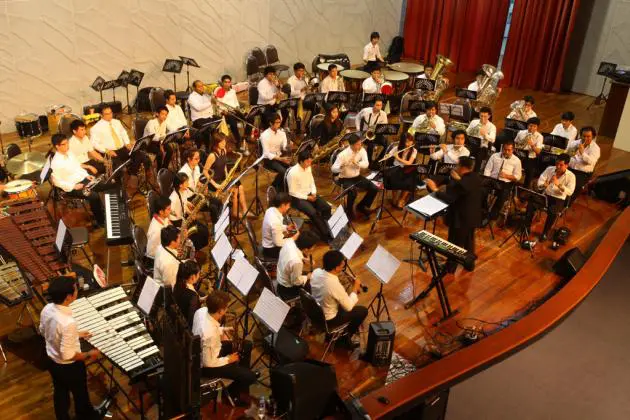
In a country better known for its student marching bands than classical orchestras, it may come as something of a surprise to learn that a symphony ensemble from a local university has made the grade for an international level music competition. The orchestra in question is the Kasetsart University Wind Symphony and they are currently in Kerkrade, a small town in the southeast of the Netherlands on the German border, preparing for their participation tomorrow in the World Music Contest.
“We’re in the highest category of Harmony and Fanfare,” says SurapolThanyawibool, director and conductor of KU Wind Symphony and the Nontri Orchestra Wind. “We applied for the first division because we wanted to go up against foreign orchestras who are made up of professional musicians. Many of the alumni and current members of Nontri are former members of KU Wind and now work as professional musicians and teachers.”
The World Music Contest is the most renowned festival for wind music in the world and focuses mainly on organising contests, concerts, courses and workshops for amateur ensembles and music bands. Every four years, the WMC welcomes participants from all corners of the globe as they arrive in Kerkrade, Netherlands to compete. According to its official website, about 750,000 visitors and music lovers will be attending this year’s event, which boasts 19,000 contestants from over 30 countries, making it one of the largest competitions in Europe.
Surapol says he decided to enter his orchestras for the contest on the advice of a member of Singapore’s Philharmonic Winds who had watched and enjoyed a performance of the KU Wind Symphony.
The KU orchestra, which was formed 16 years ago, currently boasts 63 members, among them some professional musicians and alumni of Nontri Orchestra Wind. In 2010, the KU Wind Symphony was awarded first prize at Thailand International Wind Ensemble Competition held at the College of Music, Mahidol University.
“Up to now, we haven’t been bold enough to perform on the world stage because we’ve lacked both the preparation and a budget. Even this year, we have a budget of just Bt5 million, which isn’t really enough to cover all our expenses,” Surapol says.
The Thai contingent will be up against orchestras from several countries including Hong Kong, South Korea and China but Surapol is not too worried about the competition except from the ensembles from the host country and Belgium, who he describes as “very proficient”.
For tomorrow’s competition, the Kasetsart University Wind Symphony will perform the compulsory music piece, Johan de Meij’s “Extreme Beethoven” and one free piece, James Barnes’ “The Third Symphony.”
“Extreme Beethoven really tests the abilities of each player,” says Surapol. “It starts with a well-known classical theme presented in its original form and then subtle and surprising shifts start to creep in. It’s like a medley of Beethoven’s classical pieces lasting 18.17 minutes that includes ‘Symphony No 9’, ‘Symphony No 5’, ‘Symphony No 7’, ‘The Emperor Concerto’ and ‘The Moonlight Sonata’.
“We have never played this piece before, so we have to interpret it in de Meiji’s spirit with two bands performing on top of each other and playing different rhythms. Our group of 63 musicians will build the sound so it starts very far away and gradually comes closer. De Meiji originally used 104 musicians to play this piece. We’ll be trying to interpret it in a similar way.”
“Barne’s Third Symphony is one of his greatest works yet. Composed in 1994, it was dedicated to his baby daughter Natalie, who died in infancy. The whole piece is the story of his emotional journey and progresses from the deepest darkness of despair all the way to the brightness of fulfilment and joy.
“The first movement is a work of much frustration, bitterness, despair, and despondency. The scherzo (second movement) has a sarcastic and bitter sweetness about it. The third movement is a fantasia where he imagines being with his daughter. The finale (fourth movement) represents a rebirth of spirit. Three days after completing this composition, his son Billy was born. If the third movement is for Natalie, then the finale is for Billy.
“It is one of the hardest pieces to perform but the melody is beautiful and emotional, especially the third movement, which features a dual performance by two music instruments, the cor anglais and oboe, representing a musical dialogue between the composer and his daughter. The fourth movement reflects the power of God in giving him a new child. As we have only 20 minutes allotted for our performance, we will be playing only the third and fourth movements,” Surapol concludes.
Sweet music
_ For more about the competition, visit www.WMC.nl.
