
Mahler, massive and majestic


Play
Somtow Sucharitkul dares to push the symphony to the limit before a sell-out crowd
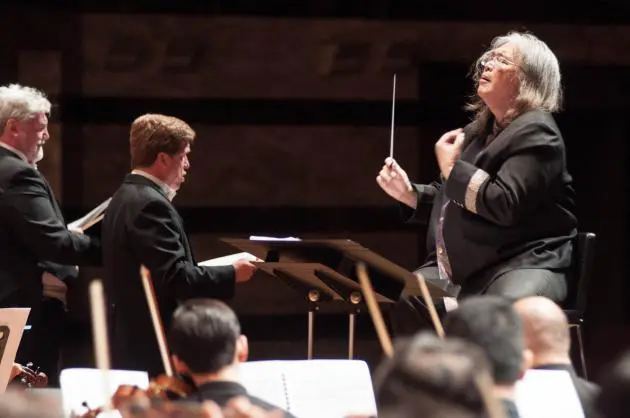
It is strange to think of last week’s Thai premiere of Mahler’s Eighth Symphony as “small” – it included members of four orchestras and eight choirs from four continents and soloists from seven countries. But, in an absolute sense, it was.
More than 1,000 performers were involved when the symphony debuted in 1908. Last Wednesday in Bangkok I counted around 500, but there wasn’t a centimetre of spare space left on the stage of the Thailand Cultural Centre. No more could have been squeezed in.
Mahler’s Eighth belongs in the “legendary” category. Though it’s not the most musically crowded symphony ever written – that would be Havergal Brian’s “Gothic” – it is certainly the biggest in the standard repertoire. It’s scored for a 150-piece orchestra, two massive choirs, a children’s choir, eight soloists, four keyboards and an offstage brass band. It sets to music two of the most important texts in Western civilisation: the hymn “Veni Creator Spiritus” and the closing scene of Goethe’s “Faust”.
The Cultural Centre was packed. In fact people had to be moved out of the first balcony. That was reserved for the brass band to join in for the last few minutes of each movement and for the third soprano soloists – the “voices from heaven”. The ticket holders had to be hurriedly re-seated in the second balcony before the symphony could begin.
And the performance was packed too – with the kind of punch that many more-experienced orchestras would be hard-pressed to deliver.
I had attended the dress rehearsal the day previous, so I knew this would be an accomplished production, especially given how idiomatic and sensitive conductor Somtow Sucharitkul is when it comes to Mahler. French conductor Frederic Chaslin once called Somtow “one of the few non-Jews who understands Mahler”.
I also knew the orchestra was able to rise to the occasion and that the “small” choir (around 300 voices) could conjure up sufficient wallop for the huge climaxes.
However, Wednesday’s performance was totally unlike the dress rehearsal. Somtow took many more risks – some of which did not work – but the level of excitement was hair-raising. Tempi, rubati and contrasts were pushed to Bernstein-like extremes, and occasionally the performance split at the seams. But mostly it held together with an architectural cohesion that made the final epiphany of redemption completely believable.
The dress rehearsal proved that this team could play the right notes. The performance had more wrong ones, but passion carried the day.
The eight soloists represented a who’s who of Bangkok Opera favourites from the last 10 years, beginning with the ever-popular Nancy Yuen, Thailand’s young discovery Nadlada Thamtanakom, and bass Gittinant Chinsamran. Jeffrey Springer’s Doctor Marianus was glorious in tone but frequently a bar ahead of the conductor. Grace Echauri was a rich-voiced first mezzo, and Emanuela Barazia a subtle second. Phillip Joll, a noted Wotan, was perhaps the only one of the soloists who was totally in command. A youthful Yin Yue made a delicate debut as the voice of “Mater Gloriosa”.
Jean-Pierre Kirkpatrick, a Mahler expert and member of the International Mahler Society, posted on Facebook afterward: “The performance was astounding – I have seen this symphony in several halls in Europe and heard many, many recordings. What I witnessed [in Bangkok] was a superb performance that was made so by the dedication and earnestness of the performers.
“Here were performers and players of a high standard locked into one of Mahler’s most difficult pieces – and it came across as full of energy, power and with a freshness and certainty that made it for me a very memorable occasion. Often orchestras and choruses get too overzealous about perfection and style, whereas this performance lacked neither. It was that essence that stems from youth’s innocence that made this performance so enticing and unforgettable. I loved it – every moment of it – and it is still ringing in my ears and through my brain 24 hours later.”
Somtow’s grand plan to play all 10 of the Mahler symphonies in Bangkok has now almost reached its end. Only No 2, “The Resurrection”, remains. I asked the maestro when we might expect to hear it.
“Since it’s about ‘The Resurrection’,” he said, “I think the right time would be the birthday of Her Royal Highness the late Princess Galyani Vadhana, to whom I once promised that, one day, Thai orchestras would be able to play all the Mahler symphonies.”
