
French art censorship evokes howls


Depictions of the Middle East conflict start a war of their own
An exhibition of 68 photographs of Palestinian suicide bombers is eliciting outrage in Paris, with critics accusing the organisers of “glorifying terrorism”.
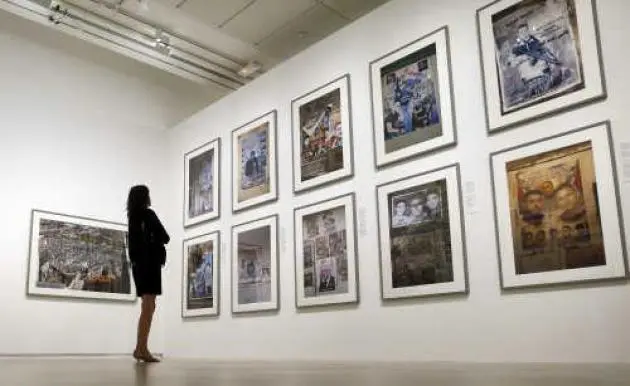
The retrospective “Phantom House” by Palestinian photographer Ahlam Shibli opened on May 28 at the state-subsidised Jeude Paume contemporary-art museum. It continues through September 1.
Of its six exhibits grouped by theme, “Death” has proven the most contentious, triggering protests, a death threat against the museum’s director, and a bomb threat that partially closed the building.
It’s the latest art controversy to roil France, with the disputes frequently centred on depictions of the Arab world. “Death” has photographs of posters and portraits of Palestinian suicide bombers that hang in public and private spaces in the West Bank and in four refugee camps.
Shibli says she wanted to show how the dead fighters continue to live on in people’s memories.
The Council of Jewish Institutions in France sent a letter to Culture Minister Aurelie Filippetti accusing the museum of “glorifying terrorism” with the photos. Above all, the council criticised the accompanying captions in which Shibli calls the suicide bombers “martyrs”.
The series had been shown at other museums, most recently in Barcelona, but it has only stirred protests in Paris. In June the France-Israel Association staged a demonstration outside the museum to demand the exhibition be closed.
Amid the row, the photographer hung a plaque at the entrance to the exhibit saying her colour and black-and-white pictures were neither propaganda nor a glorification of terrorism. “I’m no activist. My work consists of showing how not to condemn,” it reads.
A few months earlier the Jeu de Paume had become a cause celebre when Facebook took down its page over a black-and-white photo of a partially nude woman lying down to promote an exhibition. “Censorship is back again”, was a typical headline in the French press about the March incident.
The museum said its Facebook page was blocked for 24 hours. Afterwards, the photo dating from the 1940s reappeared – but with a black bar superimposed to cover the woman’s breasts. “Not being able to differentiate between a work of art and a picture of pornographic character is not only a dubious, but also dangerous mixture,” the museum said in a statement.
Late last year the Paris Institute of the Arab World (IMA) withdrew a video installation by Moroccan artist Mounir Fatmi. The video showed British-Indian writer Salman Rushdie sleeping, with a clock ticking in the background.
Fatmi was protesting the silence of Arab intellectuals after the fatwa and bounty placed on Rushdie by Iranian revolutionary leader Ayatollah Khomeini in 1989. Fatmi said the climate following the anti-Islamic film “Innocence of Muslims” was the reason for the IMA’s act of self-censorship.
A week before that incident, Fatmi had to remove his installation “Technologica” from the cultural festival Le Printemps de Septembre in the southern French city of Toulouse due to pressure from the Muslim community.
Owing to a technical glitch, the installation did not project verses of the Koran onto a building facade but on the ground instead. A female passer-by then inadvertently walked over the spot.
“What worries me most is that this is happening in France – not in the Maghreb or Saudi Arabia,” Fatmi said.
