
Stirring ode to Bagan still inspires


You'll hear "Mahar" ("The Grandeur") at the opening of the SEA Games in Myanmar in December
When a composer writes a song from the depths of his heart, the result can be a classic that lasts for years. That’s what happened to Mya Than San when he wrote “Mahar” (“The Grandeur”). The song, composed in 1994, is still adored by the public and has been selected for the opening ceremony programme of the 27th SEA Games opening on December 2 in Naypyidaw.
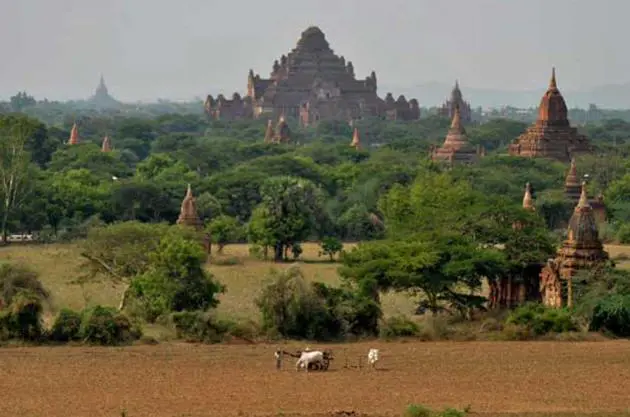
“Mahar” is a stirring ode to the greatness of Bagan and the First Myanmar Empire, founded by King Anawrahta during the 11th century. Also known as the Bagan Empire, it was one of the largest in Southeast Asia.
The composer says he felt something in the breeze one day in 1994 as he made his way through Bagan to film a documentary. With the raindrops falling and the aroma of burnt earth rising in the air, he stepped out of his car and began writing lyrics. At that moment, he recalls, he wasn’t planning on composing a song.
“I just wanted to write something, so I wrote it,” says Mya Than San. “The words came to me spontaneously, without my even thinking about it. First it looked like it might be a poem. I just felt the nature all around me, collected my thoughts, and combined it with my art. Then it became the lyric.”
The ancient scenery of Bagan, with its cracked bricks and towering pillars, provided the inspiration for “The Grandeur”. The song is a patriotic celebration of intact traditional artistry and workmanship, and of a city that captures the dignity and noble history of the First Myanmar Empire.
Anawrahta, in establishing the Bagan Empire, introduced many social, cultural and religious reforms during a reign that lasted 34 years. He’s been credited with bringing Theravada Buddhism to the country, thanks to the guidance of the venerable monk Shin Ahrahan, who came from the Thaton kingdom in what is now lower Myanmar.
Before Anawrahta’s time, Bagan people predominantly embraced the philosophy of Ari – a combination of spiritual worship called nat culture, along with Buddhism and Hinduism. The king’s reforms would have a lasting impact on the culture, as Mya Than’s lyrics reveal:
“The great Buddha’s sasana ray glowing lustrously … The most venerable Shin Ahrahan illuminated the light of sasana …”
But the song is more than just a tribute to King Anawrahta. It also celebrates the Bagan monarchy from the 11th through the 13th centuries, covering five dynasties:
“This is heritage for us all, bestowed over many centuries, one after the other.”
As the song progresses, the listener can imagine the lance marks and sword cuts of Myanmar’s historic heroes, legends of a bygone era the song refers to as “Myanmar’s national might”.
Of course, the success of “The Grandeur”’ is about more than the composer and his lyrics.
In creating a national classic, the original singer played a key role. Zaw Win Htut is a rocker. Applying his signature dramatic style and soaring vocals to the studio recording, Zaw Win gave the song an anthemic quality that has inspired generations of listeners with its nationalist spirit. The song’s success led both composer and vocalist to team up again for versions 2, 3, 4 and 5 of “The Grandeur”.
“At the time I’d been a famous rock singer for 10 years,” Zaw Win says in the official video for “The Grandeur”. “So I sang this song to express my gratitude, not only to the public who listen to my music but also to my country.”
Recently the Ministry of Culture chose “The Grandeur” as one of the opening songs for the upcoming SEA Games being held there. Zaw Win says the ministry wants to start the event with the kind of music that captures the national spirit.
“The Grandeur” certainly fits the bill. As it says, “This land is our heart and soul. Bagan is for us all!”
The music video with Zaw Win is online at http://youtu.be/K9prhYwt2J4.
