
Panda in the luggage hold


Play
Lin Ping is off to China for a year to find a boyfriend, but her travel arrangements have stirred controversy
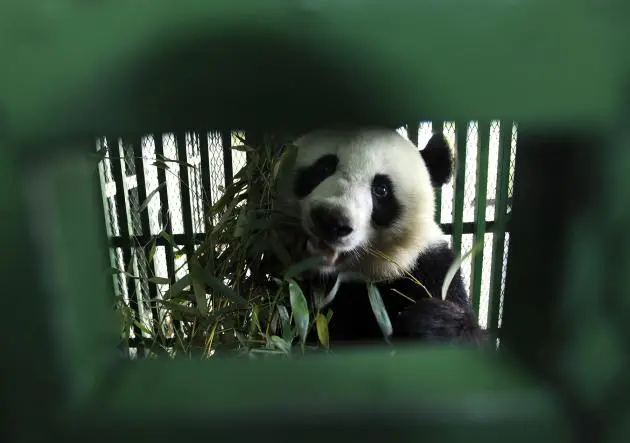
Lin Ping - the panda born in Thailand who won superstar status with her own TV channel and sent Chiang Mai Zoo admission numbers sky-high – is going “home” to China for a while to find a mate. Dampening what should be a fond farewell-for-now, though, acrimony has arisen over the means of her transport to a land she’s never known.
Pandas are famously cute, and arranging the loan of two of them from China was a coup for Thailand. They instantly became a new tourist attraction and, with the birth of Lin Ping on May 27, 2009, the country went crazy. The cub was constantly in the news, fan clubs sprang up, and the Zoological Park Organisation of Thailand was hard-pressed to keep up with the demands that the excitement generated.
Now the organisation is under siege again as fans protest its plan to freight Lin Ping to China a week from Saturday in the cargo hold of a Thai Airways passenger jet. Surely there’s a better way to transport an animal that’s so sensitive to noise and smells, they say, and surely Lin Ping deserves better treatment.
The zoo agency has chartered a flight for 300 human passengers – zoo staff, politicians and other invited guests – that will cost Bt5.5 million, plus Bt4.5 million for “operating expenses”. Lin Ping’s cage will be stowed beneath the passenger cabin and she’ll be alone during take-off and landing. She’s currently being familiarised with the cage and the sort of noise that’s common on aircraft.
In a fury on the social media, fans have demanded that the organisation instead transport Lin Ping via the free FedEx Panda Express, which uses a cage that was specially designed for giant pandas. They even contacted the Bangkok FedEx office and claimed it could be ready in two weeks.
She could also ride instead on a THAI cargo plane so that her handlers could be at her side for the entire two-and-a-half-hour flight, the fans noted.
But Dr Boripat Siriaroonrat, the agency’s assistant director and the veterinarian responsible for Lin Ping’s birth by artificial insemination, says FedEx told the organisation it needed months to prepare. And a cargo plane would be significantly more expensive because it often carries chemicals and would have to be thoroughly decontaminated.
Many factors, Boripat says, combine to make the passenger-jet storage compartment the best option, and the agency’s technicians and veterinarians are working closely with THAI to ensure complete safety. Lin Ping will be under constant observation via closed-circuit television. Procedures will be in place in the event of an emergency landing.
“Any animal’s safety comes first, and THAI and the ZPO are experienced in transporting wild animals,” he says.
Lin Ping’s devotees are not appeased, however, and the grumbling continues online. Zookeeper Suchart Sansomparn, who’s taken care of her since she was a toddler (or a waddler, at least), and will be accompanying her to China, is perhaps not surprised.
“Unlike her parents, Chuang Chuang and Lin Hui, which came to Thailand when they were young, Ling Ping was born here and it was something new that Thai people had never seen before,” he says.
“She was born at a time when the country felt hopeless and divided by the yellow-shirt-red-shirt war. She was the good news that made everyone happy.”
Dr Boripat remembers those first heady months well. “The Ling Ping phenomenon was more or less just as influential as the craze for the Jatukam Ramathep
amulet that happened just before she was born,” he says. “Pandas have a special charisma and character that people fall in love with easily. Even the World Wildlife Fund uses one as its symbol.”
Boripat credits Lin Ping with gaining his agency international recognition, given the difficulty of breeding pandas in captivity. The zoo succeeded despite the usual obstacles – the female oestrus lasting just two or three days a year and the general male apathy about sex.
Lin Ping’s popularity also made Thais more interested in endangered species, a boon to the zoo agency’s efforts to breed Red-shanked douc and Sarus cranes.
True Visions TV enjoyed a windfall of its own with its 24-hour panda channel, where viewers could watch Lin Ping lolling with her mother and interacting with her keepers. The baby’s blanket coverage seemed like overkill to cynics, but millions of people tuned in and thousands spent hours each day watching the most humdrum activities – even the cub simply sleeping. She was a chubby human infant in a black-and-white jumpsuit. “Watching the mother and child was the most beautiful experience,” Boripat acknowledges.
Lin Ping received hundreds of toys from admirers, contests were organised offering chances to get a picture taken with her, and every keeper became almost as much of a celebrity as she was. There was occasional crass commercialism, as when Lin Ping was dressed up as Santa Claus and in a qipao gown for Chinese New Year. Critics decried the objectifying of a wild animal. And she was invariably frightened by the clamour of her monthly birthday parties. Somewhat more amusing was her role as a football oracle during the World Cup and Euro Cup.
The fans complaining about Lin Ping’s travel arrangements are also lamenting the fact that she was, from a young age, kept apart from her mother during the daytime. This was due to safety concerns, since the parents’ compound is steeply sided, but many recall hearing Ling Ping’s plaintive bleats for her mother on TV. Later they spent eight months apart while Lin Ping was weaned, and when they were finally reunited, Lin Hui no longer remembered her daughter and made threatening sounds to her.
Lin Ping was happily nonplussed, returning to her previous lively self, and grew strong and healthy, inheriting her father’s physical strength. Suchart, her long-time keeper, is nevertheless fretting about the flight to China 10 days hence.
“I’m worried about the take-off because pandas are so sensitive to noise and scents,” he says.
They’ll be flying to Chengdu on September 28 and Lin Ping will spend at least a year there, being introduced to potential mates – not at the Wo Long breeding centre where her parents originated but at the new Du Jiangyan base, which remains closed to the public. Once she’s found a mate she’ll return to Thailand for another 15 years, on the same kind of “rental” contract as her parents. Thailand will pay US$1 million a year for the privilege of hosting her and her new beau.
Meanwhile the 10-year arrangement for Chuang Chuang and Lin Hui expires next month, but they’ll stay here until Lin Ping comes back, and then return to their homeland.
There are those who say Lin Ping should remain in China, with its dedicated panda sanctuaries, rather than living in a closed (and air-conditioned) facility at the Chiang Mai Zoo. Suchart and Boripat agree, believing Lin Ping would be happier where the climate and enclosure area are better suited to pandas.
SAY SO LONG
The Chiang Mai Zoo is hosting farewell activities for Lin Ping from Saturday through September 27, with a traditional soo kwan ceremony on the final day to mark the start of a major journey.
