
Exuberance embodied
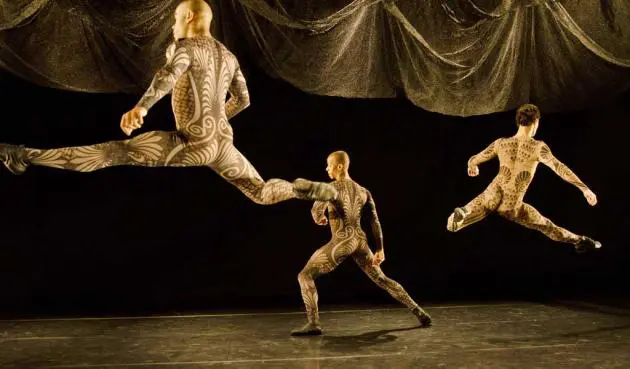


One of the world's best contemporary dance companies is on its way to Bangkok
My love affair with the Brazilian company Grupo Corpo started in October 2006 when the troupe staged a double bill at the first edition of Singapore’s “da:ns festival”.
Their performance of “Parabelo” (1997) and “Lecuona” (2004) impressed me so much that I starting using the DVD of the latter for discussion and examination in my criticism classes. The works not only showed the highly skilful dancers in a tightly knit ensemble but also the happy marriage between dance, music and visual arts as well as the innovative and seamless blend of Brazilian dance traditions and western modern dance styles.
Since then, I’ve been hoping that one day Grupo Corpo would be part of Bangkok’s International Festival of Dance and Music and thus was delighted last year when the Brazilian ambassador to Thailand whispered to me that my dream was about to come true.
True to its word, the embassy is bringing Grupo Corpo to the 15th edition of the festival. The troupe will also be performing at 2013 edition of the da:ns festival next month.
But don’t take my word about Grupo Corpo’s extraordinary talent. Here is what some dance critics have had to say about inarguably the most acclaimed contemporary dance company from South America.
Commenting on the company’s double bill at Sadler’s Wells two years ago, The Stage critic Neil Norman wrote, “Whether horizontal or vertical, the company display a boundless energy and sharp synchronicity that is utterly contagious. What’s not to love?”
His Evening Standard compatriot Sarah Frater concurred, “All the dancers combine the precision of ballet with the laid-back allure of all things Latin American. They are also lightning fast and eye-poppingly neat, added to which the women are unusually small even by the dance world’s micro standards, meaning the men can swing them around with daring and ease. And that’s not mentioning their stamina, which seems both endless and effortless.”
A year earlier at the Edinburgh International Festival, The Guardian critic Alice Bain wrote, “Grafting ballet on to myriad Latin disciplines—capoeira, rhumba, tango – it was a sizzling concoction”, and The Daily Telegraph’s Sarah Crompton confirmed, “Their combination of sharp precision and breezy relaxation is unlike anything I have ever seen.”
Across the Atlantic, Toronto Star critic Susan Walker said, “Grupo Corpo is nothing if not predictable. That quality may be the key to the Brazilian troupe’s unfailing popularity in Toronto.”
But my favourite quote comes from The Village Voice’s Eva Yaa Asantewaa who wrote, “Grupo Corpo’s women move with uncommon suppleness and don’t-give-a-damn sass,” she wrote.
We recently had a chat with Rodrigo Pederneiras, Grupo Corpo’s resident choreographer since 1978 who, along with brother Paulo, the artistic director, lighting designer and scenographer, runs the company.
“For Grupo Corpo, the ideal dancer has to have a strong and clean classical ballet technique as well as a good ear for music and be charismatic. The dancer’s movements have to seem like a constant wave, without any interruptions,” he tells XP.
“My choreographic style at the beginning was to create a spatial design, drawing imaginary lines from the entry and exit points of the dancers on the stage, testing my control over structures and movements. Classical ballet techniques are the basis of my work, but little by little, Brazilian movements were brought onto the stage. We started to use in the choreography small gestures we observe in our people – the way they walk, talk and laugh, All these become inspiration for movements.”
And then came a significant change. “The years went by, and we stopped worrying about the reinforcement of this ‘Brazilian identity’. However, I believe we’ve created a body language that’s deeply inspired by the Brazilian movements. That means our dance has a common root with our culture but is developed naturally and differently in each choreography.”
Pederneiras adds that his inspiration inevitably comes from the music. “Besides ‘Lecuona’, all the pieces we have created since 1992 have been inspired by the music exclusively composed for the company by outstanding and representative composers and musicians. Always guided by the music, I ‘break’ the classical movements in an intensely Brazilian way.
“In our works we don’t develop histories; rather, we try to evoke feelings and emotions throughout our dance. Our main goals are to touch, to move and captivate the audience.”
For this tour to Bangkok and Singapore, “Sem Mim” (2011) and “Onqoto” (2005) will be presented as a double-bill, and Pederneiras notes, “I believe they go very well together – one is about love and the other the man and the universe.”
“Sem Mim”, meaning “Without Me”, is inspired by the collection of seven songs in the “Sea of Vigo” cycle about “ladies crying to the sea, wailing that their lover was taken by the sea or singing with the hope that the sea would bring back their love. The sea is the main character, the one who brings or take happiness away.
“‘Onqoto’ is an existential question and it means ‘Where am I?’. It’s based on the human perplexity and inexorable pettiness in the face of the vastness of the universe. It was created to celebrate our 30th anniversary and it was a good question to ask ourselves at that time,” adds the choreographer whose family connection to Grupo Corpo doesn’t just stop with Paulo and himself. Four other family members are part of creative team and the photographer makes five.
And perhaps the last word should go to Brazilian dance professor Helena Katz. “With Grupo Corpo, all facets of Brazil, past and future, erudite and popular, foreign influence and local colour, and the urban and the suburban come to being as art. Brazilian art.”
So if you haven’t seen any performances at the Festival, make sure you don’t miss the one.
The writer wishes to thank the Embassy of Brazil’s Eduardo Cancado Oliveira for all assistance.
ABSOLUTE MUST-SEES
Grupo Corpo performs “Sem Mim” and “Onqoto” at the Thailand Cultural Centre at 7.30pm on Sunday. Tickets are from Bt700 to B 2,500 at www.ThaiTicketMajor.com. Visit “Bangkok’s International Festival of Dance and Music” page at Facebook.
The same double bill will be presented at the Esplanade—Theatres on the Bay’s annual “da:ns festival” on October 11 and 12. Tickets are from SGD 20 (Bt 500) to SGD 100 (Bt 2,500), at www.Sistic.com.sg. There are also a post-show talk and a masterclass. Check out “dansfestival” at Facebook.
Find out more about the company at www.GrupoCorpo.com.
The 15th Bangkok’s International Festival of Dance and Music has received generous support from Bangkok Bank, Bangkok Hospital, B. Grimm, Dusit Thani Bangkok, Indorama Venture, The Nation Group, Beiersdorf, SCG, Singha, Thai Airways International, Tourism Authority of Thailand and Toyota Motor Thailand.
