
With Rockefeller's help


The US-based foundation has been at Thailand's side for a century
In 1915 the American billionaire industrialist John D Rockefeller dispatched a representative of his Rockefeller Foundation to Siam. Dr Victor Heiser came to help eradicate hookworm disease (ankylostomiasis), using techniques that had already had tremendous success in the southern US and elsewhere.
A century later, the Rockefeller Foundation is working with the Thai government, non-governmental groups and private firms to prepare the country for the anticipated ravages caused by global warming.
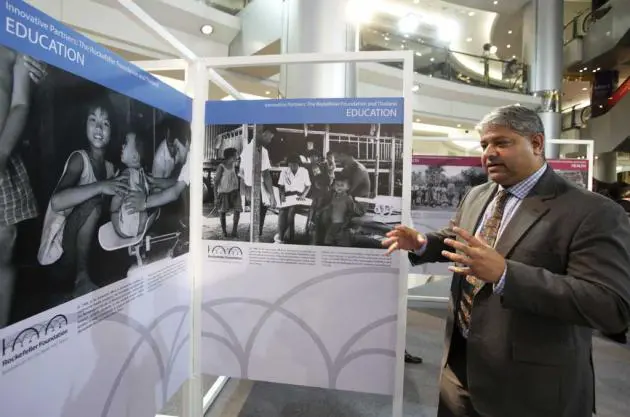
These and other examples of aid from abroad are examined in the photo exhibition “Celebration of the 100th Anniversary of the Rockefeller Foundation and Thailand’s Development in Health, Agriculture and Education” at the Siam Discovery Centre.
Hookworm disease, caused by the parasitic worm picked up from the soil that creates havoc in the intestines, was afflicting millions of farmers in the American South at the turn of the last century before the foundation put its medical experts in the field.
Having wiped out the disease there and in South Africa, among other places, attention shifted to Southeast Asia, where there were outbreaks in northern Siam, especially in Chiang Mai and Nan. Heiser and his team, working with the Siamese Red Cross and local doctors, treated nearly 350,000 people in a course of a year and installed some 83,000 latrines.
The Bangkok exhibition, which US Ambassador Kristie Kenney opened on Tuesday on the mall’s ground floor, has more than 30 rare photos from 1915 reprinted from the Rockefeller Archive in New York. Together with other items on display from the past 100 years, they reflect Siam’s development in health, agriculture, education and the environment.
Among the stirring highlights is a recollection of His Majesty the King’s father, His Royal Highness Prince Mahidol Adulyadej, establishing a hospital that in the 1920s would produce the country’s first physicians and nurses trained in modern methods.
Having earned his medical degree at Harvard University in the US, Prince Mahidol took up service at McCormick Hospital in Chiang Mai. A 1924 photo depicts staff outside the operating room there, and others show Chulalongkorn University medical students clad in shorts.
There are images of Siamese officials and Rockefeller staff visiting rural people in various locales. The Americans team with Kasetsart University to open the National Corn and Sorghum Research and Training Centre called Farm Suwan in Nakhon Ratchasima. A shot from 1968 captures the devastating flood that left rice paddies under a metre of water. “In Thailand and the Philippines, researchers supported by the Rockefeller Foundation focused on developing rice varieties that could withstand deep flooding,” the caption explains.
Ashvin Dayal, associate vice president and managing director of the Rockefeller Foundation, praised Thailand in a speech at the show’s opening for its “leading role” in the foundation’s efforts in Asia today. It has helped initiate universal health coverage to combat pandemic diseases and built “the resilience of cities to the risks associated with climate change”, he said. Much of the credit goes to “Prince Mahidol’s foresight, intellect and tenacity”.
“It is a relationship that has been built on a bedrock of trust and a shared commitment to development issues, leading to a partnership
that has flourished for almost a full century,” Dayal said.
A 200-page, large-format book, “Innovative Partners: The Rockefeller Foundation and Thailand”, examines the cooperation more deeply. It’s one of six books in the foundation’s Centennial Series. William H Becker is the author and Dr Prawese Wasi, who has worked with the foundation on many projects, wrote the foreword.
After outlining the relationship with Siam that evolved after the hookworm campaign and efforts to improve medical training here, the book recounts the history of both the foundation and its University Development Programme. It then describes the ongoing efforts to cope with changes brought about by globalisation, rapid economic development and climate change.
Thailand now boasts gifted medical practitioners and technology that are the envy of many nations, but clearly the modern world presents challenges with which the foundation is ready to help us cope. And its contributions are widely appreciated.
“There are two processes for further cooperation,” Dayal said. “First we will see how we can share knowledge and technology and partner with Thai institutions to help neighbouring countries like Vietnam with public-health issues.
“And, second, the more challenging issue is how to cope with the rapid changes of globalisation, urbanisation, the impact of climate change and the effects of the global economic crisis.”
BEST OF PARTNERS
The exhibition “Celebration of the 100th Anniversary of the Rockefeller Foundation and Thailand’s Development in Health, Agriculture and Education” concludes tomorrow on Siam Discovery’s ground floor.
The exhibition will reappear on the sixth floor from December 4 to 15 to commemorate His Majesty the King’s birthday.
The book “Innovative Partners: The Rockefeller Foundation and Thailand” can be downloaded for free from Centennial.Rockefeller|Foundation.org/publications.
You can also get a copy by sharing your favourite photo from the exhibition on Facebook, Instagram or Twitter (use #rf100bkk) with a screenshot to [email protected].
The book is in English. A Thai edition will be available by the end of the year.
