
Art as a shrill whistle


Play
Paintings and drawings "In Praise of the Masses" emerge from the anti-government protests
PALETTE KNIVES are sharpened and brushes drip with the sort of toxins that only satirists can distil amid the din of whistles at the anti-government rallies pulsing around Bangkok.
Mocking portraits of caretaker Prime Minister Yingluck Shinawatra are to be expected. Those depicting Suthep Thaugsuban, head of the People’s Democratic Reform Committee, have a heroic aspect in fast action strokes. The red, white and blue of the Thai flag are everywhere.
Forty-two paintings and prints are on view in a show called “Silpa Karawa Prachatham” (“Art in Praise of the Masses”) at the DOB Hualamphong Gallery on Rama IV Road this month. They are the results of a one-day burst of creativity – the artists assembled on Rajdamnoen Avenue on January 11, on the eve of the Bangkok Shutdown, and each received a 70-by-90-centimetre blank canvas to fill.
The artworks are for sale at prices set by the artists themselves – many starting at Bt50,000 – with all proceeds going to the Rehabilitation Fund for Victims of Political Rallies set up by the Students and People’s Network for Thailand’s Reform.
“As artists who think differently from the government, we agreed to take action and call for political reform through our artistic skills,” says Silpakorn University Associate Professor Thavorn Ko-udomvit, who is managing the exhibition.
For Thavorn, this was a rare venture into political satire. He usually takes his cues from Buddhist teachings and occasionally environmental issues. For this fund-raising show he painted the Democracy Monument silhouetted amid tree branches that are withered except for two tiny blooming flowers.
“Any laws or rules can be changed because they are only assumptions set up by people. It’s only the rules of nature that humans can’t control,” says Thavorn, who served as curator of the Thai Pavilion at the 2009 Venice Biennale.
The T-shirts he also made for the cause, bearing the inscription “Shutdown Bangkok 13.1.2014” and with one sleeve in the flag’s tricolour, sold like hotcakes at Bt300, some 5,000 shirts swiftly disbursed.
Ekachai Luadsoongnern, an impressionist, has painted a lan thom (frangipani) tree in rapid strokes, weaving the background from the national flag. “The lan thom is always associated with sorrow and death because the name is similar to la thom, meaning ‘suffering’,” he explains. “And the root of the word actually comes from an ancient Khmer reference to worship.
“My painting signifies my deference to anyone who fights for change. This is the first time I’ve done anything related to politics, but I wanted to express my views rather than keep quiet.”
National Artist Preecha Thaothong, who is renowned for his use of light and shadow in his paintings alongside classical Thai architecture, depicts Rahu, the Hindu god of darkness, as a symbol of these turbulent times. Rahu is seen swallowing a world in the hues of the flag. The red of the upper part of the canvas and the yellow at the bottom merged into orange in the middle.
“We should unlock the red-and-yellow code and find a solution for our country, which is witnessing a breakdown of the moral code,” says Preecha. “Rahu represents the cancer that’s been threatening our lives for a long time and reached the final stage under the Thaksin regime and his little sister Yingluck.”
Wattana Poolcharoen utilises strong brushstrokes and the palette knife to portray Suthep with one fist raised and the other hand clutching the flag. Journalists and photographers surround him with the Democracy Monument in the background.
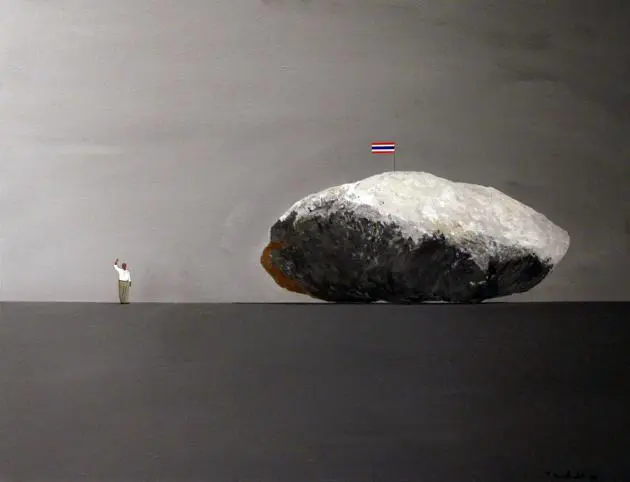
Teerawat Ngarmchuachit, another Silpakorn lecturer, presents Suthep as a tiny David confronting a Goliath rock topped by the Thai flag. The rock is a common device for Teerawat, symbolising steadiness and serenity, but this time it’s become an obstacle requiring bravery, sacrifice and determination to overcome.
“The rock has changed from its symbolic meaning of setting oneself free from attachments, because I can’t set myself apart from this conflict – if I keep quiet, I will suffer later,” he says.
Hongjorn Sanae-ngamcharoen’s abstract painting has the flag’s stripes revolving amid birds, the sun and moon, leaves from the sacred bodhi and the Democracy Monument, together with verses in praise of the protesters.
Muangthai Busamaro depicts galloping horses in red, white and blue as a metaphor for achieving a goal. “The horse as one of the 12 animals of the Chinese zodiac as an emblem of vitality and courage,” he says. “Its intrepid spirit and unremitting effort are given recognition because of its numerous contributions to the development of civilisation. The sun in the painting represents bright hope.”
Tinnakorn Kasornsuwan offers cartoonish renderings of a male and female face whose outlines overlap, the man wearing a T-shirt bearing a child’s sketch of a house. “The protesters come from different walks of life,” he notes, “and even though they’re tired out, I believe they’re happy to be sharing the same goal.”
All of the artists contributed to a painting also titled “Silpa Karawa Prachatham” that was auctioned off for Bt250,000. They hope to raise Bt2 million altogether, and so far there are reserved offers on half of the paintings in the show.
Other participating artists include Vasan Sitthiket, Amrit Chusuwan, Sriwan Janehuttakarnkit, Sakwut Wisesmanee and Sutee Kunavichayanont. And five poets, led by Naowarat Pongpaiboon, penned verses on canvas for the occasion.
Silpakorn University lecturers and students organised a four-day “Art Lane” last week on the street midway between Soi Tonson and the Chidlom Skytrain station. It featured street performers, graffiti artists and on-the-spot T-shirt screening, as well as talk shows and music.
CREATIVE FURY
>>The exhibition “Silpa Karawa Prachatham” continues until January 31 at the DOB Hualamphong Gallery, opposite Hualamphong railway station.
>>It’s open daily except Monday from 10.30 to 7.
>>Find out more at (02) 237 5592-4 and www.DOBThailand.com.
