
A spell in Japan's hells


Play
The volcanic pools of Beppu are fit only for demons - humans slip into cooler healing waters nearby
At its best, travel involves stepping out of your comfort zone. One way to do this in Japan is to step into the comfort zone of an onsen, or hot spring. My previous visits to Japan were lacking in cultural immersion, so this time I decided to use up my short stay in the city of Beppu, said to be the world’s first hot-spring tourist town.
Attracting sore and stressed-out visitors since the 1600s, the Beppu-Oita area has the greatest gush of natural hot water anywhere outside Yellowstone National Park in the US.
I step off the JR Kyushu Express into a town of low-rise buildings set in a cauldron of hills, rags of ocean peeping through sullen clouds.
Just outside the station entrance, a bubbling hot-spring fountain offers a free freshener for grimy travellers’ hands and faces. Next to it stands a statue of the “father” of hot-spring tourism, Kumahachi Aburaya, leaping off the ground with a joyous expression and both arms raised.
From his watery cape hang two oni demons – a reference to Beppu’s hot-spring “Hells”, which Aburaya turned into the first modern Japanese tourism experience in 1927. Eager to dive in, I pass on – but I would soon be cursing Aburaya’s ghost under my breath.
The first onsen I visit is Takegawa (“Bamboo Tile”), which opened in 1878. I pay the ¥100 (Bt32) entry fee and head inside to discover floors buffed to a glistening shine by generations of socks and soles. A glass display case shows sections of ancient clay and bamboo pipes clogged with mineral sediments like sclerotic veins.
I enter the men’s section and am surprised to find only one pool. Unlike sophisticated Korean hot springs, there are no showers, and yellow-green pomelos bob about in the bubbling brew. I can only handle 10 minutes of the heat, but in that short space I’m transported back to a lost age of simplicity, free of distractions and modern gimmicks.
Hamawaki, my second hot-spring visit of the day, is more akin to its Korean counterparts. Though older than Takegawa – Hamawaki was already a popular onsen in 1817 – it has been whisked into the modern age with a huge beige-tiled building. Five pools of varying temperature are rounded off with a wood sauna and waterfall jets. It still seems bare bones, though, lacking amenities like towels and water dispensers.
After my hot-water detox, I opt to avoid the city’s dubious-looking alcohol retox venues. I also shy away from the local speciality, puffer fish – not so much for fear of the deadly toxins but because of the scary price. Instead, I dine on ramen in pork-bone broth, a cheaper local delicacy.
Eight hells
The next day I am ready for the Hells.
I board a bus outside the train station and head for Kannawa, just out of town. Here, about 1,200 years ago, Mount Tsurumi erupted, creating the eight hellish springs.
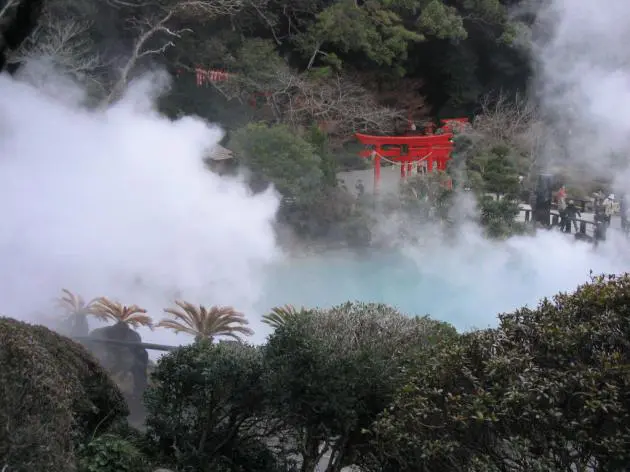
An otherworldly view unfolds as we approach, thick white plumes spewing from dozens of pipes and smokestacks on the hillsides. Four of the Hells were designated beauty spots by the government in 2009, though the landscape has inspired fear and awe for centuries.
Scattered along a winding, uphill lane, the eight Hells can be visited individually for ¥400 each, or you can take the full tour with a ¥2,000 ticket book.
The first one I enter is White Pond Hell. I am greeted by a sulfurous stench and white steam rising from a shallow, milky-blue pool. Any thoughts of bathing here are quickly dispelled by dipping your finger into the almost-boiling water.
Crocodile Hell (a crocodile farm) and Oven Hell, with a statue of a red demon perched on a cooking pot, are less impressive. I rush through Mountain Hell and onto Sea Hell. Here, a basket of eggs sits simmering in the aquamarine waters. Visitors wait less than 10 minutes to sample the hardboiled results.
Monks’ Heads Hell has more strange sights – plopping grey mud and a steaming rock pile – but by this point I’m feeling jaded by all these watery Hades.
Damn the Blood and Geyser Hells, I decide. My muscles are sore from the previous day’s hike through knee-deep snow at Aso-Kuju National Park, and I’m frustrated at bathing my eyes in steamy waters that are too hot for the rest of my body to enter.
I head back to town and follow the guidebook directions to Hyotan Hot Springs. The tourist spectacle pioneered by Kumahachi Aburaya is great for the eyes, but Beppu’s real charm lies in what it can do for tired muscles. Though far out of my comfort zone in Hyotan, I slip on a yukata and a pair of wooden sandals and stumble towards the invitingly warm spring waters.
