
False romance of the rings


Exposing the plight of the 'long neck' Kayan women
The daily life and struggles of Myanmar’s ethnic minorities are often far removed and largely misinterpreted by the general public and tourists, who often tend to romanticise local customs.
Years of civil war and military dictatorship have had a devastating impact on many minorities and decades of censorship have done much to cloud the histories of the nation’s ethnic groups.
This could not be more evident than with the famed Kayan, a subgroup of Karenni or Kayah people, a Tibeto-Burman minority who came from northeastern Myanmar.
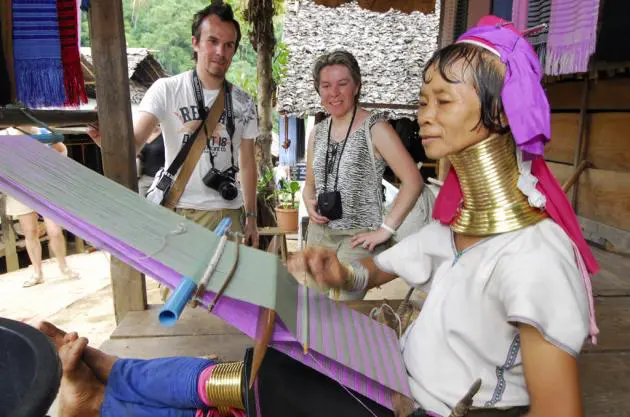
The famed “long neck” women of the Lahwi tribe wear long brass |coils around their necks that many believe are a symbol of beauty. |Some anthropologists even suggest |it gives women a resemblance to a dragon, an important figure in |Kayan folklore.
Although they are accepted as one of Myanmar’s official “ethnic races” and are often portrayed as a quaint and tradition-loving tribe, many were forced to flee their homes into neighbouring Thailand in the late 1980s due to a brutal civil war.
The long neck Lahwi women first became a tourist attraction in the refugee camps on the Thai border. Taking exotic photographs and |gawking at these “giraffe women,” as they became known, became big business for Thai guides and village headmen who managed hilltribe trekking tours.
While Lahwi women were also able to make a meagre income, it often perpetuated a practice that was restrictive to girls and at times led to exploitation, with some women forced to live as refugees.
Traditionally, girls first start to wear rings when they are about five years old. Over the years longer coils with more turns are added, increasing the weight of the brass, which pushes the collar bone down and compresses the rib cage. The neck itself is not actually elongated; only the appearance of a stretched neck is created by the deformation of the clavicle.
In 2006 some of the younger women in Mae Hong Son, in Thailand’s northwest, started to remove their rings, choosing instead to pursue their education and independence, as well as protest against the exploitation and restrictions the practice entailed.
While there has been growing awareness of such cultural exploitation in Thailand, some Lahwi women continue this tradition in remote parts of Kayah and Shan states in Myanmar, often encouraged by tourist profiteers.
Unfortunately, some foreigners are attracted by these remote ethnic customs simply because they appear to have avoided the trends of modernisation. As unprecedented numbers of tourists visit Myanmar, it’s possible we may experience a repeat of the culturally exploitative tourism that began in the refugee camps.
In 2013, celebrated filmmaker Aung Ko Latt, won the Special Jury Award at the Asean Film Festival for his production “Kayan Beauties.”
The story is a gritty portrayal of the Kayan “long neck” women and centres on the lives of three women as they embark on a journey to search for a kidnapped Kayan girl who has been taken by human traffickers in Thailand.
Although the film was subject to censorship here, it was one of the first to attempt to portray the gruelling realities of ethnic minorities, and it is a must see.
The film premiered in Myanmar cinemas last August and won the prize for best cinematography at the Myanmar Film Academy Awards last year.
With Myanmar’s relaxation of censorship and growing media freedoms, hopefully more films of this nature will help educate the general public and tourists, on the realities of ethnic minorities in Myanmar.
