
Crossing boundaries in Kobe


Interdisciplinary collaborations between Japan and Asean artists highlight a recent contemporary dance fest
Organised by Npo Dance Box with support from, among others, the Government of Japan’s Agency for Cultural Affairs, the third edition of the Kobe-Asia Contemporary Dance Festival wrapped last night after four weeks of occasional programming.
Small in size, with only two double-bill programmes of three shows each on two weekends and an exhibition running the whole length of the festival, the event took huge artistic risks by commissioning four new collaborative works in which Japanese artists worked with their Asean counterparts.
As evidenced in Programme A two weekends ago at the ArtTheatre dB Kobe, being small doesn’t mean insignificant, but quite the opposite.
Dance Box selected world-renowned dance company contact Gonzo’s founder Yuya Tsukahara as the director of this festival and his theme was “My home is shivering and changing, or is it me and my body wriggling?”
“This is a festival dealing with the interaction between technology and philosophy. By ascertaining ‘simple questions’ which occur in our daily lives, the participating artists will create new performance sessions,” he explained.
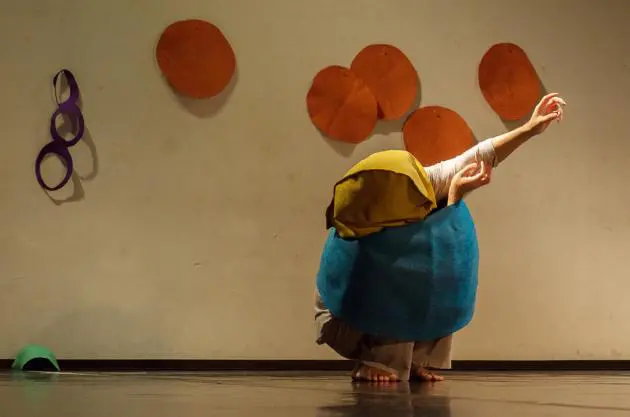
At the beginning of the first performance of Programme A, Pichet Klunchun, clad in grey pyjamas, handed out objects of different colours and sizes, all made of suede and designed by Japanese artist Tomoko Soda, to the audience seated on the two sides of the performance area in the traverse stage configuration. Also dominant were a sewing machine with red thread and the stage lighting apparatus above it which, when combined, looked like another artwork. Among these lights was a TV monitor in which we could see the still image of a man sleeping on a sofa.
While Pichet was upstage, his company member Kornkarn Rungsawang started the machine and the threads were sewn together. She then started recounting episodes of incidents, in Thai with playwright Toshiki Okada holding a notebook with Japanese translation, each ending with the sentence “Your dream ends there.” These were interspersed with actress Mika Masuda’s travel monologues during which she travelled from one city to another by train notwithstanding her heavy luggage with a broken wheel, accompanied by physical movements for which Okada is known.
As Pichet delivered his only line and the 75-minute performance’s only English words, “I had a dream last night,” the audience started to make connections between these dreams of travelling to a foreign land and what happened to the Japanese tourist on foreign soil.
At the post-show discussion in the foyer where Soda’s art works were on display, Pichet revealed that he spent eight nights in eight different houses in Kumamoto where Okada is based. He had dreams every night and took notes of them every morning. Okada turned them into monologues for Kornkarn.
After the 30-minute interval, the audience returned to the hall to watch and listen to the three members of Filipino rock band Skychurch performing their adrenaline-pumping songs. We stood around three sides of the hall while in the centre, the five members of contact Gonzo began their unique contemporary dance movements which always looked like they were fighting and hurting one another. Photographs taken in the Philippines by Yusuke Nishimitsu were projected onto the screen,
During one song, Tsukahara went to the stage with a wooden bench on which he sat down and slingshot dozens of oranges towards his company members, one of whom was holding a sword. Pulps and juice began to fly around and audiences were given empty cardboard boxes as protection shields.
During another song, the dancers ran around in circle and invited the audience to join them. Towards the end, the image on the screen morphed into a live Skype video conversation with Nishimitsu who’s somewhere in the Philippines.
I ran into Skychurch afterwards and they informed me that Tsukahara found out about them online and they had only met just a few days before the first performance.
During their first meal together in Kobe, the lead singer also fell in love with the sauce that’s put on okonomiyaki and wrote a song about it, which they included in the performance.
Skychurch and contact Gonzo clicked with each other so well in such a short time that the former’s songs sounded as if they were composed for the latter but this cohesiveness also made the audience forget that there’s also another part to the work – Nishimitsu’s photographs and videos on the screen.
In the end, these two vastly different works reminded the audience that all fields of arts are related and even though artists have been trained in one or two specific fields, they can work across fields from time to time.
Now that the Japan Foundation is planning to promote more artistic collaborations between Japan and Southeast Asia, these two interdisciplinary works serve as good examples of artist collaboration.
Pichet already has an idea on how to bring this work to Thailand.
“Maybe this time Okada can spend some nights in Thai houses and come up with his dreams and we can combine these with what’s already in the performance.”
I instantly proposed a bed in my suburban house on the condition that he cooks okonomiyaki for my breakfast.
The writer wishes to thank NPO Dance Box’s director Fumi Yokobori for all assistance.
On the Web: www.DB-DanceBox.org
