
Eickmeyer holds a proof copy of his rendition of "All Quiet". That war, that book, a century on
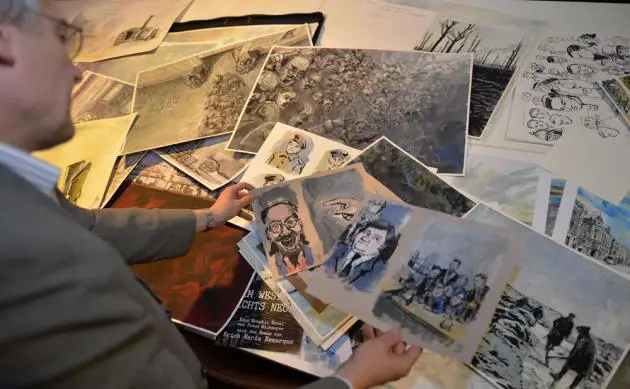


A German artist offers a graphic novel version of All Quiet on the Western front "
WORLD WAR I is now 100 years distant, yet the events of 1914 still speak to us – from the initial war euphoria through the growing disillusionment to the terrors of the trenches. The novel “All Quiet on the Western Front” by Erich Maria Remarque is one reason that we still have a clear picture of this war today.
First published in 1928, Remarque’s book has been translated into more than 50 languages and continues to be widely read. Now an all-pictures version is appearing in the form of a 176-page graphic novel by German artist Peter Eickmeyer.
He drew 70 full-page spreads and hundreds of smaller boxes to tell the story. The images in ink show a sombre world, frequently in ash-grey and earthy tones.
“I wanted the style to feel angry,” says Eickmeyer, 50, who is based in the small town of Melle in northern Germany. Remarque hailed from Osnabrueck, 30 kilometres from Eickmeyer’s studio.
The artist recalls that he pushed so hard on his pen that he broke it on one occasion as he was doing the drawings. “That was when I saw that this was precisely the mode of expression that I was looking for,” he says. He had found it impossible to recreate the novel in the “clean” panels of traditional comic style.
The fact that the graphic novel is appearing in 2014, exactly 100 years after the war broke out, is a coincidence, Eickmeyer says. The work had been planned for some time. He began working on his version in 2009, but negotiations on copyright via Swiss literary agents Mohrbooks and the University of New York, which has managed the Remarque estate since the author’s death in 1970, were lengthy.
Germany’s interest in the centenary of the war’s outbreak has been muted by comparison with other European nations, but there has been an rise in war books appearing in the shops.
In 2012 only 109 new print books and 55 ebooks in German dealt with the First World War, but last year those numbers doubled, says Thomas Koch of the German book federation Boersenverein. Eickmeyer’s graphic novel is a first for Germany, where war is a subject of general revulsion.
Remarque started his novel while recovering from wounds in hospital in Duisburg in 1917, says Thomas Schneider, head of the Erich Maria Remarque Peace Centre in Osnabrueck. “He came back to the theme in 1927 and completed his novel.”
The novel, with its main protagonist Paul Baeumer, is not in fact autobiographical, though the original marketing suggested so. In fact Remarque, who was working as a journalist at the time, made use of various sources for the plot.
Like Remarque, Eickmeyer and his wife Gaby von Borstel undertook their own research for the graphic version, travelling to Ypres in Belgium, the site of two battles.
Whereas in Germany World War I is too remote for many people, overlaid by World War II, Eickmeyer realized, “In Flanders and northern France the memory is still very strong.” He and his wife visited the museums and cemeteries and even trenches that have been reopened.
Attention to historical detail was a key point for the artist. Did the German soldiers wear modern steel helmets or the traditional Prussian spiked helmet? At the start of the war the spiked one was still in use, but the improved steel helmet was introduced in 1916.
The graphic novel also contains numerous references to other works, whether films or Picasso’s painting “Guernica”, another significant anti-war statement of the 20th century.
Sven Jachmann of publishing house Splitter says there has been exceptional interest ahead of publication. “This is quite unusual for a debut in the comic genre,” he says, noting that there has also been interest from abroad.
