
The writing on the wall


Play
Graffiti artist Arker Kyaw got in trouble with that picture of Obama. He's not out of the woods yet
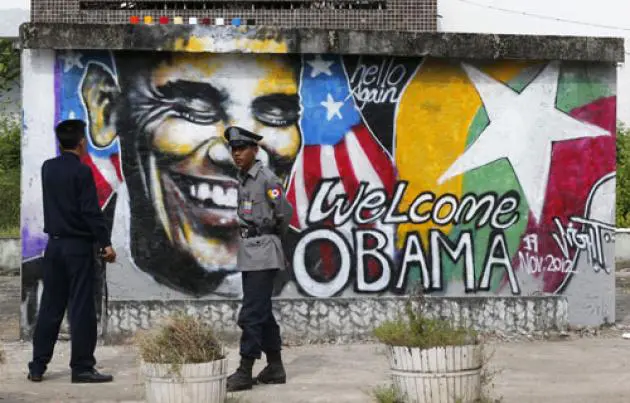
A young man from from Dawei in southern Myanmar has become a minor celebrity as a street artist in Yangon, the former capital. Arker Kyaw, 21, captured the spotlight with a portrait of Barack Obama that appeared on an urban wall just as the US president was making a historic visit to the once-isolated country in late 2012.
The fame garnered Arker a trip to Thailand recently as Myanmar’s representative at the Meeting of Styles, a global gathering of graffiti aficionados and “hip-hop artists” in Hua Hin. There, Arker created a piece called “Night”, It was subtitled “Moving” to acknowledge that there has been forward movement in efforts to end his homeland’s penchant for censorship.
“‘Moving’ means doing something different in your life if you really want,” Arker told The Nation at his studio in Yangon. His own battle against censorship continued over the years, right up to that Obama painting on a wall near Yangon’s Kandawgyi Park.
The authorities covered up the artwork not once but twice. He kept returning to paint it again. It was a photograph of the third version, posted on Facebook, that caught the notice of the foreign press and became a symbol of a nation on the verge of sweeping change.
Then the government announced a ban on public street art altogether.
“More freedom is needed,” said Arker, who took his early artistic inspiration from TV shows caught on satellite feeds. “It’s up to the authorities to stop the censorship. An artist can’t stop it. But we are still moving, moving forward.”
Arker was in criminal court last year after the Yangon City Development Committee fined him for painting a portrait of President Thein Sein on a wall, Arker’s way of celebrating the 68th birthday of the former general who has initiated such dramatic changes in the country.
Well-meaning or not, he ended up having to pay a fine of 100,000 kyat – about Bt3,300 – because he hadn’t sought permission in advance for the graffiti.
By night he sprays walls and by day he makes movies. Arker and his brother, Soe Wai Htun, worked on a five-minute film called “Floating Bliss” after the world noticed the deadly conflict that was taking place between Myanmar’s Buddhists and Muslims. The message: all humans are the same. It’s about young adults from different artistic and ethnic backgrounds finding happiness in an unexpected place.
“We’re Buddhists,” Soe Wai Htun said of he and Arker, “but we have Christian and Muslim friends. We all love each other. There was no fighting among the people of Myanmar before, but now there’s a lot of conflict coming out. We are asking why they’re doing this. We don’t want to be like that. Human is human – no need to fight.”
“Floating Bliss”, directed by Maung Maung Tha Myint, was selected for screening at last year’s Singapore-Myanmar Film Festival.
Arker and his brother also worked with Thin Win Hlaing on the documentary “The Night” two years ago, which was about graffiti artists in a more open society than Myanmar. It was nominated for a prize at the Art of Freedom Film Festival in Yangon.
Arker emphasises that, with his graffiti, his main purpose is to call attention to socio-political issues, though he admits that some of his work can be seen as critical of the government. “The idea is not to blame the government, though. We are showing what we need and what we have to develop to move into the future. It will be a better place.”
Arker expects to have his own solo show this year, featuring graffiti as well as paintings on canvas and other pieces that he’s being secretive about for now.
Asked about his biggest dream and fondest hope, he said he simply longs for peace. “I just want to be an artist and live a more peaceful life – no worries about things – because my life right now is not so peaceful. It keeps on shifting.”
He does have a grand dream, he said, but he won’t share what that is either. Like Myanmar itself, he tends to keep people waiting, but with expectations that can’t help but be high.
