
Say cheers to Gaz Regan
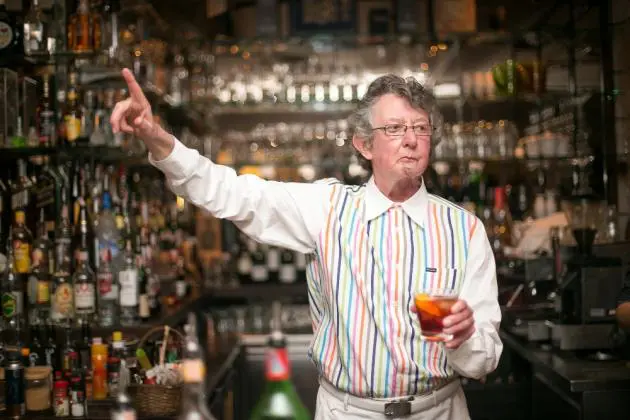


Raised in an English pub, famous in Manhattan, the bartender's bartender turns frowns upside-down
Ask the top bartenders about the secrets of their success and you’ll get a different answer every time. We tend to prefer Gary “Gaz” Regan’s explanation: It’s not about fancy drinks, he says, it’s about working the bar. Known more for his easy-going charm, readiness to serve and attention-grabbing oufits than any innovative cocktail recipes, Gaz is probably the best living example of the old-time bartender who really knows how to cheer up the people sitting around that bar.
Growing up in his family’s pair of pubs in Lancashire, England, Gaz started rinsing glasses behind the bar at age 14 and was already determined to become “the good bartender”, just like his father. Gaz moved to New York City in the ’70s, when he was 22, and started a career that now spans four decades, during which he’s become one of the best loved and most respected “good bartenders” in the business.
Gaz works regularly with firms like Diageo, Pernod Ricard and Heaven Hill, travelling the world to conduct workshops and judge cocktail competitions. He’s usually a key speaker during London Cocktail Week, is a perennial judge at Diageo’s “World Class” competition, and has adjudicated contests in Australia, France, Slovakia and the US.
And he still mans the bar at the Dead Rabbit on Water Street, way downtown in Manhattan, New York. The regulars there must have been moping when he trekked off to Bangkok recently for a Diageo bartender workshop at the Sofitel So Bangkok. We were there, panting with questions.
What’s cooking, Gaz?
Well, I’m just an old bartender, but that gets me travelling all over the world. I’m also a writer, and through my writing I also try to connect with other bartenders. I also do workshops, but I don’t normally talk about making drinks – it’s more about being behind the bar, meeting people and caring for people.
You were lucky to have your father as a role model. What was he like?
He was essentially the “priest” in that blue-collar community where the pub was. He cared for each and every single one of his customers, treated them with respect and even looked out for them. One woman called my father in the middle of the night after her husband died, because she didn’t know who to talk to. A thug became a nice gentleman in my father’s pub because he was polite and mindful to him. He handled difficult situations well. My father didn’t make cocktails, of course, but I learned “people skills” from him.
What were the cocktails like when you first moved to New York?
The drinks we made back then were not very good. The stuff I made was no better or worse than the rest of the bars in New York. We didn’t use fresh fruit juices and we took shortcuts and everything, but everybody was happy at the time because no one knew any better! It was not until late ’80s or very early ’90s that bartenders in America started making really good cocktails. They made good cocktails prior to Prohibition, but that lasted almost 14 years, and by the time the alcohol ban was repealed, nobody remembered the old days.
There was a bartender called Dale DeGroff at the Rainbow in New York who really spearheaded the “craft cocktails”. Similar thing happened at the same time in London, too. Now the bartenders in 21st century have taken craft cocktails up to a whole different level. Things I see and what they’re doing now are absolutely astounding.
How did you come up with the finger-stirred Negroni?
[Laughs] That started about four years ago. I was in France, helping judge a bartender competition. I was behind the bar with some other guys making Negronis, and we were trying to make them as fast as possible. Just for a laugh, I started stirring with my finger. Everybody laughed and it just kind of stuck. It always makes people smile, and it all goes back to bartenders making people happy. Nobody has been offended yet!
Anything you’ve been concocting lately?
I’m not very creative. I’ve been more creative over the past five years because I learn from younger bartenders. I understand my ingredients more than I ever used to.
My strength is not in making drinks, but in reacting with customers and the team behind the bar. I smile and greet everyone, from the manager to the dishwasher. You know, nobody ever talks to a dishwasher, but if you take the time and greet him, you’ll change his whole day. And that changes everything and the whole dynamic of the workplace.
You’ve said bartenders can change the world.
Well, yes! If a bartender has 10 customers at his bar and he makes all 10 of those people happier, then in a very, very small sense the bartender is making a difference in the world. Now if there are a million bartenders all over the world doing the same thing on the same night, you have 10 million people in the world happier than they used to be. As far as I’m concerned, that’s changing the world.
