
Vietnam's famed crooners of yesteryear


Play
Bui Xa upholds a singing tradition once favoured as much by nobility as by pastoral folk
Every lover of Vietnamese music knows Bac Ninh as the home of quan ho (love duets) and ca tru (ceremonial singing), both listed by Unesco as elements of the world’s “intangible heritage”.
However, not many are aware that the northern province cradles another special music genre – hat trong quan.
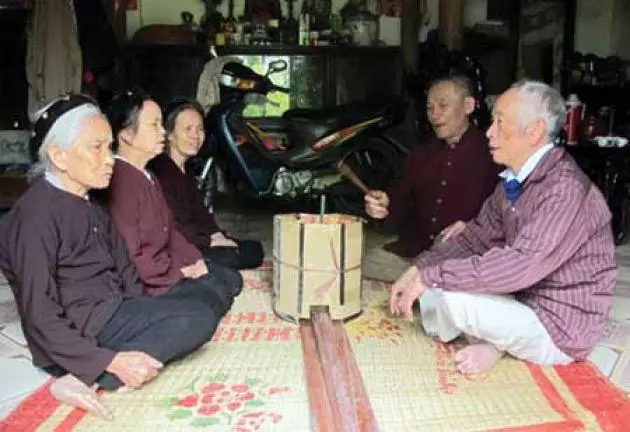
This is an art form that involves spontaneous back-and-forth repartee singing accompanied by drums, quite like the more famous quan ho but with distinctions its aficionados swear by.
In the old days, on mid-autumn nights, youngsters gathered at a communal house or at the hamlet entrance and divided themselves into two camps (men and women) and had fun singing trong quan.
The most prominent trong quan location is Bui Xa in Thuan Thanh district, where the art flourished centuries ago and has been preserved and developed since, says 88-year-old Pham Cong Ngat, whose family has been singing trong quan for four generations.
Trong quan singing began in Bui Xa in the 13th century, during the Tran Dynasty. Along with other troupes, like Ba Dat in Vinh Phu and Da Trach in Hung Yen, Bui Xa Trong Quan had been invited by King Trung Quang in the 15th century to Thang Long (the capital) to sing for him, says Ngat.
“When I was 14 I was already following my father everywhere to perform,” says Ngat, who set up his own troupe in 1993.
In the past, artists in Bui Xa used to sing all night, attracting people from far and wide, he says. His five-member troupe rehearsed often and collected more than 100 old songs.
Despite failing health, Ngat’s wife Vu Thi Kiem, 86, is still enthusiastic about teaching the art to young couples. Kiem says the way Bui Xa artists sing trong quan is different from other places, where it is quan ho that is performed with verses in a six-eight word-format in the distich meter, a fast rhythm. In Bui Xa, a ten-nine format is sung in larghetto tempo.
A good voice, passion and the capacity to respond quickly in a contest mark a good trong quan singer, Kiem says.
Le Ba Dao, who heads the Trong Quan Club, the successor to Ngat’s troupe, says they now have 28 members, age 39 to 88. They meet Friday through Sunday every week, with some members bringing along young family members to join in, Dao says.
“What we’re most happy about is that no club member is ever absent, and we’ve also drawn a lot of interest from the local young people.”
The club recorded its “real success” years ago in bringing the art form to the stage, performing for large audiences, but this did not last long, Dao says ruefully.
He says the club now faces difficulties in preserving and developing the folk singing because there is no environment for young people to be fully sensitive to how interesting and beautiful real trong quan is.
For instance, there is no all-night festival, as in the old days, to enjoy trong quan performances. The only place they can witness a performance is the club. Furthermore, there are only six experienced artists left in the club, and they are too old and weak, Dao says.
To help the art survive and grow, there needs to be much more attention and support from authorities as well as the local community, he adds.
Agreeing with Dao, Ngat says the folk singing really flourished in Bui Xa before the August Revolution of 1945. Every autumn, in the middle of the eighth lunar month, villagers would organise a festival to pray for good weather, unity among the people and favourable crops.
Many young men from different directions flocked to the festival to compete with local artists. Later many singing couples married, Ngat says.
The decline of trong quan began after 1945, with only a handful of artists taking it to the frontlines of the resistance war against the French, he explains.
