
Movements and manipulation


Play
Thai and Japanese puppet demonstration promises further cultural exchanges in the future
The Japan Foundation has long been one of the most active foreign cultural institutions in Thailand. In addition to regular activities like Japanese language classes and film screenings, they organise various other cultural activities year-round, and not just in Bangkok. This is possible not only because of their annual budget but also because of the collaboration between them and many local institutions and agencies.
Last Tuesday at the Thailand Cultural Centre’s Small Hall, with the support from the Culture Ministry’s Department of Cultural Promotion, the Japan Foundation held the Asian Puppet Theatre Exchange: Bunraku Demonstration and Workshop. Both the afternoon and evening sessions were well attended by Thai theatre artists including renowned puppeteer Kiatsuda Bhiromya whose “Chao Kunthong” has entertained and enlightened us for many years, as well as students and Japanese expats.
Six performers from the National Bunraku Theatre took the stage first in the afternoon session and were followed by Joe Louis Theatre, Bann Tookkatoon Hoonkrabok Thai and Semathai Marionette Arts for Social Foundation. After the demonstrations and workshops, a question-and-answer session among the participating troupes was vibrantly moderated by Vilawan Svetsreni, director of Hobby Hut Puppet Troupe.
In the evening, the Joe Louis Theatre performed two episodes from the Ramakien: “Khrut Yut Nak” (“Garuda fights Naga”) and “Hanuman Chap Nang Suphannamatcha” (“Hanuman captures Suphannamatcha”). A demonstration on how to manipulate their hun lakhon lek followed, bringing to mind those organised by the company at the now defunct theatre at Suan Lum Night Bazaar, with students enjoying a hands-on try on the stage.
For its part, the National Bunraku Theatre began by showing a video excerpt of an actual performance but the image quality was too poor to have any effect.
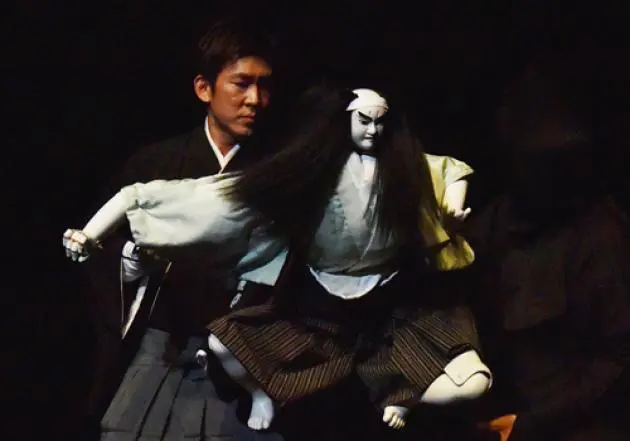
Despite its length, their live performance of “Utanosuke’s Urgent Report” with one male character that immediately followed the video was fulfilling, with many of the audience recognising the similarities to and differences with hun lakhon lek.
The troupe then explained and demonstrated the three main elements, referred to collectively as Sangyo: the narrator, the shamisen and the puppets. The theatrical magic lies not only in each performer’s immaculate skills but also in how voice acting, music and puppet manipulation all work cohesively. A few lucky audience members were also invited to try their hand at wielding the bunraku puppet.
Another short scene with a female character, “The Red-Hot Love: The Fire Watch Tower”, wrapped the National Bunraku Theatre’s Thailand premiere. By that time, the Thai audience already had an understanding of the Sangyo, enabling us to enjoy this scene even more. This is a good reminder that audience education and development are always important in arts management.
It became evident during the question-and-answer session that many audience members had been making links between Japanese and Thai puppeteering styles, with one person asking why one bunraku puppeteer, the one who controls the head and the right arm of the puppet, shows his face, while the other two do not – traditionally they all wear black head masks. In hun lakhon lek, we can see all three puppeteers and the movement of their limbs.
The Japanese artists replied that the audience had requested that the lead puppeteer be unveiled and they had responded accordingly.
Three years ago, I watched a full performance at the National Bunraku Theatre and was amazed at the local and international audience’s enthusiasm for it. This is contrary to the Thai response to traditional theatre performances at the National Theatre – even Joe Louis Theatre no longer has its own venue and performs at its restaurant on Charoen Krung Road.
The artists then let us in on their secret to drawing the crowds: they now also perform contemporary stories involving marital affairs.
These two replies clearly demonstrate that traditional performing arts can be sustained when the artists bend some conventional rules and adjust to the demands of contemporary audiences. We should always remember that tradition evolves through time; it’s not frozen in time.
The morning after the demonstration and workshop, representatives from National Bunraku Theatre and Joe Louis Theatre held a meeting and it’s safe to assume that next time the Japanese company is in town, we’ll have plenty more to enjoy.
This is a new path of cultural promotion as initiated by Japan Foundation’s Asia Centre and their “WA” project “towards interactive Asia through fusion and harmony here, one in which they’re not merely interested in showing us what they do – or what they can do better than us – but in how we can exchange our knowledge and expertise as well as develop true mutual understanding.
COMING HERE IN NOVEMBER
As part of the Bangkok Theatre Festival, Japan Foundation will bring the contemporary theatre performance “Girl X”, set for November 7 and 8.
