
Tradition with an informal bias


Play
Emi Mitobe The Yomiuri Shimbun. Asia News Network TOKYO
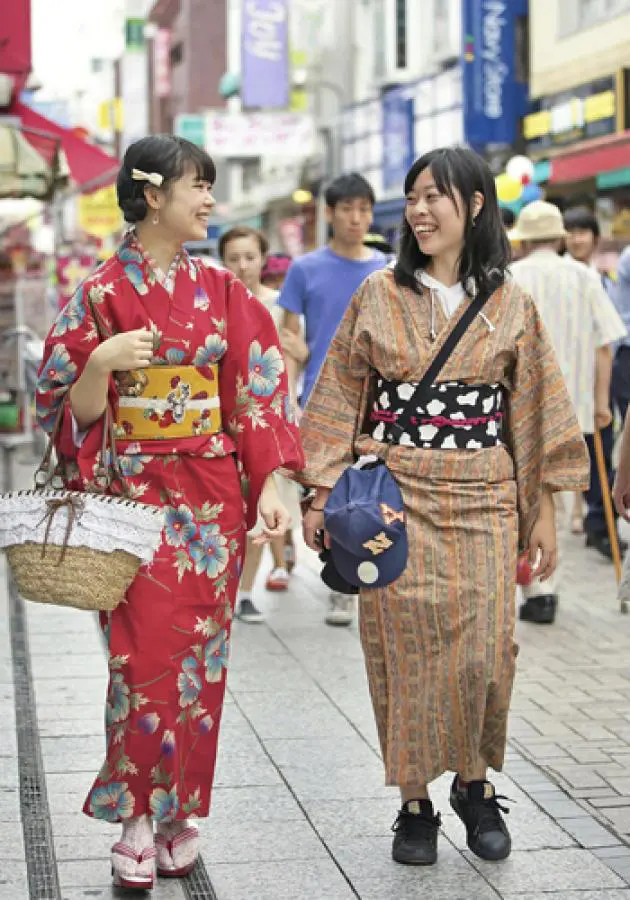
Young people are redefining kimono fashion, mixing the traditional Japanese clothing with Western accessories and clothes such as hats and sneakers, something many would have once considered shocking.
Shops where young people gather in Tokyo have picked up on the style, and at least one well-known department store has started proposing new ways to wear kimonos.
“It’s fun to think about what I can coordinate with kimono,” says Asahi Hasegawa, 20, a junior at Kagawa Nutrition University.
“I bought the lace I’m using instead of obijime string for the obi sash at a 100 yen shop,” adds her pal Kaho Yamada, 19, a sophomore at Teikyo Heisei University.
Hasegawa’s unique take on kimono style involves wearing a parka underneath her kimono, a handmade Holstein patterned obi sash and sneakers. “Whenever I see clothes that might suit kimono, I feel compelled to buy them. It’s easy to make an obi from a cloth,” she says with a smile.
When Hasegawa was a child, she looked forward to the New Year, when she would go out wearing a kimono with her grandmother. But there were fewer chances to wear the kimono as she grew older, leaving her feeling unsatisfied.
She came across a kimono circle that was recruiting members on Facebook and decided to join it in January this year. The about 30 male and female members of the circle hold kimono-wearing classes and attend fireworks events wearing kimonos.
Wataru Kono, 25, a senior at Meiji University who represents the circle, always wears a kimono when he goes out. He often wears a kimono and geta clogs on campus. “I can keep my back straight when I tighten my obi,” he says.
In the Harajuku district in Tokyo, the hub of young fashion in the capital, second-hand clothing stores that stock kimono and the roughly 10 kimono shops in the are growing in popularity.
One kimono shop in Harajuku handles recycled and vintage kimono. Yurika Nakajima, 21, a clerk in the shop, wears a white blouse with roses embroidered on its round collar under a kimono with black and white stripes. “It’s the same as wearing a one-piece dress,” she said.
Nakajima says one of the shop’s hottest products is a “kimono debut set” priced at 10,000 yen (Bt3,000) and up, which includes a kimono and obi. Many customers are in their 20s, she said.
The hardest aspect of the kimono is learning how to put one on, but that doesn’t seem to bother the young people of today. Store manager Seri Hirama, 27, says, “I learned how to put on kimono from a video.” There are many videos online that demonstrate how to put on kimono, which Hirama says is a reference for young people.
In July, about 30 men and women wearing kimono and yukata gathered at a water-bus stand in Asakusa, Tokyo, for “Kimono Jack.” The event started by kimono lovers in Kyoto in 2010 invites people wearing kimono to gather in downtown and tourist spots.
Hiroyuki Morikawa, 36, a representative of Tokyo Kimono Jack, which organised the July event, said, “We hope people who see kimono groups in town over the weekend will become interested in kimono and will want to wear kimono themselves.”
The popular belief that kimono are expensive is changing.
In Mitsukoshi department store’s main store in Nihonbashi, Tokyo, a kimono shop named Hanamusubi was launched in October last year and introduces new kimono styles.
Mitsukoshi is the nation’s most established store in terms of the kimono business – its predecessor was Echigoya, a kimono shop during the Edo period (1603-1867). The department store is known for selling kimono made-to-order from one roll of cloth at prices starting at 200,000 yen. But now, Hanamusubi offers ready-to-wear kimono from 40,000 yen and up. The shop also sells pierced earrings made of washi Japanese paper, which shows its eclectic approach to kimono. Accessories have traditionally been considered taboo when wearing kimono.
The shop is aiming to invite new customers to the stagnant kimono market, trying every possible means, including introducing new kimono styles by reaching out to young designers.
Shinsaku Kakita, 27, who manages Hanamusubi, explained: “We’d like to introduce a new kimono culture while preserving the traditional charms of kimono. We recommend customers wear kimono and go out without worrying about formalities.”
