
These bridges to history


Play
If Rama V's Charoen bridges still can't be restored, at least we'll soon have a better appreciation of their remarkable legacy
AMONG THE many changes King Chulalongkorn initiated in Bangkok when it was still known far and wide as “the Venice of the East” were the 15 “Charoen” bridges erected over its famous canals.
Long left to deteriorate, these literal links to the past are overdue for renewal. If that time still hasn’t come, efforts are at least underway to plan for it.
The whitewashed concrete spans, many of them arching high to accommodate the busy small-boat traffic of the time, were among the infrastructure that reshaped the Siamese capital beginning in 1906.
King Rama V had by then made two trips to Europe and, on his return home, wanted to give Siam a more cosmopolitan appearance, encouraging citizens to wear Western-style clothes and hiring Italian architects to build grand new public buildings. The neo-classical Ananta Samakhom Throne Hall, the Royal Plaza and Ratchadamnoen Avenue all reflect the powerful influence of European urban architecture.
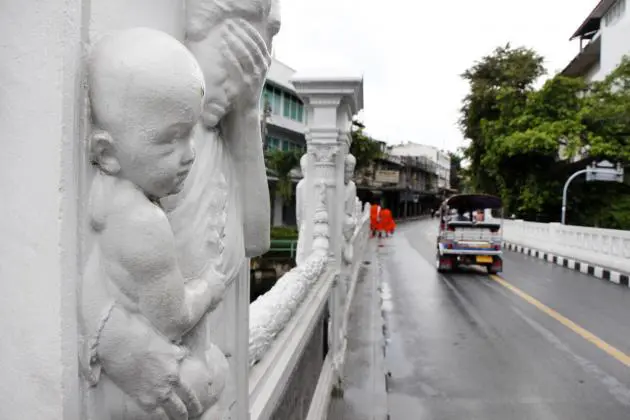
The Charoen Bridges were adorned with sculptures and bas-reliefs in stucco, but, whereas the palaces retain their grandeur, attracting tourists in the millions, the bridges have long been neglected, if not demolished.
Jakapan Vilasineekul of Silpakorn University wants to make amends for that neglect. He’s inaugurated a Bt1.8-million Bridge Sculpture and Stucco Conservation Project in collaboration with Silpakorn and Kasetsart universities.
“I was trained to appreciate the beauty of art, so it was apparent to me that the authorities had no intention of conserving some of our historical structures,” Jakapan says. “In our project we’ll undertake research on the old bridges that might be useful when repairs have to be made in the future.”
A bridge isn’t just a dry means to cross a canal or river, he says. “It can depict the story of the past, too.”
Jakapan led a successful effort more than a decade ago to prod the city into restoring the venerable Kurusapa compound. The buildings are now collectively registered as an historical monument.
This month he and his team, mostly students, will begin by taking a good look at the Mahatthai Uthit Bridge on Boripat Road, which Prince Damrong Rajanubhab built as a memorial to his half-brother, King Chulalongkorn, for the grand sum of Bt57,053.29. It was opened in 1914, a lovely mix of Western and Eastern styles.
“It’s the ideal pilot project because our budget is small and the bridge’s structure and details remain largely intact,” says Amarit Chusuwan,
Silpakorn’s dean of painting, sculpture and graphic arts. “It will be a good case study for the students.”
So little seen, so often ignored, a bas-relief on a tall buttress extension on one side of the bridge depicts a woman carrying her son and holding a bundle of tuberoses in the other hand. There’s a man on the opposite side patting a youngster on the back, comforting him over the then-recent death of Rama V.
The team will spend three months researching the bridges’ history, another three educating the public about the structures and a final three months assessing damage to the bridges.
“It’ll take about a year to gather all the pertinent information,” says Jakapan. “That includes estimating the extent of repairs needed, surveying public opinion and doing the research.
“Perhaps the most interesting part for the public will be when we team up with Kasetsart to build miniature 3D models of the bridges, which will go on display in an exhibition.”
Dr Kunnayut Eiamsa-ard from Kasetsart’s engineering faculty is planning a workshop to train the students how to make lifelike models. “There are different techniques for three-dimensional scanning,” he says. “We’ll use image-processing to produce a prototype and a ‘point cloud’ system to record all the data and recreate the different surfaces of the bridges. The 3D scanning technology is normally used in medicine to create prototypes of body organs.”
The Charoenrat 31 Bridge over Klong Lord will likely be the second structure studied, and it’s one of the oldest – raised during the reign of King Mongkut (Rama IV). Its decorations include the monarch’s “signature” and low bas-reliefs of tigers carrying a knife-like kris.
“It’s notable that the Italian artists and architects of that time adapted their designs to better suit Siamese culture,” says Jakapan. “You can see pineapples, bananas and star apples on the Saowanee Bridge, for example. But in the reign of King Rama V, everything was related to Western culture.”
The Hua Chang Bridge has stylised elephants, though. The stucco on the Charoensri 34 Bridge was meanwhile worked into floral formations.
“There actually used to be 38 of these bridges,” says Jakapan, “but most were removed when the roads were expanded.
“We need to pay more attention to these fine old structures and do our best to conserve them. Royalty knew how to make the city and its buildings beautiful, and the buildings and bridges encouraged creativity in daily life.”
