
Feeding the world in Milan


Play
The Thai Pavilion at Expo Milano 2015 sets out to nourish and delight
The next Universal Exposition gets underway six months from today in Italy and the 140 odd participating countries are already talking excitedly about what their pavilions will have to offer.
Thailand, of course, is no exception and the architects of the Thai entry were happy to outline their plans to journalists last week.
Taking place northwest of Milan, the theme for Expo Milano 2015 is “Feeding the Planet, Energy for Life”. It’s an appropriate concept given that as many as 1 in 9 people do not have enough to eat today, a problem that can only worsen as populations increase and resources run low. And so the aim of this Expo is to underscore the right to healthy, secure and sufficient food for all the world’s inhabitants.
Thailand is taking the theme seriously and the Agriculture and Cooperative Ministry has adopted the theme “Nourishing and Delighting the World” for the national pavilion.
“Our theme is nourishing people from around the world and delighting them with our unique Thai tastes,” says Upathum Nisitsukcharoen, managing director of Right Man, which is in charge of the presentations in the Thai Pavilion.
The Thai Pavilion will be divided into five zones, “The Land of Plenty, Spirit of Thai”, “Golden Land”, “Kitchen to the World”, “King of Agriculture” and “Food for the Future”.
The first zone is like an overture and offers a taste of what’s to come. The second zone, “Golden Land”, will present the abundance of natural resources through a 26-metre-high circular projector sending images all around the hall as well as through holograph techniques. “Kitchen to the World” showcases agricultural products and the high-standard of the country’s food processing.
“Thai food is very popular in many countries and Thai restaurants are among the top five choices when people eat out. I believe that ready-to-eat food will be a large market in the future, as we are already seeing by the huge growth in convenience stores. People no longer have the time to cook so they want something they can prepare in seconds. This trend is now spreading around the world and we have to make foreigners confident in the cleanliness and taste of our products,” Upathum says. “This zone is a 360-degree virtual globe theatre with an eight-metre-high LED wall, a tunnel and two bridges.
“Our fourth zone focuses on sustainability as reflected in the ideas and projects initiated by His Majesty the King, who gives precedence to agriculture and offers new theories for our farmers. Meanwhile, the last zone is like a future supermarket and will serve a variety of ready-to-eat foods to visitors.
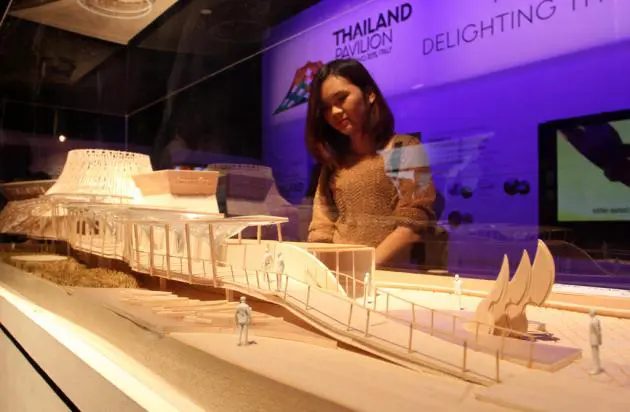
For Milan, the designers have moved away from the elegant temple-like structure used in Shanghai and have instead adopted the ngob, the traditional rice farmers’ hat, as the architectural symbol. This sits on top of a pagoda-like base, with visitors being greeted by a naga, the half-human half-snake diety, regarded as the god of prosperity.
“It wasn’t easy to interpret the theme even though agriculture is very much part of our history and culture. And it is also a big challenge for us to design a Thai Pavilion so different from the previous ones. Europe is open to all forms, shapes and spaces in architecture but we in Thailand remain concerned about our cultures and customs. That’s why the previous Thai Pavilion adhered to strict Thai architectural norms. For Milan, we are decomposing the original image into other abstracts while attempting to communicate our message,” says Smith Obayawat, president of the Association of Siamese Architects and founding principal of the Office of Bangkok Architects.
Among the ideas put forward for the pavilion during the brainstorming phase was a naga entwined around the building and piles of straw, though the latter was quickly rejected as it had already been adopted for the Italian pavilion.
“The shape of Thai Pavilion is similar to an axe, just like the map of Thailand,” says Smith, adding that the pavilion will cost more than Bt700 million when complete.
“The outer structure of the building was inspired by the base of a pagoda and has a circular shape. It shows that Thailand is an agricultural country that has good natural resources, a great climate and excellent farmers. Along with underlining these three factors, the pagoda base features three long aluminium strips that mirror our rice demonstration paddy next to the building, as well as the sky and visitors into the expo.
“The 17-metre-high ngob, which is made of wood, is a marvellous example of folk architecture. The pavilion is also climate friendly with the building self-sufficient in both energy and ventilation. We also have a rooftop nursery to decorate with trees, which will serve as a VIP area from which to observe the atmosphere of the expo around the Thai pavilion.
“Previous expos have taught us that the queues are always long. Our visitors will queue on the 80-metre-long pathway ramp and enjoy a Thai experience while they wait.
On the Web:
www.ThailandPavilionExpo2015.com
www.MilanExpoTours.com.
