
Meet the Paris slum dwellers who gave birth to modern art


Play
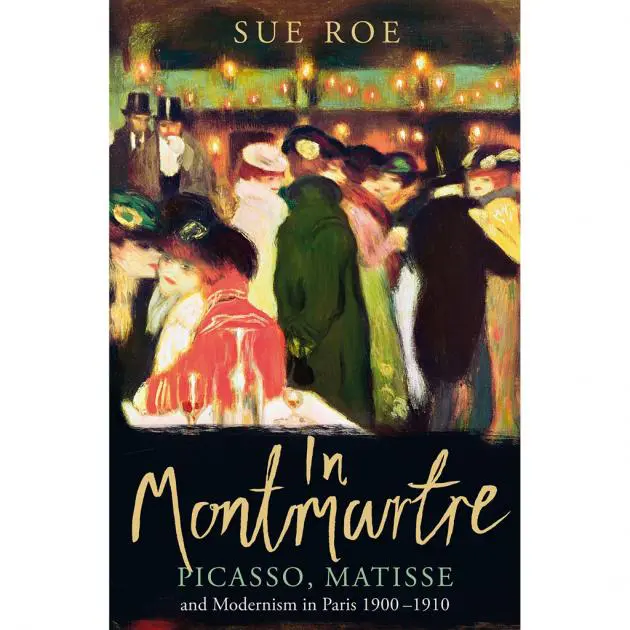
'In Montmartre' descends into the filthy backstreets where Picasso, Matisse, Gertrude Stein and their brood spawned a culture revolution
Anyone who’S visited Paris will be shocked by the photographs of Montmartre that appear in Sue Roe’s account of 10 turbulent years in the history of that great city and the artists most closely associated with it.
For this Montmartre is not the Montmartre of a gleaming Sacre-Coeur and its picturesque cobbled streets with their chic little tourist cafes, but a Montmartre of wooden shacks and tumbledown sheds, a nest of rats and filth and poverty – in short, a home of the poor among whom the greatest Western artists of the 20th century were numbered.
For them, Montmartre was cheap accommodation, cheap wine, absinthe, opium, dancers, models and prostitutes. And art. And debate about art. For Montmartre in the first decade of the 20th century was the hothouse from which some of the greatest revolutions in art history emerged.
And what a cast of characters it boasted. Not just Picasso and Matisse, but Derain, Vlaminck, Braque, Brancusi and Modigliani among the artists, Gertrude and Leo Stein among the intellectuals and collectors, art dealer Ambroise Vollard, and Sergei Diaghilev and Guillaume Apollinaire among the art critics, initially on the sidelines but by the end of the decade occupying central roles. It is an extraordinary collection of individuals, and Roe invokes them with vigour and skill, an unerring eye for detail and ear for anecdote bringing alive this most fascinating of times.
At its heart is the Picasso-Matisse relationship, initially hostile, later more harmonious but in this decade unremittingly competitive. The two titans of 20th century painting shared a common master in Cezanne but their versions of Cubism and the developments that followed were diverse and divergent. But what is clear is that both men were looking for a new way of painting based on a new way of seeing.
This was the era when motion pictures began to flicker in the forerunners of our cinemas and they provoked many questions about how we see and the recognition that, in life, we do not see from a fixed viewpoint but a multifaceted one. How, then, to represent this on two-dimensional canvas? Roe makes it clear that underlying the development in their paintings was serious intellectual debate.
Another more intimate relationship also defines this decade for Picasso. When he arrived fresh from his native Spain in 1900, Picasso was just 19. Before long he had met Fernande Olivier, a model and painter. “All summer long, Picasso kept catching sight of the striking redhead. ... At the end of August (1904), the weather broke, in a sudden dramatic storm. Fernande, caught in the rain, came rushing into the Bateau-Lavoir, where Picasso seemed to be waiting for her. He had a kitten in his hand, which he playfully held out to her. She smiled and took it, and he invited her up to his studio, where, for the first time, she sensed the full impact of his magnetism.” She was to live with him as model and muse for the rest of the decade, inspiring over 60 portraits.
In intellectual terms, one of Picasso’s most important relationships was with Georges Braque. Both in their mid-20s, they were temperamentally very different characters, Picasso volatile and expressive, Braque “friendly but inscrutable, exuded sangfroid”. One of the many joys of Roe’s beautifully written book is the large number of anecdotes she employs to bring these characters to life. So there is something rather endearing about these two brilliant and frequently earnest young men taking time off to share their love of cowboy stories, throwing themselves into Paris street culture and going to the cinema together. Of the two main characters in the book, Matisse gets fewer pages and there is little doubt whose side the author is on in the “battle” between the two. Partly this is due to age and personality. Matisse was 10 years older than Picasso and already a more subdued and withdrawn figure, more formal than the wildly bohemian Picasso crowd. Nonetheless, both intellectually and in terms of his art, he is a key figure of the decade and, whether it was fully admitted or not, he was profoundly influential for Picasso and his coterie.
“In Montmartre” is a thoroughly enjoyable book. It is not an in-depth work of art history and potential readers with a good grounding in the development of 20th-century Western art will not find an enormous amount of new material here. For the less familiar, it will serve as a good introduction. But what both will find is a wonderfully vivid, anecdote-laden account of a group of fascinating characters. It is Roe’s achievement to abandon a biographical focus on just one artist and to present instead a period of art history teeming with talents that interacted both socially and intellectually in important ways, and in doing so created both the legend of Montmartre and a new aesthetic.
In Montmartre: Picasso, Matisse and Modernism in Paris 1900-1910
By Sue Roe
Published by Fig Tree/Penguin Books
Available at major bookshops, Bt1,101
Reviewed by Martin Spice
