
Yesterday once more


Play
Football fans in the northeast city of Newcastle relive memories by wearing an old football strip
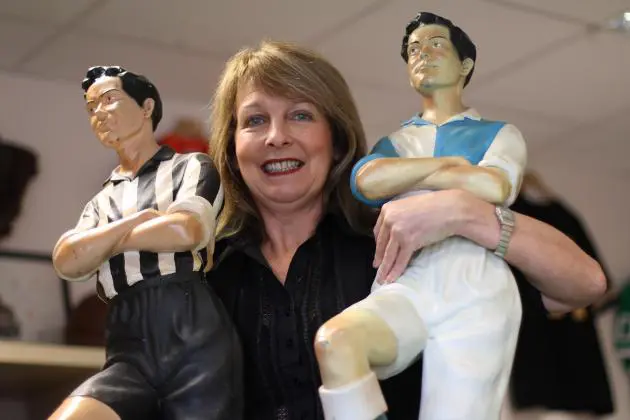
Michele Finch has seen grown men in tears over a remake of a football jumper their team wore in a season gone by.
“It evokes the memories,” says the founder of The Old-Fashioned Football Shirt company (TOFFS), a maker of replica football kit in England’s north-east that uses old patterns to turn out new jerseys.
“Once they feel it, you can see that they can’t wait to get it on – and you feel they don’t ever want to take it off.”
TOFFS, set up by Finch and her husband, has made and sold 150,000 shirts since the couple set up shop in Gateshead in 1990.
Nowadays, football strip is big business. Real Madrid shifted around 1.5 million jerseys last year, just ahead of Manchester United. Rounding out the top five were Barcelona, Bayern Munich and Chelsea. Germany’s is the top-selling national strip, followed by Brazil and Argentina.
Designs change at big clubs every year, both for the home and the away strip, and fans are usually keen to keep their team uniform current.
Retro team strip is a niche business, where production runs are small, costs are high and a new jersey in an old design can cost two, three, or four times what less-discerning fans would pay for the latest gear.
Gary Bierton is from Manchester-based Classic Football Shirts, one of the world’s top dealers in dated strip. He testifies to the passion that old shirts evoke.
“You’re reconnecting people with that great experience, that one game, than one season, where they’ve really been captivated by it,” he says.
Club strip was not made available to fans until the 1970s. For older supporters, there were no club shops and no jumpers to buy. Now, from monster clubs like Manchester United, you can buy your whole wardrobe and even furnish part of your house.
TOFFS has a collector in Scotland with 57 of its shirts. There are no names on the back, just the numbers denoting the position of the player. The fabric is specially made, the colours perfectly matched and the club emblems carefully embroidered.
“It’s a touchy-feely thing,” Finch says. “Our shirts are made here in the northeast by some of the same people who made the originals. I’d never want anyone to look at our shirts and say it looks like it’s been made en masse somewhere.”
In seasons when clubs languish in the league, replica shirts do well because fans want a reminder of when their team was on top.
Dave Shaw has been a Newcastle United fan all his life. A prized possession is an old jumper signed by all the team in the club’s classic black-and-white equidistant stripes.
“It’s a tribal thing,” Shaw says of his collection of the zebra-crossing strip from times past.
“Everyone in the tribe wears the same garment so you know who you are and you know who the enemy are,” he says. “When you put it on you feel like you’re part of something, part of something special.”
Bierton’s company does not make shirts but buys and sells outdated football strip. You can even buy garments worn by players. Its highest-ticket item so far is a West Bromwich Albion shirt from 1935 that went for 3,500 pounds (Bt181,000).
>>> “People want to wear a shirt like that because it symbolises an important era for the club,” he says “It’s an expression of support.”
Unfortunately for some fans, real shirts usually come in just the one size. There are no children’s sizes and they look like jerseys you can play in rather than go out in.
“Over the last 10 or 15 years shirts have become much more well-fitted,” Bierton says.
“Not just to wear at the game but for anything really. But shirts from the 80s and the 90s aren’t really like that. They’re big fitting. They’re not really what you’d want to be going to the pub in sometimes.”
Wearing something not so comfortable, a lot more expensive and a stand-out in the sea of modern shirts in the terraces takes some explaining.
Finch and Bierton are agreed that it is all about nostalgia, about preserving a club’s heritage, about lineage and remembrance.
“Clubs eventually come to realise that the heritage is the success of it, the fans at home, the local area,” Bierton says. “Any club that’s been at the top and slipped down a bit has realised that. Like Leeds United.
“They could’ve been a big corporate money machine like Manchester United but now they’re a more traditional football club. They’ve got back to basics. The fans like that. It’s what makes a club.”
