
Not a fraction more


Play
Scientists race to redefine the "unstable" kilogram
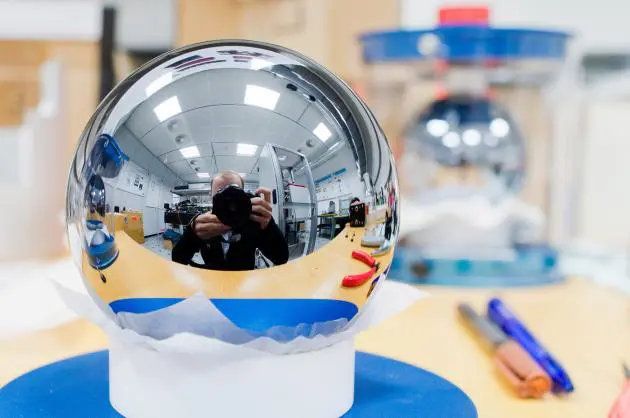
Two near-perfect 1-kilogram spheres, fashioned from 99.9957-per-cent pure silicon-28 and polished to a high lustre, are at the centre of a race among scientists to redefine the kilogram.
Valued at more than 2 million euros (Bt86 million), they are the pride of the Physikalisch-Technische Bundesanstalt (PTB) in Braunschweig, Germany’s national institute of weights and measures.
Since 1889 the kilogram has been defined as the mass of a platinum-iridium cylinder, known as the “international prototype of the kilogram”, stored in a vault at the International Bureau of Weights and Measures (BIPM) near Paris.
It is the sole standard for calibration of all the world’s scales.
As PTB physicist Arnold Nicolaus notes, the kilogram – the metric unit of mass – is the last of the seven international base units of metric measure still defined as a physical object rather than in terms of a naturally occurring constant.
The metre’s definition, for example, comes from the speed of light.
This causes problems. For reasons unclear, the difference in weight between the BIPM’s master kilogram and the more than 80 national kilogram prototypes around the world has grown to about 50 micrograms, or 50 millionths of a gram.
While the small discrepancy means nothing to most people, it is very irritating to metrologists and at odds with the accuracy requirements of modern science and industry. Metrology is the study of measures.
“Many physical equations and values depend on an exact definition of mass,” Nicolaus says.
What is more, the entire international system of weights could be thrown into disarray if the master kilogram were somehow damaged or lost. So for years a BIPM committee has been coordinating various experimental efforts to redefine the kilogram in terms of a fundamental constant.
One of the two main approaches is the so-called Avogadro project, headed by the PTB and including the BIPM along with metrological institutes from the United States, Britain, Italy, Belgium, Japan and Australia.
It aims to redefine the kilogram in terms of what is known as the Avogadro constant by counting the number of atoms in a single-crystal sphere of silicon, thus relating the kilogram to an atomic mass.
Exploiting the ordered arrangement of atoms in a single-crystal silicon sphere, scientists have now measured the Avogadro constant with a hitherto unattained accuracy of eight spaces after the decimal point.
Put another way, they have reduced the measurement uncertainty of the kilogram to 30 millionths of a gram, thereby meeting the BIPM’s most important requirement for a redefinition of the unit for mass.
The measurements involved methods including high-precision laser interferometry and X-ray diffraction to determine various parameters of the spheres.
“First we determine the diameter and volume of a sphere,” explains the PTB’s Horst Bettin, who heads the Avogadro constant working group. “Then we measure the spacing between the atoms, which are arranged in a lattice. From this we calculate the volume of an atom” –which allows the number of atoms to be calculated.
When the weight of an atom is known, the weight of the sphere can be precisely determined. A 1-kilogram silicon sphere contains about 21 septillion atoms. A septillion is a number with 24 zeros.
Bettin said he knew how to halve the Avogadro project’s measurement uncertainty. He blames it on the spheres’ very slight out-of-roundness and some fleeting surface contamination that occurred during the polishing process.
In reference to their smoothness, he remarks: “Put at Earth scale, it would be as if the highest mountain peak and deepest ocean trench were just nine metres apart.” Reduce that imperfection and the balls would be make even more accurate prototypes.
The other main approach to redefinition of the kilogram rests on what is called Planck’s constant and relates electrical power to mechanical power using a so-called watt balance. Tests have produced a measurement accuracy similar to that of the Avogadro project.
“It’s a race among scientists,” says Bettin, adding with a grin, We can do it better.”
The finish line will presumably come in 2018. That is when, Bettin said, the BIPM-led General Conference on Weights and Measures will decide on a new, stabler definition for the kilogram.
