
A hero remembered


Play
Thammasat University exhibition honours the life and fair-minded ideals of its much-loved rector Puey Ungphakorn
There are no signs declaring “freedom, equality and fraternity” at the new exhibition honouring the life and times of the late Thai technocrat Puey Ungphakorn currently on show at Thammasat University but the sentiments behind the notion can nonetheless be felt floating through the air.
Organised to mark the 99th anniversary of his birth, the exhibition opened last week with a symposium that underlined how much Thammasat University’s well-known rector is still missed.
Another former Thammasat rector Charnvit Kasetsiri, who served as vice-rector during Puey’s tenure, Thamrongsak Petchlertanan of the Foundation for the Promotion of Social Sciences and Humanities Textbook Projects, economist Pokpong Janwit and former Bank of Thailand governor Tharisa Wattanaket were profuse in their praise as they discussed topics ranging from Puey’s visions for the university, his contributions to rural development and his commitment to freedom of expression in the academic world.
“The best way to commemorate Puey’s contribution to Thai society is to study his academic legacy,” Pokpong opined.
Charnvit agreed, listing the facets that made up the man.
“Puey was a teacher, an economist, a war hero, a proponent of rural development, and most importantly, a humanitarian,” said Charnvit, stressing that Puey’s interests and works went far beyond the scope of economics.
Charnvit cited social sciences, humanities, science and technology as other areas touched by Puey. His ultimate goal, he added, was to realise the concept of Santi Pracha Dhamma, a society in which the rule of law prevailed and economic disparity was reduced.
“Puey’s idea was to empower academia through freedom of expression,” said Thamrongsak, adding that university should always serve as a forum for discussion of ideas.
Praising Puey for his ethics and courage to stand for what was right, Tharisa spoke of his major role in shaping Thailand’s economy and noted that he remained a legend at the Bank of Thailand. “In some respects, Puey’s devotion to his work has become the DNA of the bank,” she said.
The fourth child of an immigrant Chinese fishmonger, Puey enjoyed a modest childhood. One of the first group of students to attend the newly opened Thammasat University, he studied there from 1934 to 1937 before earning a government scholarship to further his education in economics at the London School of Economics in 1938. Following the outbreak of World War II, Puey joined the Free Thai Movement in the UK. He received military training from the British army and parachuted into northern Thailand in 1944. He was immediately captured and held as prisoner of war until Japan surrendered in 1945.
When the war ended, Puey returned to the UK to further his studies and earned a PhD in economics in 1949. He returned home after his graduation and went to work at the Bank of Thailand. He quickly rose through the ranks to become governor, a position he held for 12 years, during which he fought hard against political pressure from the-then premier Field Marshal Sarit Thanarat and his cronies who tried to influence the Bank of Thailand and the country’s monetary system. Puey’s efforts and contributions to development projects gained international attention when he was awarded the Magsaysay Award for his devotion to government service in 1964, the first Thai to receive the honour.
In 1966 Puey became the dean of the Faculty of Economics at his alma mater and initiated a long-term project that looked at raising the productivity and economic level of rural Thais.
Despite pressure to enter politics, Puey demurred and in 1973 assumed the position of rector of the university.
“He was appointed rector at a time of great political turmoil but did his utmost to protect freedom in the academic world,” Charnvit said, pointing to the parallels between the 1970s and today.
“Thammasat is once again in crisis due to the controversial relationship between some of its administrators and the current military regime.”
Puey’s defence of academia was not to last. Branded a communist by the political right despite speaking out about the student demonstrations of 1975 and ’76, he was forced to flee Thailand in 1976 for the UK, where he lived until his death in 1999.
Yet his commitment to freedom has lived on. The Foundation for the Promotion of Social Sciences and Humanities, which he founded in 1966, has recently launched an e-library that allows the public to easily access several Thai and translated texts free of charge.
Despite all his contributions to society, Puey remained humble and modest in his manner to the very end.
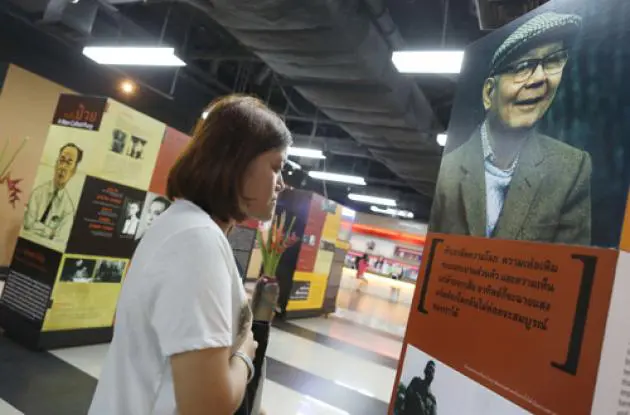
“A case in point was his failure to mention that he had been awarded the title of Member of the British Empire by His Majesty King George VI in 1946 for his participation in World War II,” says Chanisara Sokan, the organiser of the “A Man called Puey” exhibition, which covers aspects of his youth as well as his time as rector at Thammasat.
And even today, Puey’s vision and work are inspiring new generations of Thais.
“I was particularly drawn by his concept of Santi Pracha Dhamma,” says Chanisara. “I find the idea of rule of law prevailing and the concept of dharma being used as a basis for societal power particularly appealing.”
COURAGEOUS INTEGRITY
“A Man called Puey” continues through the end of the month in the foyer of the Pridi Banomyong Library at Thammasat University, Tha Pra Chan.
