
Towards an equal world


Play
UN gender equality campaign encourages Thai men to stand up for women's right
A SOLIDARITY MOVEMENT for gender equality that brings together one half of humanity in support of the other half, the HeForShe campaign has been taken up in several countries since its launch last September in New York, and now it has arrived in Thailand.
Actively promoted by actress Emma Watson in her capacity as UN Women Goodwill Ambassador, the aim is to engage men and boys around the world to join the gender equality movement.
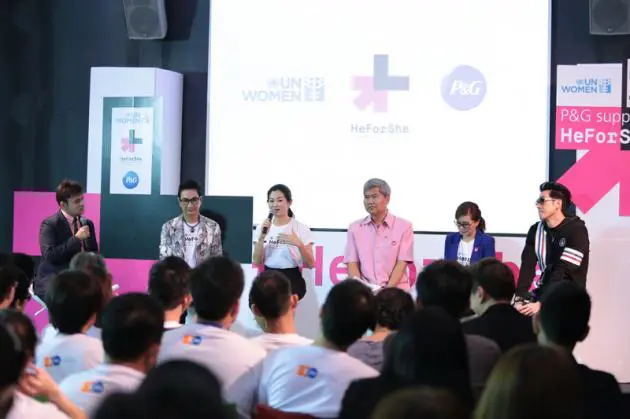
In Bangkok, Procter and Gamble Trading (P&G Thailand) has joined with UN Women Asia and the Pacific in declaring its commitment to foster gender equality within the company and its affiliates as well as to reach out to Thai males to support this global agenda.
As part of that commitment, P&G is supporting its female employees, offering them specialised training to further their careers as well as safety and health-related programmes and flexible working hours.
“None of us live the same lives as our parents or grandparents. We have moved far away from it. Gender equality is more advanced than in their day. We know that because more women are in the labour force and more women are involved in the decision making at all level of the societies. In many though not all countries, women and girls have the same access to education as men and boys. It is one area that has achieved success,” notes Roberta Clarke, regional director of UN Women Asia and the Pacific and the agency’s representative in Thailand.
“However, women are still facing problems. Maternal mortality is still quite high in some countries, particularly where women don’t have control over their sexual health. Sexual and domestic violence against women globally is a major problem. In times of conflict and disaster, violence against women also increases.”
Yet despite the successes, the average proportion of women in Parliament remains low: 22-per-cent globally and 18 per cent in the Asia Pacific region.
“We have a vision of 50-50 and we want to accelerate that commitment by eliminating discrimination globally by 2030,” Clarke continues.
“It may take a little while for culture transformation at the community level but it is certainly possible at the level of the state if everyone commits. We can end these gender inequalities in law and policy. That’s the point of the campaign. We will launch 50-50 everywhere, in the home, workplace, institutions, parliament, private sectors, that is the goal.”
HeForShe was created to inspire men and boys to become more engaged with gender equality issues.
“The movement was originally conceived as a struggle led only by women but in recent years men have begun to stand up in addressing equalities. It’s cultural norms that restricts and restrains women and men,” Clarke notes.
“Men and women live in the same culture, where we have stereotype of the genders and the roles they play. Oftentimes, men receive more privileges by virtue of their masculinity. But women are demanding gender equality. This is why HeForShe must transform cultural norms. We expect men and boys to accept their responsibility to end inequality. They have to change their hearts and their minds and they must act consistently.”
Somchai Charoenamnuaysuk, director general of the Department of Women’s Affairs and Family Development under the Thai Ministry of Social Development and Human Security, notes that the World Economic Forum in 2014 rated Thailand 61st out of 142 countries based on the number of gender equality markers, including economic factors. Education, he stresses, will play an important role in narrowing the country’s gender gap in Thailand.
“There’s an imbalance in our population with one million more women than men. The figures are 32.9 million females to 31.8 million male. As long as we believe that men are more important than women, gender equality is out of our reach. We need to teach children about equal rights from grade one of primary school. Only that way can attitudes be changed,” he says.
Violence against women and girls is also a big problem, in Thailand as in other parts of the world. “As long as men think they have power over women, they can easily hurt them. Drugs, alcohol and gambling makes the situation worse,” Somchai says.
Former TV news anchor Suquan Bulakool points out that gender inequality in Thailand is not as bad as in other countries. “Society does accept women’s capabilities but we definitely need more opportunity to show off those qualities.”
Singer Jetrin Wattanisin, who has three sons, adds that it is his responsibility to nurture his boys and ensure they become men of quality.
“I’ve always taught my sons to honour women and show them respect. I think my wife has been doing a great job in raising our kids. Both of us believe that the best way to learn is by example so we have always been good role models for the kids,” he says.
But producer Varayuth Milintachinda, whose television dramas are enthusiastically watched by women nationwide, cautions that true gender equality could be hard to develop in the context of Thai society.
“If we make a period drama, it is quite obvious that Thai traditions give more importance to men than women. However, in modern dramas at least, men are less violent. Instead, we see women being aggressive and fighting over a man. In the kissing or sex scenes, which are the climax of any drama with a happy ending, we see the happiness of both the leads.
Gender equality, he adds, is not portrayed in the novels on which many a drama is based, so it’s not really possible to bring it to the small screen.
“But in dramas we do see women with exacting careers and it is obvious that they are smart. They have freedom to think or act like men while the male character has to show his respect to women, whether it’s his mother, girlfriend or wife, because that’s the way female viewers like it. I believe gender equality will gradually develop in Thai society but it will take time,” he adds.
In the end, though, gender equality can only be achieved if men and boys also rally in collective support.
As Emma Watson says, “Fighting for women’s rights has too often become synonymous with man hating – this has to stop.”
On the Web:
www.HeForShe.org
AsiaPacific.UNWomen.org
