
Earth, air, fire and Kamol


Play
The four elements come together in national artist Kamol Tassananchalee's sculptures for the Venice Biennale
ONE OF THE world’s top art exhibitions, the Venice Biennale, returns next month, and the 56th edition will feature more than 136 artists from 53 countries, with 89 of the artists exhibiting for the first time.
Among them is National Artist Dr Kamol Tassananchalee, who will represent Thailand in its seventh participation at the Biennale.
The theme this year is “All the World’s Futures” and Kamol is confident that his conceptual series “Earth, Air, Fire and Water” meets the requirements of this project, which is devoted to a fresh appraisal of the relationship of art and artists to the current state of things.
Chai Nakhonchai, director-general of the Culture Ministry’s Office of Contemporary Art and Culture, which is responsible for the Thai Pavilion at the Biennale, agrees.
“We set up a committee to consider our choice of artist’s qualifications, namely the ability of his works to reach international platforms, and his readiness. Dr Kamol has all those virtues,” Chai says.
Kamol, 71, will bring 20 of his creations to the Thai Pavilion, which will be located at Paradiso Gallerie in the Giardini. His curator is Richard David Garst.
“It’s rather like the Olympic Games,” says Kamol, who was named a National Artist in 1997. “The Venice Biennale has been going on for 120 years with the participation of such big countries as America, Russia, Japan, South Korea and Canada, all of which now have permanent venues because they rent them year after year. In the future, I think Thailand should have a permanent venue too. That would surely be better than having to move venues all the time. It is a pity that we can’t do anything about the building. Because of this, we don’t have the freedom to produce our works of art as we would like to.
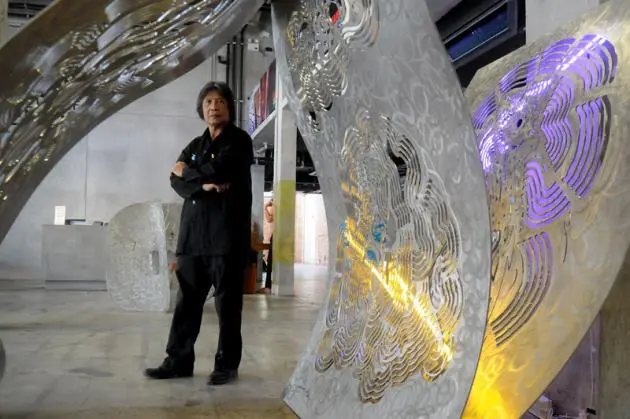
“Fortunately, my concept of ‘Earth, Air, Fire and Water’ fits well with the theme. These four elements have always been part of life and in my interpretation become Buddhist philosophy and internationalism. My series is composed of perforated and moveable stainless steel sheets that I have adjusted to fit the space we have been given. Because we do not have a permanent venue, I’ve had to carefully study the height and the width of the building.”
Kamol adds that his 8x5-metre sculpture will be installed at the exterior of the pavilion. Although it is intended to be laid on the ground, for the show it will be placed on a base. Inside the pavilion, visitors will see a perforated sculpture with neon lights shining through, symbolising wind, waves and fire.
“The ‘Thainess’ comes from its similarity to our nang yai [shadow play], in which light passes through the puppets and appears as a shadow on the ground. It demonstrates both Thainess and internationalism. My sculpture consists of a roller, which represents the rotation of the world. Four perforated pieces with a roller in each will lean against the wall of the first hall. A large movable sculpture, which can transform into several shapes and forms, will be at the centre of another hall and the mezzanine will see four connected pieces replacing two windows. I’ve designed four works of art in an overall size of 7x2 metres to be part of these two windows. I will also show two printing woodcuts on black and white paper in the video room,” he explains.
Kamol believes that his concept will reach out to foreign visitors.
“It is symbolic, not realistic, and it has to be sensed through our emotions. Light shines through the perforated symbols of wind, sea waves and fire in the stainless steel and that should make it understandable to all,” he says.
Kamol has spent more than Bt1 million to create the works of art as well as to print 7,000 catalogues and pamphlets, which will be handed out over the six months of the show.
Although Thailand has only participated in the Venice Biennale since 2003, its connection with Italian art and culture dates back to 1897, when King Chulalongkorn visited the second Biennale during a tour of Europe.
For Thailand’s first participation in 2003, the Culture Ministry selected seven artists: Kamol Phaosavasdi, Tawatchai Puntusawasdi, Michael Shaowanasai, Vasan Sitthiket, Manit Sriwanichpoom, Montri Toemsombat and Sakarin Krue-On. Their presentation was on a theme similar to this year’s – “Reverie and Phantasm in the Epoch of Global Trauma”.
Other artists who have taken part in the Biennale include Arin Rungjang and Wasinburee Supanichvoraparch, who represented Thailand in 2013, and Navin Rawanchaikul in 2011.
BANGKOK OF THE WEST
>>The 56th Venice Biennale runs from May 9 to November 22. For details, check www.LaBiennale.org.
