
Where have all the hornbills gone?
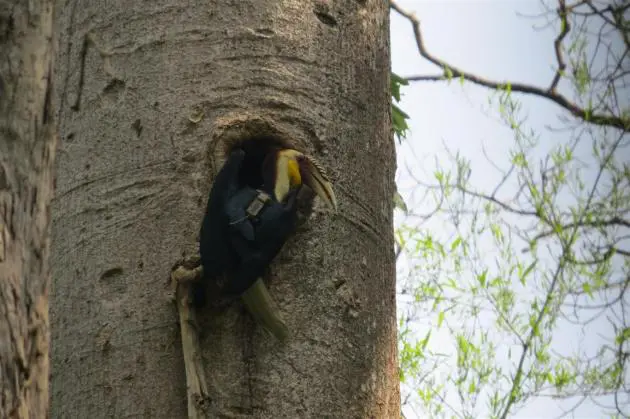


A new study looks at the bird's unique migration behaviour
OVER THE PAST 30 years, members of Mahidol University’s Hornbill Project research team have roamed the forests of Khao Yai National Park in Nakhon Ratchasima, Thungyai Naresuan Wildlife Sanctuary in Kanchanaburi and Huai Kha Khaeng Wildlife Sanctuary in Uthai Thani as part of their continuing research work on hornbills and arrived at the conclusion that all 13 hornbill species found in Thailand were sedentary, meaning that the largest birds in our forests did not venture out of their preferred environments.
But the team led by Professor Pilai Poonswad still could not explain the disappearance of the large plain pouched hornbills from their habitat in Huai Kha Khaeng at the end of each breeding season in May, nor indeed their sudden reappearance at the beginning of their breeding season the following January.
Puzzled by the unique behaviour of this particular hornbill species, they embarked on a project to get to the bottom of the enigma under the umbrella of a general multi-year research grant from PTT Exploration and Production for the preservation of hornbills.
From 2013, as part of a specific research project, tiny solar-powered transmitter devices were attached to the backs of plain pouched hornbills and the tracking carried out using a satellite-based GPS system. By tracking the birds it was discovered that after the breeding season this hornbill species would fly more than 1,000 kilometres south to the Belum Forest Reserve in Perak, Malaysia.
Along the way the tracked hornbills would stop in patches of forests in both Thailand and Myanmar such as Thungyai Naresuan, Khuean Srinagarindra National Park in Kanchanaburi, Kaeng Krung National Park in Surat Thani and other forests.
The research team made ground checks based on the exact GPS locations along the migration routes and sighted a large flock of the birds at Banglang National Park in Yala Province and even larger flocks at the Belum Forest Reserve in Perak.
The data obtained gave rise to speculation that sub-populations of plain pouched hornbills breed in a number of different forest locations but they then all migrate south using similar routes after the breeding season. This behaviour means the species is breeding from a larger gene pool and is thus healthier. The migratory behaviour of this species of hornbills is the first scientifically proven evidence of hornbill migration recorded anywhere in Asia and Africa where the large birds are found.
The discovery further reinforces the critical importance of natural forests along the hornbill migration routes and especially the connectivity of natural forests located in the west such as Huai Kha Khaeng and Thungyai Naresuan along the Tenasserim mountain range that also include forests such as Kaeng Krachan National Park in Phetchaburi and Kui Buri National Park in Prachuap Khiri Khan. Important natural forests along the migration routes also include adjacent forests in Myanmar and Chumphon Province further south, the forest complexes of Khlong Saeng Wildlife Sanctuary and Khao Sok National Park both in Surat Thani, the forests of the southernmost province of Narathiwat such as the HalaBala Wildlife sanctuary, which connects to the natural forests of Malaysia and leads into the Belum Temembor forest complex.
Additional programmes to be undertaken in the future to ensure the long-term survival of this migratory species of hornbills will require close cooperation between Myanmar, Malaysia and Thailand. Among the activities planned are training programmes to develop the capabilities of hornbill scientists in neighbouring countries to look after hornbill nest sites in natural forests, as well as to implement initiatives to prevent poaching of hornbill chicks.
It will be important to ensure the safety of the Plainpouched hornbills in the forests identified by the GPS tracking system along the migration routes such as the Packchan Nature Reserve in Myanmar located at the same latitude as the town of Chumphon in Thailand, the Tanintharyi National Park located across the border from Kaeng Krachan National Park in Phetchaburi and the Lenya National Park across the border from the town of Prachuap Khiri Khan.
Such a transnational conservation programme for the long-term preservation of the Plain pouched hornbill needs to include the preservation of natural forests along the migration routes in all the three countries involved to ensure continuity of forest areas at the frontiers between all three countries. The presence of hornbills in those forests along the migration routes plays a critically important role in planting trees in those forests as hornbills are efficient fruit seed disseminators.
Woraphat Arthayukti is chairman of the Hornbill Research Foundation.
Fleeing for food
PROFESSOR PILAI POONSWAD, leader of Mahidol University’s Hornbill Project, says the recent discovery that the birds are migrating will help determine the future of the endangered plain pouched hornbill, explaining that she remains convinced that the hornbill has never migrated before.
“My hypothesis is that food has become so much harder to find that the hornbills have decided to take the risk of their lives. We know from our research that the birds have to come back to their own nests as, unlike other birds, hornbills cannot build their own. They cannot make a hole in the tree so they need to find one and stick to it. That’s why we used to run a ‘home for hornbill’ project. The bird’s instinct will bring it back to nature where food is plentiful.
“Our study will help determine their survival as well as tell us whether there is sub-population of this type of hornbill and how many communities might exist.
“It is essential that this research continues but with costs now running into Bt3 million to Bt4 million a year and no funding sources currently available, we are running out of money. We are in the process of trying to make donations for hornbills tax-exempt.
“I believe it is our duty as Thais to preserve this endangered species as well as the forests that have always served as its home.”
KUPLUTHAI PUNGKANON, THE NATION
FLOCK TOGETHER
- Funding from PTT has ended, so the Hornbill Research Foundation is searching for new sponsors.
- Donations can be transferred to the Hornbill Research Foundation, account 026-2-75910-2, Siam Commercial Bank, Ramathibodi Branch.
- Cheques and postal orders are also accepted. Make them out to the Hornbill Research Foundation and sentd them to the Hornbill Research Foundation, c/o Department of Microbiology, Faculty of Science, Mahidol University, Rama VI Road, Bangkok 10400
- For details, call (02) 201 5532 or check www.sc.mahidol.ac.th/research/hornbill.htm.
