
Exploding canvases


Cai Guoqiang brings his gunpowder art to Yokohama
A NEW YORK-based Chinese artist returns to this part of the world with “Nighttime Sakura”, a gunpowder work that’s the largest of its kind to have been attempted by Cai Guoqiang to date.
The 58-year-old Chinese contemporary artist, who is based in New York, is presenting the 8x24 metre painting, as the centrepiece of his ongoing solo exhibition, “There and Back Again”, at Yokohama Museum of Art in Japan until October 18.
A native of Quanzhou in eastern China’s Fujian province, Cai started to experiment with gunpowder art while still in China but developed his own style during a nine-year stay in Japan.
“Many Japanese artists spent their lifetime in creating a perfect work of sakura[cherry blossom]. I also wanted to have a try but with the explosive power of gunpowder,” he says.
Cai adds that the flower looks fragile, but its beauty becomes even more precious owing to how short-lived it is.
“Is it possible to re-create the blossom by violently exploding something? And can the momentary explosion of the powder manifest into the enduring charm of sakura? I couldn’t help but wonder.”
The production process of the artwork turned out to be bumpy. The various types of Japanese gunpowder have little impurity and after being ignited, leave almost no explosive trail. The explosions didn’t extensively produce the effect of gradual smudging on traditional Japanese paper.
It dismayed Cai so much that he converted his struggles into an emotional series of gunpowder paintings titled “Seasons of Life” that’s also on display at the present exhibition.
The artist was inspired by shunga, the Japanese erotic art, to conduct a dialogue between vivid colours and desire in his works. He drew in the centre of each painting a nude couple, giving man and woman a neutral look. He tattooed on their bodies images of Japanese gambling tools then surrounded them with sketches of various animals and plants in the four seasons, implying the different stages in a relationship.
Cai was most excited by the final result of exploding coloured powders. The smoky scarlet brings to mind a “sense of being insane and abused” that can be found in paintings by Francis Bacon (1909-92). A large area of dusty grey delivers coolness and stability, and the comfort of “releasing the other ego of me”, he says.
“The primitive energies of black and colourful gunpowder interweave to transmit the loss and lust of a journey of life.”
He says he deliberated on the subject of lust for a long time before he finally realised it in “Seasons of Life”. He draws upon the Asian philosophy that time and space are integrated. And he is relieved to find that the dynamics of “Seasons of Life” compensate for the plainness of “Nighttime Sakura”.
“There and Back Again” seeks to review his state of mind during his years of struggle as a young Chinese artist in Japan, to where he moved in 1986. He also shows an installation work “Morning Glory” and gunpowder drawings on porcelain – “Spring”, “Summer”, “Fall” and “Winter” – at the same show. They were produced last year.
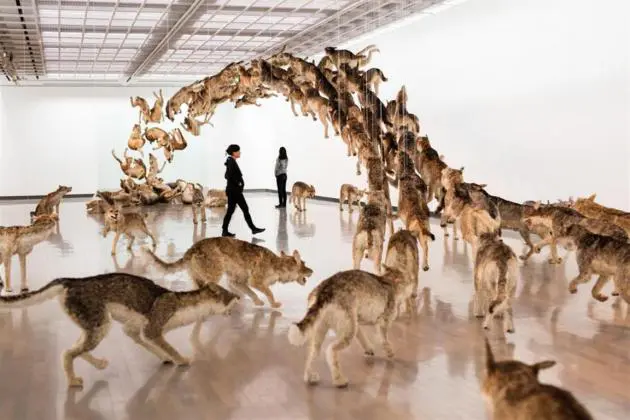
Cai also displays the impressive “Head On”, which includes 99 wolf replicas rushing in a line toward a glass wall. The works complete a chain of clues to the development of his art and life over two decades.
Cai conversed with the public through his massive, explosive art style during his time in the neighbouring country.
“Life was hard, ... I worked on a limited budget. But it didn’t stop me from being active, innovative and bold,” he says.
Cai left for New York City in 1995, with a grant from the Asian Cultural Council. For the last 20 years he has toured the world with his artworks, and recently felt the need to re-visit the places where it all began for him.
The exhibition at Yokohama Museum of Art follows the completion of “Sky Ladder”, a 2.5-minute firework performance staged in mid-June for Cai’s family in his hometown.
A 500-metre-long ladder, strapped with bags of gunpowder, was pulled up in the air by a gigantic white balloon and then the ladder was set aflame. As it burned from the end, the ladder burst into a dragon of golden flames into the dark sky.
Cai says the project realised his childhood dream of “talking to the universe”, and fulfilled his feelings of gratitude for those that supported him back home.
While “There and Back Again” serves as an academic retrospective of the methodology of a young, fearless Cai, he also hopes it will inspire future creations.
